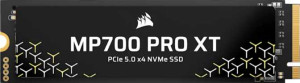
Corsair MP700 Pro XT 2TB
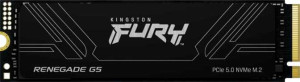
Kingston Fury Renegade G5 4TB

Corsair MP700 Pro XT 2TB Kingston Fury Renegade G5 4TB

Overview

Welcome to our in-depth comparison of the Corsair MP700 Pro XT 2TB and the Kingston Fury Renegade G5 4TB, two of the most formidable PCIe 5.0 NVMe SSDs on the market. Both drives share a strong foundation — M.2 form factor, DRAM cache, TLC NAND, and a 5-year warranty — yet they diverge in key areas such as random I/O performance, storage capacity, endurance ratings, and controller choice. Read on to see how these flagship drives stack up across every critical specification.

Common Features

  • Both drives use the M.2 form factor.
  • Both drives feature a DRAM cache.
  • Both drives are NVMe SSDs.
  • Both drives use NVMe version 2.
  • Both drives use TLC NAND flash storage.
  • Both drives use PCIe version 5.
  • Both drives have 8 controller channels.
  • Both drives come with a 5-year warranty.

Main Differences

  • Sequential read speed is 14900 MB/s on Corsair MP700 Pro XT 2TB and 14800 MB/s on Kingston Fury Renegade G5 4TB.
  • Random read speed is 2700000 IOPS on Corsair MP700 Pro XT 2TB and 2200000 IOPS on Kingston Fury Renegade G5 4TB.
  • Sequential write speed is 14500 MB/s on Corsair MP700 Pro XT 2TB and 14000 MB/s on Kingston Fury Renegade G5 4TB.
  • Random write speed is 3300000 IOPS on Corsair MP700 Pro XT 2TB and 2200000 IOPS on Kingston Fury Renegade G5 4TB.
  • Internal storage capacity is 2000GB on Corsair MP700 Pro XT 2TB and 4000GB on Kingston Fury Renegade G5 4TB.
  • The controller is Phison PS5028-E28-86 on Corsair MP700 Pro XT 2TB and Silicon Motion SM2508 on Kingston Fury Renegade G5 4TB.
  • Terabytes Written (TBW) endurance rating is 1400 TB on Corsair MP700 Pro XT 2TB and 4000 TB on Kingston Fury Renegade G5 4TB.
  • MTBF is 1.5 million hours on Corsair MP700 Pro XT 2TB and 2 million hours on Kingston Fury Renegade G5 4TB.
Specs Comparison
Corsair MP700 Pro XT 2TB

Corsair MP700 Pro XT 2TB

Kingston Fury Renegade G5 4TB

Kingston Fury Renegade G5 4TB

Read speed:
sequential read speed 14900 MB/s 14800 MB/s
random read speed 2700000 IOPS 2200000 IOPS

Both drives compete at the very top of consumer NVMe performance, with sequential read speeds that are nearly identical — 14900 MB/s for the Corsair MP700 Pro XT versus 14800 MB/s for the Kingston Fury Renegade G5. That 100 MB/s gap is statistically negligible in practice; no real-world workload will expose a perceptible difference in large sequential transfers such as moving video files or loading game assets.

The more meaningful differentiator is random read performance. The MP700 Pro XT reaches 2,700,000 IOPS compared to the Renegade G5's 2,200,000 IOPS — a roughly 23% advantage. Random IOPS governs how quickly a drive handles the thousands of small, scattered read requests typical of OS boot, application launches, and database queries. A higher figure here translates to snappier day-to-day responsiveness, particularly under multitasking or in workloads that stress the storage queue with many concurrent operations.

Overall, the Corsair MP700 Pro XT holds a clear edge in this group. While sequential reads are essentially tied, its substantially higher random read throughput gives it a practical advantage in the workloads most users actually feel — making it the stronger pick for latency-sensitive use cases.

Write speed:
sequential write speed 14500 MB/s 14000 MB/s
random write speed 3300000 IOPS 2200000 IOPS

Write performance tells a more decisive story than read speeds did. The Corsair MP700 Pro XT posts 14500 MB/s sequential write against the Kingston Fury Renegade G5's 14000 MB/s — a modest but real 3.5% lead that can matter during sustained large-file writes like encoding output, disk imaging, or transferring large media archives.

The gap widens considerably on random writes: the MP700 Pro XT delivers 3,300,000 IOPS versus the Renegade G5's 2,200,000 IOPS — a 50% advantage. Random write IOPS is arguably the most demanding metric for storage in professional workflows, directly affecting how quickly a drive commits small, unpredictable writes such as those generated by virtual machines, compilers, or heavy swap usage. A 50% lead here is not a paper spec; it represents a fundamentally faster response under the kind of write pressure that exposes storage bottlenecks.

The Corsair MP700 Pro XT wins this group on both fronts. While sequential write speeds are reasonably close, the commanding random write advantage makes it the stronger choice for write-intensive workloads — and reinforces a consistent performance lead over the Fury Renegade G5 across the board.

General info:
type M2 M2
SSD cache DRAM cache DRAM cache
Is an NVMe SSD
NVMe version 2 2
internal storage 2000GB 4000GB
release date October 2025 April 2025
controller Phison PS5028-E28-86 Silicon Motion SM2508
SSD storage type TLC TLC
PCI Express (PCIe) version 5 5
Controller channels 8 8
Terabytes Written (TBW) 1400 4000
MTBF 1.5million hours 2million hours
warranty period 5 years 5 years
Has an integrated heatsink
has RGB lighting

At the architectural level, these two drives share a remarkably similar foundation — both are M.2 PCIe 5.0 NVMe 2.0 SSDs with DRAM cache, TLC NAND, and an 8-channel controller. That common platform explains their closely matched raw speeds, but the differences beneath the surface matter for long-term ownership decisions. The Corsair MP700 Pro XT ships with a Phison PS5028-E28-86 controller, while the Kingston Fury Renegade G5 uses Silicon Motion's SM2508 — two of the leading PCIe 5.0 controllers, each with its own firmware tuning philosophy, though neither has a universal edge on the other based on specs alone.

Where the Kingston pulls decisively ahead is endurance. Its 4000 TBW rating dwarfs the Corsair's 1400 TBW — and even when normalized for capacity, the Renegade G5 sustains roughly 1000 TBW per terabyte versus the MP700 Pro XT's 700 TBW per terabyte. Paired with a higher MTBF of 2 million hours (versus 1.5 million), the Kingston is rated to withstand significantly more punishment over its lifetime. For NAS use, content creation with heavy write cycles, or any environment where data is constantly churned, this gap is consequential.

For buyers weighing longevity and raw capacity, the Kingston Fury Renegade G5 holds a clear advantage in this group — doubling the storage, outpacing endurance ratings per TB, and projecting greater long-term reliability. The Corsair remains competitive on fundamentals, but loses ground here on the specs that matter most for sustained, demanding use.
Comparison Summary & Verdict

Both the Corsair MP700 Pro XT 2TB and the Kingston Fury Renegade G5 4TB are elite PCIe 5.0 SSDs that share the same core architecture, but their differences reveal distinct strengths. The Corsair MP700 Pro XT 2TB holds a notable edge in random read and write IOPS, making it the sharper tool for workloads demanding intense small-file throughput. The Kingston Fury Renegade G5 4TB, on the other hand, counters with double the storage capacity, a significantly higher TBW endurance rating of 4000 TB, and a superior MTBF of 2 million hours, pointing to greater long-term reliability and value for high-volume users. Sequential speeds are competitive on both sides, keeping raw transfer performance close. Your choice ultimately comes down to priorities: peak random performance or generous capacity with stronger endurance.

Corsair MP700 Pro XT 2TB
Buy Corsair MP700 Pro XT 2TB if...

Buy the Corsair MP700 Pro XT 2TB if you prioritize the highest possible random read and write IOPS for demanding workloads and intensive small-file operations.

Kingston Fury Renegade G5 4TB
Buy Kingston Fury Renegade G5 4TB if...

Buy the Kingston Fury Renegade G5 4TB if you need larger storage capacity along with superior long-term endurance, backed by a higher TBW rating and a longer MTBF.