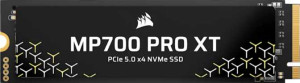
Corsair MP700 Pro XT 2TB
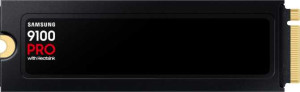
Samsung 9100 Pro 2TB

Corsair MP700 Pro XT 2TB Samsung 9100 Pro 2TB

Overview

Welcome to our in-depth spec comparison between the Corsair MP700 Pro XT 2TB and the Samsung 9100 Pro 2TB, two of the most powerful PCIe 5.0 NVMe drives on the market. Both share a strong common foundation, yet they diverge in meaningful ways across sequential and random performance, controller architecture, and endurance ratings. Read on to see how these flagship SSDs stack up against each other.

Common Features

  • Both drives use the M.2 form factor.
  • Both drives feature a DRAM cache.
  • Both drives are NVMe SSDs.
  • Both drives use NVMe version 2.
  • Both drives offer 2000GB of internal storage.
  • Both drives use TLC NAND flash storage.
  • Both drives connect via PCIe version 5.
  • Both drives use an 8-channel controller.

Main Differences

  • Sequential read speed is 14900 MB/s on Corsair MP700 Pro XT 2TB and 14700 MB/s on Samsung 9100 Pro 2TB.
  • Random read speed is 2700000 IOPS on Corsair MP700 Pro XT 2TB and 1850000 IOPS on Samsung 9100 Pro 2TB.
  • Sequential write speed is 14500 MB/s on Corsair MP700 Pro XT 2TB and 13400 MB/s on Samsung 9100 Pro 2TB.
  • Random write speed is 3300000 IOPS on Corsair MP700 Pro XT 2TB and 2600000 IOPS on Samsung 9100 Pro 2TB.
  • The controller is the Phison PS5028-E28-86 on Corsair MP700 Pro XT 2TB and the Samsung Presto (S4LY027) on Samsung 9100 Pro 2TB.
  • Terabytes Written (TBW) endurance rating is 1400 TB on Corsair MP700 Pro XT 2TB and 1200 TB on Samsung 9100 Pro 2TB.
Specs Comparison
Corsair MP700 Pro XT 2TB

Corsair MP700 Pro XT 2TB

Samsung 9100 Pro 2TB

Samsung 9100 Pro 2TB

Read speed:
sequential read speed 14900 MB/s 14700 MB/s
random read speed 2700000 IOPS 1850000 IOPS

In sequential read performance, the two drives are virtually indistinguishable: the Corsair MP700 Pro XT reaches 14,900 MB/s against the Samsung 9100 Pro's 14,700 MB/s. That 200 MB/s gap is less than 1.4% and will never surface in any real-world workload, whether you are transferring large video files, loading game assets, or booting an OS.

The meaningful split comes in random read performance, where the MP700 Pro XT's 2,700,000 IOPS outpaces the 9100 Pro's 1,850,000 IOPS by roughly 46%. Random IOPS governs how quickly a drive can juggle masses of small, scattered read requests — the exact pattern that dominates database queries, virtual machine disk I/O, heavy multitasking, and application launches. The higher this number, the snappier a system feels under pressure rather than under a single large file transfer.

For sequential workloads the two drives are a practical tie, but the Corsair MP700 Pro XT holds a clear edge in random reads. Users who push sustained mixed workloads — developers, content creators with large asset libraries, or anyone running VMs — will notice the difference. For everyday consumer use where sequential speed is the main bottleneck, the advantage largely evaporates.

Write speed:
sequential write speed 14500 MB/s 13400 MB/s
random write speed 3300000 IOPS 2600000 IOPS

Write performance tells a more decisive story than read performance did. The Corsair MP700 Pro XT posts a sequential write speed of 14,500 MB/s compared to the Samsung 9100 Pro's 13,400 MB/s — a gap of about 8%. That margin is still modest for single-stream transfers, but it becomes tangible when ingesting multi-gigabyte raw video files or writing large disk images where sustained throughput is everything.

The random write gap is where the MP700 Pro XT makes its strongest case: 3,300,000 IOPS versus 2,600,000 IOPS, a difference of roughly 27%. Random write IOPS directly affects how a drive handles the constant flood of small, unpredictable writes generated by operating systems, compilers building large codebases, and transactional storage workloads. A higher figure here translates to less queuing, lower latency under load, and a system that stays responsive even when the drive is being hammered from multiple directions simultaneously.

Across both write metrics, the MP700 Pro XT holds a consistent and meaningful advantage. Unlike the near-tie seen in sequential reads, the write side shows a real separation — particularly in random write IOPS where workload complexity amplifies the gap. Power users dealing with write-intensive tasks will find the Corsair the stronger performer in this group.

General info:
type M2 M2
SSD cache DRAM cache DRAM cache
Is an NVMe SSD
NVMe version 2 2
internal storage 2000GB 2000GB
release date October 2025 February 2025
controller Phison PS5028-E28-86 Samsung Presto (S4LY027)
SSD storage type TLC TLC
PCI Express (PCIe) version 5 5
Controller channels 8 8
Terabytes Written (TBW) 1400 1200
MTBF 1.5million hours 1.5million hours
warranty period 5 years 5 years
Has an integrated heatsink
bits of encryption supported 256 256
has RGB lighting

At the platform level, these two drives are built on the same foundation: both are M.2, PCIe 5.0, NVMe 2.0 SSDs using TLC NAND with a DRAM cache, 8 controller channels, and identical 2TB capacities. That shared architecture is why their performance numbers sit so close to each other — the underlying pipeline feeding data to and from the NAND is structurally equivalent.

The controller is the one meaningful architectural differentiator. The MP700 Pro XT uses a Phison PS5028-E28-86, a well-established third-party silicon widely adopted across the high-end PCIe 5.0 market. The Samsung 9100 Pro runs Samsung's proprietary Presto (S4LY027) controller, designed in-house alongside Samsung's own NAND. Vertical integration can offer tuning advantages, but in this comparison the real-world performance data speaks louder than controller origin — and the Phison-based Corsair actually leads across both read and write workloads.

On endurance, the MP700 Pro XT edges ahead with a TBW rating of 1,400 versus the 9100 Pro's 1,200 TBW — a roughly 17% advantage. Both carry a 5-year warranty and identical MTBF figures, but for write-heavy professional environments where drives accumulate wear quickly, the higher TBW ceiling provides a longer usable lifespan guarantee. Overall, this group is largely a tie on platform fundamentals, with the Corsair holding a modest but tangible endurance edge.

Comparison Summary & Verdict

Both the Corsair MP700 Pro XT 2TB and the Samsung 9100 Pro 2TB are exceptional PCIe 5.0 NVMe SSDs that share the same capacity, TLC NAND, DRAM cache, and 8-channel design. However, the differences are clear when it comes to raw performance. The Corsair MP700 Pro XT 2TB holds the edge with higher sequential read and write speeds, significantly greater random IOPS in both read and write, and a stronger TBW endurance rating of 1400 TB versus 1200 TB. The Samsung 9100 Pro 2TB counters with its in-house Samsung Presto controller, which may appeal to those who value vertical integration and ecosystem trust. Choose the Corsair if you want the highest measurable throughput; choose the Samsung if you prefer a tightly integrated, brand-consistent storage solution.

Corsair MP700 Pro XT 2TB
Buy Corsair MP700 Pro XT 2TB if...

Buy the Corsair MP700 Pro XT 2TB if you want the highest sequential and random read/write speeds available, along with a superior endurance rating for demanding workloads.

Samsung 9100 Pro 2TB
Buy Samsung 9100 Pro 2TB if...

Buy the Samsung 9100 Pro 2TB if you prefer a tightly integrated solution built around Samsung's own Presto controller and are comfortable trading a small performance margin for brand ecosystem consistency.