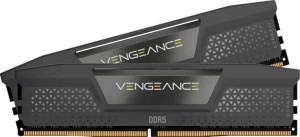
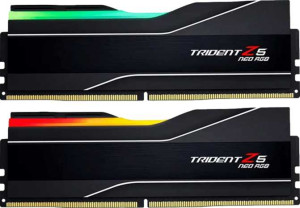
Both kits run at the same DDR5-6000 MHz tested speed with an identical SPD of 4800 MHz, so raw clock frequency is a non-factor here. The real story lies in the timings. The G.Skill Trident Z5 Neo RGB operates at CL28-36-36-96, while the Corsair Vengeance DDR5-6000 runs a much looser CL36-44-44-96. Lower CAS latency and tRCD/tRP timings mean the memory controller has to wait fewer cycles before data is accessible, which directly translates to faster response in latency-sensitive workloads like gaming frame pacing, real-time audio, and rapid memory-access tasks.
The most telling metric is true latency — a calculated figure that normalizes timings against clock speed to express actual delay in nanoseconds. The G.Skill kit posts 9.33 ns versus the Corsair's 12 ns, a gap of roughly 22%. That is not a marginal difference: it means for every memory access cycle, the G.Skill kit resolves data nearly three nanoseconds faster. At the scale of thousands of memory operations per second, this compounds into measurably lower system latency, particularly on AMD Ryzen platforms where the memory subsystem is tightly coupled to the Infinity Fabric.
On performance alone, the G.Skill Trident Z5 Neo RGB holds a clear and significant advantage. It delivers the same bandwidth as the Corsair kit — identical clock speed — but with substantially tighter timings and a meaningfully lower true latency. For users prioritizing memory responsiveness, the G.Skill kit is the stronger performer in this group by a comfortable margin.