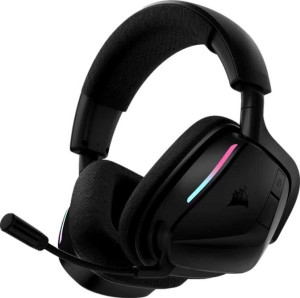
Corsair Void V2
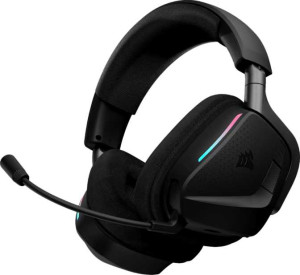
Corsair Void v2 MAX

Corsair Void V2 Corsair Void v2 MAX

Overview

Welcome to our in-depth specification comparison between the Corsair Void V2 and the Corsair Void v2 MAX. Both headsets share the same wireless gaming DNA, packing identical audio hardware and microphone specs under the hood — but a closer look reveals some meaningful distinctions. From battery endurance to platform compatibility and portability, this comparison breaks down exactly where the two models diverge to help you make the best buying decision.

Common Features

  • Both headsets have an over-ear fit.
  • Both headsets weigh 303 g.
  • RGB lighting is present on both headsets.
  • Neither headset has an open-back design.
  • Both headsets have stereo speakers.
  • The lowest frequency on both headsets is 20 Hz.
  • The highest frequency on both headsets is 20000 Hz.
  • Active noise cancellation is not available on either headset.
  • Both headsets offer virtual surround sound.
  • Spatial audio is supported on both headsets.
  • Both headsets have a 50 mm driver unit size.
  • The sound pressure level is 116 dB/mW on both headsets.
  • Both headsets have an impedance of 32 Ohms.
  • A noise-canceling microphone is present on both headsets.
  • The lowest microphone frequency is 100 Hz on both headsets.
  • The highest microphone frequency is 8000 Hz on both headsets.
  • The microphone is not removable on either headset.
  • A mute function is available on both headsets.
  • Microphone sensitivity is -40dBV/Pa on both headsets.
  • Both headsets have a single microphone.
  • Both headsets take 1.5 hours to fully charge.
  • A rechargeable battery is included on both headsets.
  • A battery level indicator is present on both headsets.
  • The battery is not removable on either headset.
  • Both headsets can be used wirelessly.
  • Both headsets have a USB Type-C connector.
  • Fast pairing is not available on either headset.
  • A control panel placed on the device is present on both headsets.
  • Both headsets can be used as a headset.
  • Neither headset has a vibration function.
  • A travel bag is not included with either headset.

Main Differences

  • The Corsair Void v2 MAX can be folded, while the Corsair Void V2 cannot be folded.
  • Battery life is 130 hours on the Corsair Void V2 and 70 hours on the Corsair Void v2 MAX.
  • The Corsair Void V2 is compatible with PlayStation, PC, and Nintendo Switch, while the Corsair Void v2 MAX is also compatible with Xbox in addition to those platforms.
Specs Comparison
Corsair Void V2

Corsair Void V2

Corsair Void v2 MAX

Corsair Void v2 MAX

Design:
Fit Over-ear Over-ear
weight 303 g 303 g
has RGB lighting
can be folded
has an open-back design
has stereo speakers

In terms of design fundamentals, the Corsair Void V2 and the Corsair Void v2 MAX are virtually identical: both are over-ear, closed-back headsets with stereo speakers, RGB lighting, and an identical weight of 303 g. At that mass, neither is a featherweight, but it is a typical and generally acceptable figure for a full-featured gaming headset in this category.

The sole design differentiator is foldability: the Void v2 MAX supports folding, while the standard Void V2 does not. This is a meaningful practical advantage for users who travel, commute, or simply need compact storage. A foldable form factor reduces the footprint significantly when the headset is not in use and lowers the risk of damage to the earcups or headband during transport.

For home-only desktop use, this distinction is largely irrelevant and the two headsets are effectively tied on design. However, for anyone who needs portability, the Void v2 MAX holds a clear edge purely by virtue of its folding capability — a feature the standard Void V2 simply does not offer.

Sound quality:
lowest frequency 20 Hz 20 Hz
highest frequency 20000 Hz 20000 Hz
has active noise cancellation (ANC)
Surround sound Virtual Virtual
supports spatial audio
driver unit size 50 mm 50 mm
sound pressure level 116 dB/mW 116 dB/mW
impedance 32 Ohms 32 Ohms
has a neodymium magnet
has passive noise reduction
drivers count 2 2

Across every measurable sound quality specification, the Corsair Void V2 and Corsair Void v2 MAX are a perfect match. Both headsets use 50 mm neodymium drivers — a size that generally delivers strong bass presence and good overall volume throw — and share an identical frequency response of 20 Hz to 20,000 Hz, covering the full range of human hearing. With a sensitivity of 116 dB/mW and an impedance of 32 Ohms, both are easy to drive from standard PC, console, or USB audio sources without requiring a dedicated amplifier.

Neither headset offers active noise cancellation, but both provide passive noise reduction through their closed-back, over-ear construction — sufficient for dampening moderate ambient sound in a home or office environment. On the surround side, both support virtual surround sound and spatial audio, which is standard for gaming headsets in this tier and useful for directional awareness in competitive or immersive titles.

With no differentiating data points across any specification in this group, the two headsets are a complete tie on sound quality. A buyer choosing between them can expect an identical listening experience, and should look to other spec groups — such as connectivity or microphone performance — to inform their decision.

Microphone:
has a noise-canceling microphone
lowest mic frequency 100 Hz 100 Hz
highest mic frequency 8000 Hz 8000 Hz
has a removable microphone
has a mute function
mic sensitivity -40dBV/Pa -40dBV/Pa
number of microphones 1 1

The microphone specifications for the Corsair Void V2 and Corsair Void v2 MAX are identical across every data point. Both feature a single, non-removable noise-canceling microphone with a frequency range of 100 Hz to 8,000 Hz and a sensitivity of -40 dBV/Pa. That frequency ceiling is fairly typical for gaming headset microphones — it captures the core range of the human voice clearly while cutting out higher-frequency noise, which is generally sufficient for in-game chat and casual voice calls.

The -40 dBV/Pa sensitivity sits in a standard range for close-proximity boom microphones: sensitive enough to pick up speech at normal speaking volume without requiring the user to lean in, but not so sensitive that it captures excessive background noise. Combined with the noise-canceling feature, both headsets are reasonably well-equipped for clear voice communication in typical gaming environments. The built-in mute function on both is a practical convenience, though unremarkable at this product tier.

Since no specification differs between the two, this category is a complete tie. Neither headset holds any microphone advantage over the other, and users can expect equivalent voice pickup performance from both.

Power:
Battery life 130 hours 70 hours
charge time 1.5 hours 1.5 hours
has a rechargeable battery
has a battery level indicator
has a removable battery

Power is where these two headsets part ways most noticeably. The Corsair Void V2 offers a rated battery life of 130 hours, nearly double the 70 hours provided by the Corsair Void v2 MAX. Both figures are well beyond what most users would need between charges — even heavy daily users would go weeks without plugging in — but the gap is substantial enough to be meaningful for anyone who frequently forgets to charge or uses the headset in environments where charging is inconvenient.

Where the two are evenly matched is on charge time: both replenish fully in 1.5 hours, which is a reasonable turnaround for headsets in this category. Both also include a battery level indicator, giving users advance warning before a charge becomes urgent — a small but welcome quality-of-life feature. Neither has a removable battery, which is standard at this tier.

The Void V2 holds a clear advantage in this category, delivering significantly more runtime per charge with no penalty in charge time. For users who prioritize low-maintenance, infrequent charging, the standard Void V2 is the stronger choice here. The Void v2 MAX's 70-hour life is still very generous in absolute terms, but it cannot match the endurance of its counterpart on paper.

Connectivity:
connectivity 2.4GHz wireless, Bluetooth Bluetooth, 2.4GHz wireless
compatibility PlayStation, PC, Nintendo Switch PlayStation, PC, Xbox, Nintendo Switch
Can be used wirelessly
Has USB Type-C
has fast pairing

Both headsets share the same wireless foundation: 2.4 GHz wireless and Bluetooth dual connectivity, USB Type-C charging, and no fast pairing support. The 2.4 GHz connection is the preferred mode for gaming given its lower latency and more stable signal compared to Bluetooth, while Bluetooth adds flexibility for pairing with phones or other secondary devices. This dual-mode setup is a genuine strength shared by both headsets.

The only differentiator in this group is platform compatibility. The Corsair Void V2 supports PlayStation, PC, and Nintendo Switch, while the Corsair Void v2 MAX adds Xbox to that list. For the majority of users on PlayStation or PC, this distinction is irrelevant. However, for Xbox owners — or households with multiple consoles across ecosystems — the Void v2 MAX's broader compatibility is a meaningful practical advantage.

On connectivity, the Void v2 MAX holds a narrow but clear edge solely due to its Xbox compatibility. Users who do not own an Xbox, or who game exclusively on PC and PlayStation, will find the two headsets functionally identical in this category and should weigh other factors in their decision.

Features:
release date April 2025 September 2025
control panel placed on a device
can be used as a headset
has a vibration function
travel bag is included

The features specification group offers no grounds for differentiation between the Corsair Void V2 and the Corsair Void v2 MAX. Both include an on-device control panel, which is a practical convenience for adjusting volume or muting without reaching for a keyboard or software — a small but appreciated feature during active gaming sessions. Both also function as full headsets, combining audio output with microphone input.

Neither headset includes a vibration function or a travel bag. The absence of haptic feedback is common at this tier and unlikely to factor into most purchasing decisions. The lack of a bundled travel bag is worth noting only for users who intend to carry the headset regularly, though the Void v2 MAX's foldable design — noted in the Design category — partially compensates for this omission in portability contexts.

Based strictly on the data in this group, the two headsets are a complete tie. No feature present here distinguishes one from the other, and buyers should continue to rely on other specification groups to inform their final choice.

Comparison Summary & Verdict

After examining the full specification set, it is clear that the Corsair Void V2 and Corsair Void v2 MAX are closely matched in audio performance, microphone quality, and core connectivity. The key differentiators come down to three areas: the Void V2 offers a remarkable 130-hour battery life, nearly double the 70 hours of the MAX, making it the stronger pick for users who rarely want to charge. The Void v2 MAX, on the other hand, gains an edge with its foldable design for easier portability and broader platform compatibility that extends to Xbox alongside PlayStation, PC, and Nintendo Switch. Choose the Void V2 if long-term battery endurance is your top priority; opt for the Void v2 MAX if you value flexibility across multiple gaming platforms and a more travel-friendly form factor.

Corsair Void V2
Buy Corsair Void V2 if...

Buy the Corsair Void V2 if exceptional battery life is your top priority — its 130-hour runtime nearly doubles that of the MAX, meaning far fewer charging sessions during extended gaming sessions.

Corsair Void v2 MAX
Buy Corsair Void v2 MAX if...

Buy the Corsair Void v2 MAX if you need broader platform support including Xbox, or want a foldable design that makes the headset easier to store and carry on the go.