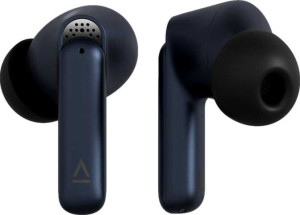
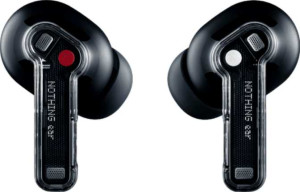
At the foundation, both earbuds are well-equipped for noise isolation, combining active noise cancellation with passive noise reduction. The frequency ceiling is identical at 40,000 Hz on both, reaching well into the ultrasonic range — a spec that matters more on paper than in practice for most listeners. Where things diverge is at the low end: the Aurvana Ace Mimi reaches down to a remarkable 5 Hz, versus the Nothing Ear 3's more standard 20 Hz floor. That sub-bass extension is theoretically impressive, though human hearing typically bottoms out around 20 Hz, meaning real-world audible impact of this difference is minimal.
The driver size gap is more consequential. The Nothing Ear 3 uses a 12 mm driver compared to the Aurvana Ace Mimi's 10 mm unit. Larger drivers generally move more air, which can translate to fuller low-frequency response and greater overall dynamic range — though driver tuning ultimately determines the listening experience more than size alone.
The decisive differentiator here is spatial audio support: the Nothing Ear 3 has it, the Aurvana Ace Mimi does not. For users who consume immersive content — gaming, films, or spatially mixed music — this is a meaningful capability gap. Factoring in the larger driver and spatial audio support, the Nothing Ear 3 holds a clear edge in this category on paper, making it the stronger choice for users who prioritize a feature-rich, immersive sound profile.