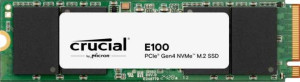
Crucial E100 1TB
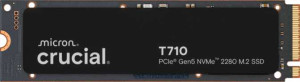
Crucial T710 1TB

Crucial E100 1TB Crucial T710 1TB

Overview

Welcome to our in-depth spec comparison between the Crucial E100 1TB and the Crucial T710 1TB, two M.2 NVMe SSDs sharing the same 1TB TLC-based capacity but targeting very different users. While both drives slot into the same form factor and skip extras like RGB lighting or an integrated heatsink, they diverge sharply across sequential speeds, PCIe generations, cache architecture, and long-term endurance metrics. Read on to see which drive suits your build and budget.

Common Features

  • Both products use the M2 form factor.
  • Both products are NVMe SSDs.
  • Both products offer 1000GB of internal storage.
  • Both products use TLC NAND flash storage type.
  • Neither product has an integrated heatsink.
  • Neither product features RGB lighting.

Main Differences

  • Sequential read speed is 5000 MB/s on Crucial E100 1TB and 14900 MB/s on Crucial T710 1TB.
  • Sequential write speed is 3000 MB/s on Crucial E100 1TB and 13700 MB/s on Crucial T710 1TB.
  • SSD cache is HMB (Host Memory Buffer) on Crucial E100 1TB and DRAM cache on Crucial T710 1TB.
  • NVMe version is 1.4 on Crucial E100 1TB and 2 on Crucial T710 1TB.
  • The controller is Silicon Motion SM2268XT on Crucial E100 1TB and Silicon Motion SM2508 on Crucial T710 1TB.
  • PCIe version is 4 on Crucial E100 1TB and 5 on Crucial T710 1TB.
  • Controller channels number 4 on Crucial E100 1TB and 8 on Crucial T710 1TB.
  • Terabytes Written (TBW) is 80 TB on Crucial E100 1TB and 600 TB on Crucial T710 1TB.
  • MTBF is 1 million hours on Crucial E100 1TB and 1.5 million hours on Crucial T710 1TB.
  • Warranty period is 3 years on Crucial E100 1TB and 5 years on Crucial T710 1TB.
Specs Comparison
Crucial E100 1TB

Crucial E100 1TB

Crucial T710 1TB

Crucial T710 1TB

Read speed:
sequential read speed 5000 MB/s 14900 MB/s

Sequential read speed is one of the most telling indicators of SSD performance, directly affecting how fast large files load, how quickly applications launch, and how snappy a system feels during data-intensive tasks. The Crucial E100 1TB delivers a sequential read speed of 5000 MB/s, which is a solid PCIe Gen 4 class figure that comfortably handles demanding workloads like 4K video editing, game loading, and OS boot times.

The Crucial T710 1TB, however, operates on an entirely different level at 14900 MB/s — nearly three times faster. This places it firmly in the PCIe Gen 5 tier, where peak throughput becomes relevant for professionals dealing with massive sequential workloads: think uncompressed RAW video streams, large AI model transfers, or high-speed data pipelines. For everyday use, the gap may not always be perceptible, but in sustained, large-file scenarios the difference is substantial and measurable.

The T710 holds a commanding and unambiguous edge in this group. Unless workloads are specifically tuned to saturate Gen 5 bandwidth, the E100′s 5000 MB/s is more than capable for most users — but for those who need maximum sequential throughput, the T710 is in a different performance class entirely.

Write speed:
sequential write speed 3000 MB/s 13700 MB/s

Write speed determines how efficiently a drive can commit data to storage — a critical factor during file transfers, system backups, video capture, and any workflow that involves writing large volumes of data continuously. At 3000 MB/s, the Crucial E100 1TB posts a respectable sequential write figure that keeps pace with mainstream PCIe Gen 4 drives and handles typical prosumer workloads without becoming a bottleneck.

Stacking the Crucial T710 1TB against it reveals a dramatic gap: 13700 MB/s of sequential write throughput — more than four times faster. At this level, the T710 can ingest data faster than most storage pipelines can even supply it, which matters most in scenarios like writing uncompressed 8K footage directly to the drive, cloning large NVMe volumes, or operating as a high-speed scratch disk in professional media production environments.

On write performance, the T710 wins decisively. The E100′s 3000 MB/s is entirely adequate for a broad range of users, but the T710′s 13700 MB/s is in a category that few competing drives can match — making it the clear choice for write-intensive professional workloads where sustained throughput is non-negotiable.

General info:
type M2 M2
SSD cache HMB (Host Memory Buffer) DRAM cache
Is an NVMe SSD
NVMe version 1.4 2
internal storage 1000GB 1000GB
release date January 2025 May 2025
controller Silicon Motion SM2268XT Silicon Motion SM2508
SSD storage type TLC TLC
PCI Express (PCIe) version 4 5
Controller channels 4 8
Terabytes Written (TBW) 80 600
MTBF 1million hours 1.5million hours
warranty period 3 years 5 years
Has an integrated heatsink
has RGB lighting

Both drives share the same M.2 form factor, TLC NAND, and 1TB capacity, but their underlying architectures tell very different stories. The most consequential structural difference is caching: the Crucial E100 relies on HMB (Host Memory Buffer), borrowing a slice of system RAM to compensate for the absence of dedicated DRAM, while the Crucial T710 integrates a true DRAM cache on the drive itself. Dedicated DRAM provides more consistent low-latency access to the drive′s mapping tables, which translates to steadier performance under mixed and sustained workloads — HMB is a capable workaround, but it introduces dependency on system memory bandwidth and can lag behind in demanding scenarios.

The controller and interface generational gap compounds this further. The E100′s Silicon Motion SM2268XT operates over PCIe 4 with 4 controller channels, while the T710′s SM2508 runs on PCIe 5 with 8 channels — doubling the parallelism and interface bandwidth simultaneously. Endurance is where the gap becomes especially stark: the E100 is rated for just 80 TBW against the T710′s 600 TBW, meaning the T710 can absorb nearly eight times more lifetime write data before reaching its rated limit. The T710 also backs this up with a longer 5-year warranty versus the E100′s 3 years and a higher 1.5 million hour MTBF.

Across virtually every architectural dimension in this group, the T710 holds a clear and meaningful advantage — superior caching, a more capable controller, doubled channel parallelism, and dramatically better endurance and longevity assurances. The E100 is a competent entry-level drive for light to moderate use, but the T710 is built for users who demand reliability and sustained performance over the long term.

Comparison Summary & Verdict

After examining every available spec, a clear picture emerges for each drive. The Crucial E100 1TB is a solid entry-level option built on PCIe 4.0 with a Silicon Motion SM2268XT controller and Host Memory Buffer caching, delivering respectable 5000/3000 MB/s read/write speeds. Its lower TBW of 80TB, 3-year warranty, and 1-million-hour MTBF make it best suited for everyday users who need reliable storage without premium pricing. The Crucial T710 1TB, on the other hand, is a performance-class drive leveraging PCIe 5.0, an 8-channel Silicon Motion SM2508 controller, dedicated DRAM cache, and blistering 14900/13700 MB/s sequential speeds. Backed by a 600TB TBW rating, 1.5-million-hour MTBF, and a 5-year warranty, it is built for power users, content creators, and professionals who demand the fastest storage available today.

Crucial E100 1TB
Buy Crucial E100 1TB if...

Buy the Crucial E100 1TB if you want a dependable everyday M.2 NVMe SSD on a PCIe 4.0 platform and do not need extreme sequential speeds or heavy write endurance.

Crucial T710 1TB
Buy Crucial T710 1TB if...

Buy the Crucial T710 1TB if you need the fastest PCIe 5.0 performance available, with dedicated DRAM cache, a 600TB TBW rating, and a 5-year warranty for demanding workloads.