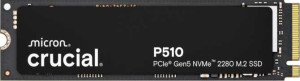
Crucial P510 1TB
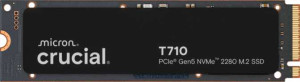
Crucial T710 1TB

Crucial P510 1TB Crucial T710 1TB

Overview

Welcome to our in-depth spec comparison between the Crucial P510 1TB and the Crucial T710 1TB. Both drives share the same M.2 PCIe 5.0 interface, 1TB TLC NAND storage, and a 5-year warranty, making this a fascinating head-to-head between two drives built on a similar foundation. The key battlegrounds here are sequential and random read/write speeds, cache architecture, and controller design — areas where these two drives take notably different approaches.

Common Features

  • Both drives use the M.2 form factor.
  • Both drives are NVMe SSDs.
  • Both drives offer 1000GB of internal storage.
  • Both drives use TLC NAND flash storage.
  • Both drives use PCIe version 5.
  • Both drives have a Terabytes Written (TBW) rating of 600.
  • Both drives come with a 5-year warranty.
  • Neither drive includes an integrated heatsink.

Main Differences

  • Sequential read speed is 11000 MB/s on Crucial P510 1TB and 14900 MB/s on Crucial T710 1TB.
  • Random read speed is 1500000 IOPS on Crucial P510 1TB and 1800000 IOPS on Crucial T710 1TB.
  • Sequential write speed is 9500 MB/s on Crucial P510 1TB and 13700 MB/s on Crucial T710 1TB.
  • Random write speed is 1500000 IOPS on Crucial P510 1TB and 2200000 IOPS on Crucial T710 1TB.
  • SSD cache is HMB (Host Memory Buffer) on Crucial P510 1TB and a dedicated DRAM cache on Crucial T710 1TB.
  • The controller is the Phison PS5031-E31T on Crucial P510 1TB and the Silicon Motion SM2508 on Crucial T710 1TB.
  • The controller has 4 channels on Crucial P510 1TB and 8 channels on Crucial T710 1TB.
Specs Comparison
Crucial P510 1TB

Crucial P510 1TB

Crucial T710 1TB

Crucial T710 1TB

Read speed:
sequential read speed 11000 MB/s 14900 MB/s
random read speed 1500000 IOPS 1800000 IOPS

Both drives deliver serious read performance, but the Crucial T710 1TB holds a clear advantage across the board. Its sequential read speed of 14900 MB/s outpaces the P510's 11000 MB/s by roughly 35% — a gap that translates into noticeably faster large file transfers, quicker game load times, and snappier OS boot sequences in real-world use.

The lead carries over to random reads as well, where the T710 reaches 1800000 IOPS versus the P510's 1500000 IOPS. Random IOPS matter most during multitasking, database access, and workloads with many small file requests — so the T710's 20% edge here benefits power users and professionals more than casual consumers.

The T710 wins this category decisively on both metrics. The P510 is no slouch and its 11000 MB/s sequential speed is still well above mainstream NVMe drives, but for users who prioritize peak read throughput, the T710 is the stronger choice.

Write speed:
sequential write speed 9500 MB/s 13700 MB/s
random write speed 1500000 IOPS 2200000 IOPS

On the write side, the performance gap between these two drives is even more pronounced than on reads. The T710 achieves a sequential write speed of 13700 MB/s, compared to 9500 MB/s on the P510 — a 44% difference that becomes tangible when saving large video files, running backups, or moving bulk data between drives.

Where the T710 really pulls ahead is in random write performance: 2200000 IOPS versus the P510's 1500000 IOPS, a roughly 47% margin. Random write IOPS are critical for write-intensive workloads like virtual machines, application installations, and frequent file saves in creative or development environments. That kind of headroom makes a meaningful difference under sustained pressure.

The T710 takes a commanding win in this category. The P510's write specs are respectable for a mainstream high-performance drive, but the T710's advantage on both sequential and random writes is substantial enough to matter in any scenario that stresses storage throughput.

General info:
type M2 M2
SSD cache HMB (Host Memory Buffer) DRAM cache
Is an NVMe SSD
internal storage 1000GB 1000GB
release date January 2025 May 2025
controller Phison PS5031-E31T Silicon Motion SM2508
SSD storage type TLC TLC
PCI Express (PCIe) version 5 5
Controller channels 4 8
Terabytes Written (TBW) 600 600
warranty period 5 years 5 years
Has an integrated heatsink
has RGB lighting

Beneath their shared M.2 PCIe 5 NVMe form factor and identical 1TB TLC capacity, two architectural decisions set these drives apart. The T710 pairs its controller with a dedicated DRAM cache, while the P510 relies on HMB (Host Memory Buffer), which borrows a slice of system RAM instead. Dedicated DRAM sits directly on the drive and responds faster under sustained workloads, whereas HMB performance can fluctuate depending on system memory pressure — a real consideration for users running memory-intensive applications alongside heavy storage tasks.

The controller difference reinforces this gap. The T710's Silicon Motion SM2508 operates across 8 channels, doubling the parallelism of the P510's Phison PS5031-E31T with its 4 channels. More channels allow the controller to read and write to more NAND flash simultaneously, which is the architectural root of the substantial speed advantages the T710 demonstrated in sequential and random throughput. It is not a minor tuning difference — it is a fundamentally more capable pipeline.

Where the two drives converge is meaningful: same TBW endurance rating of 600, identical 5-year warranty, and the same TLC flash type. For longevity and reliability assurances, buyers get an equal deal. But on the internal architecture that drives real-world performance, the T710 holds a clear structural edge.

Comparison Summary & Verdict

After examining every specification, a clear picture emerges. The Crucial P510 1TB is a capable and well-rounded PCIe 5.0 drive that relies on HMB (Host Memory Buffer) caching and a 4-channel Phison controller, making it a solid choice for users who want next-generation speed at a more accessible level. The Crucial T710 1TB, on the other hand, raises the bar significantly with its dedicated DRAM cache, 8-channel Silicon Motion SM2508 controller, and considerably higher peak speeds — up to 14900 MB/s sequential read and 2200000 IOPS random write. If you are a content creator, enthusiast, or power user who demands the absolute best sustained performance, the T710 is the clear pick. If you want a reliable, fast PCIe 5.0 upgrade without paying a premium, the P510 delivers excellent value.

Crucial P510 1TB
Buy Crucial P510 1TB if...

Buy the Crucial P510 1TB if you want a dependable PCIe 5.0 upgrade with strong performance and do not require the top-tier speeds or dedicated DRAM cache of a flagship drive.

Crucial T710 1TB
Buy Crucial T710 1TB if...

Buy the Crucial T710 1TB if you need the fastest possible sequential and random read/write speeds, and want the advantage of a dedicated DRAM cache and an 8-channel controller for demanding workloads.