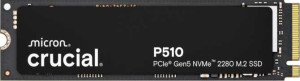
Crucial P510 1TB
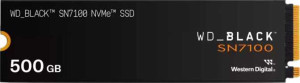
Western Digital WD Black SN7100 500GB

Crucial P510 1TB Western Digital WD Black SN7100 500GB

Overview

Welcome to our in-depth specification comparison between the Crucial P510 1TB and the Western Digital WD Black SN7100 500GB. Both drives share a solid foundation as M.2 NVMe SSDs with TLC NAND storage and a 5-year warranty, but they diverge sharply when it comes to raw performance and PCIe generation. Read on to explore how these two drives stack up across sequential and random speeds, endurance ratings, and core specifications.

Common Features

  • Both drives use the M.2 form factor.
  • Both drives use HMB (Host Memory Buffer) as SSD cache.
  • Both drives are NVMe SSDs.
  • Both drives use TLC NAND flash storage.
  • Both drives have 4 controller channels.
  • Both drives come with a 5-year warranty.
  • Neither drive has an integrated heatsink.
  • Neither drive has RGB lighting.

Main Differences

  • Sequential read speed is 11000 MB/s on Crucial P510 1TB and 6800 MB/s on Western Digital WD Black SN7100 500GB.
  • Random read speed is 1500000 IOPS on Crucial P510 1TB and 760000 IOPS on Western Digital WD Black SN7100 500GB.
  • Sequential write speed is 9500 MB/s on Crucial P510 1TB and 5800 MB/s on Western Digital WD Black SN7100 500GB.
  • Random write speed is 1500000 IOPS on Crucial P510 1TB and 1200000 IOPS on Western Digital WD Black SN7100 500GB.
  • Internal storage capacity is 1000GB on Crucial P510 1TB and 500GB on Western Digital WD Black SN7100 500GB.
  • The controller is Phison PS5031-E31T on Crucial P510 1TB and Polaris 3 A101-000172-A1 on Western Digital WD Black SN7100 500GB.
  • PCIe version is 5 on Crucial P510 1TB and 4 on Western Digital WD Black SN7100 500GB.
  • Terabytes Written (TBW) endurance rating is 600 TB on Crucial P510 1TB and 300 TB on Western Digital WD Black SN7100 500GB.
Specs Comparison
Crucial P510 1TB

Crucial P510 1TB

Western Digital WD Black SN7100 500GB

Western Digital WD Black SN7100 500GB

Read speed:
sequential read speed 11000 MB/s 6800 MB/s
random read speed 1500000 IOPS 760000 IOPS

Read speed is where these two drives diverge most sharply. The Crucial P510 1TB delivers a sequential read speed of 11000 MB/s, nearly 62% faster than the Western Digital WD Black SN7100 500GB's 6800 MB/s. In practice, this gap is most noticeable during large file transfers — think moving multi-gigabyte video projects, game installs, or OS images — where the P510 can sustain a significantly higher throughput over extended periods.

The random read advantage is equally pronounced: the P510 reaches 1,500,000 IOPS versus the SN7100's 760,000 IOPS — roughly double. Random IOPS matter most in real-world multitasking scenarios: booting an OS, launching applications simultaneously, or running a database workload. Twice the random read throughput translates into noticeably snappier system responsiveness under load, not just in synthetic benchmarks.

The Crucial P510 holds a clear and commanding advantage in this category across both sequential and random read metrics. Unless the SN7100 compensates strongly in other areas such as write performance, thermals, or pricing, the P510 is the more capable drive for read-intensive workloads.

Write speed:
sequential write speed 9500 MB/s 5800 MB/s
random write speed 1500000 IOPS 1200000 IOPS

Write performance follows the same pattern established by the read specs. The Crucial P510 posts a sequential write speed of 9500 MB/s against the WD Black SN7100 500GB's 5800 MB/s — a gap of roughly 64%. For workloads involving continuous large writes, such as capturing high-bitrate video, compiling large codebases, or cloning drives, this difference translates into meaningfully shorter wait times.

The random write comparison is closer but still favors the P510: 1,500,000 IOPS versus 1,200,000 IOPS — a 25% lead. While less dramatic than the sequential gap, this advantage still matters in write-heavy multitasking environments, such as virtual machines performing simultaneous disk I/O or workstations running background indexing alongside active file creation. The SN7100 is by no means slow here, but it does trail consistently.

Across both sequential and random write metrics, the Crucial P510 maintains a clear edge. The sequential advantage is substantial enough to impact day-to-day workflows, while the random write lead, though smaller, reinforces the P510's overall superiority in write-intensive scenarios.

General info:
type M2 M2
SSD cache HMB (Host Memory Buffer) HMB (Host Memory Buffer)
Is an NVMe SSD
internal storage 1000GB 500GB
release date January 2025 March 2025
controller Phison PS5031-E31T Polaris 3 A101-000172-A1
SSD storage type TLC TLC
PCI Express (PCIe) version 5 4
Controller channels 4 4
Terabytes Written (TBW) 600 300
warranty period 5 years 5 years
Has an integrated heatsink
has RGB lighting

Both drives share the same M.2 NVMe form factor, TLC NAND storage type, and HMB caching — meaning neither carries a dedicated DRAM buffer, instead borrowing system RAM to manage the drive's mapping table. The most consequential architectural difference is the PCIe generation: the Crucial P510 runs on PCIe 5.0, while the WD Black SN7100 is a PCIe 4.0 drive. This single distinction doubles the available bandwidth ceiling and directly explains the dramatic speed gap observed in the read and write groups. For users with a PCIe 5.0-capable motherboard, the P510 can fully exploit that interface; the SN7100 cannot.

Capacity and endurance also diverge significantly. The P510 offers 1TB of storage with a 600 TBW endurance rating, while the SN7100 ships at 500GB with 300 TBW — exactly half across both metrics. TBW is a long-term reliability indicator: a higher rating means the drive is rated to sustain more cumulative write activity before wear becomes a concern. For heavy users writing large volumes of data regularly, the P510's endurance headroom is a practical advantage, not just a spec sheet figure.

Warranty parity at 5 years for both drives is a shared strength. Overall, the Crucial P510 holds the edge in this group on three fronts — interface generation, raw capacity, and endurance — making it the more future-proof and long-term capable option of the two.

Comparison Summary & Verdict

After a thorough side-by-side analysis, both drives prove to be capable NVMe SSDs built on TLC NAND with shared fundamentals, but they target meaningfully different audiences. The Crucial P510 1TB stands out with its PCIe 5.0 interface, delivering exceptional 11000 MB/s sequential read and 1500000 IOPS random performance alongside a higher 600 TBW endurance rating and double the storage capacity. The Western Digital WD Black SN7100 500GB operates on PCIe 4.0 and offers more modest speeds, but remains a well-rounded drive for users who do not yet need the bandwidth ceiling of next-gen storage. Choose the Crucial P510 1TB for demanding workloads and future-proofed builds, and opt for the WD Black SN7100 if a PCIe 4.0 platform or a smaller capacity fits your current setup better.

Crucial P510 1TB
Buy Crucial P510 1TB if...

Buy the Crucial P510 1TB if you want maximum sequential and random read/write performance, a PCIe 5.0 connection, higher endurance, and double the storage capacity.

Western Digital WD Black SN7100 500GB
Buy Western Digital WD Black SN7100 500GB if...

Buy the Western Digital WD Black SN7100 500GB if you have a PCIe 4.0 platform, need only 500GB of storage, and do not require the top-tier speeds of a next-generation drive.