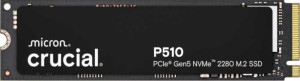
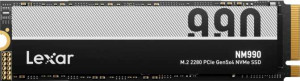
Both drives share the same foundational profile — M.2 form factor, NVMe, PCIe 5.0, and 2TB capacity — so the meaningful distinctions come down to architecture and endurance. The most significant structural difference is the cache implementation: the Lexar NM990 uses a dedicated DRAM cache, while the Crucial P510 relies on HMB (Host Memory Buffer), which borrows a slice of system RAM instead. A dedicated DRAM cache keeps the drive′s mapping tables on-chip and consistently accessible, which supports more stable latency under sustained load. HMB is an effective cost-saving approach but can introduce variability when system memory is under pressure.
Controller channel count is another architectural gap worth noting. The NM990′s 8-channel controller can access more NAND dies in parallel than the P510′s 4-channel design — this is a primary reason why the NM990′s peak speeds are higher, and it also contributes to more consistent throughput during prolonged workloads rather than just bursts. On endurance, the NM990 is rated for 1500 TBW versus the P510′s 1200 TBW, a 25% higher write ceiling that will matter to users who write heavily — video editors, developers, or anyone running the drive as a scratch disk.
Warranty parity at 5 years means long-term coverage is identical, and neither drive adds a heatsink, so thermal management depends equally on the host system. Overall, the NM990 holds a structural edge in this group: its DRAM cache and wider controller give it an architectural foundation that better supports the high sustained throughput its headline specs promise, while the higher TBW rating adds a practical durability advantage for write-intensive use cases.