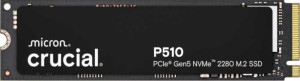
Crucial P510 2TB
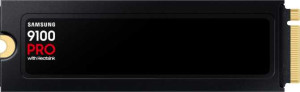
Samsung 9100 Pro 2TB

Crucial P510 2TB Samsung 9100 Pro 2TB

Overview

Welcome to our in-depth spec comparison between the Crucial P510 2TB and the Samsung 9100 Pro 2TB. Both drives share a strong foundation — PCIe 5.0, M.2 form factor, TLC NAND, and a 5-year warranty — but diverge significantly when it comes to raw read and write speeds, cache architecture, and controller design. Read on to see how these two high-performance NVMe SSDs stack up across every key specification.

Common Features

  • Both drives use the M.2 form factor.
  • Both are NVMe SSDs.
  • Both offer 2000GB of internal storage.
  • Both use TLC NAND flash storage.
  • Both connect via PCIe version 5.
  • Both have a Terabytes Written (TBW) rating of 1200.
  • Both come with a 5-year warranty.
  • Neither drive includes an integrated heatsink.

Main Differences

  • Sequential read speed is 10000 MB/s on Crucial P510 2TB and 14700 MB/s on Samsung 9100 Pro 2TB.
  • Random read speed is 1500000 IOPS on Crucial P510 2TB and 1850000 IOPS on Samsung 9100 Pro 2TB.
  • Sequential write speed is 8700 MB/s on Crucial P510 2TB and 13400 MB/s on Samsung 9100 Pro 2TB.
  • Random write speed is 1500000 IOPS on Crucial P510 2TB and 2600000 IOPS on Samsung 9100 Pro 2TB.
  • The SSD cache is HMB (Host Memory Buffer) on Crucial P510 2TB and a DRAM cache on Samsung 9100 Pro 2TB.
  • The controller is the Phison PS5031-E31T on Crucial P510 2TB and the Samsung Presto (S4LY027) on Samsung 9100 Pro 2TB.
  • The number of controller channels is 4 on Crucial P510 2TB and 8 on Samsung 9100 Pro 2TB.
Specs Comparison
Crucial P510 2TB

Crucial P510 2TB

Samsung 9100 Pro 2TB

Samsung 9100 Pro 2TB

Read speed:
sequential read speed 10000 MB/s 14700 MB/s
random read speed 1500000 IOPS 1850000 IOPS

Both drives deliver serious read performance, but the Samsung 9100 Pro 2TB holds a decisive advantage across the board. Its sequential read speed of 14700 MB/s is roughly 47% faster than the Crucial P510's 10000 MB/s — a gap large enough to matter in real workloads like large file transfers, game asset streaming, or loading massive datasets.

The random read story follows the same pattern. The 9100 Pro's 1850000 IOPS edges out the P510's 1500000 IOPS by about 23%, which translates to snappier application launches, faster OS responsiveness under multitasking, and lower latency when handling many small files simultaneously — the kind of mixed I/O workload that defines everyday desktop and workstation use.

The Samsung 9100 Pro has a clear edge in this category. While the Crucial P510 is far from slow, the 9100 Pro outpaces it in both sequential and random reads by margins that go beyond spec-sheet bragging — they reflect a genuine generational performance gap that users doing bandwidth-intensive or latency-sensitive work will notice.

Write speed:
sequential write speed 8700 MB/s 13400 MB/s
random write speed 1500000 IOPS 2600000 IOPS

Write performance is where the gap between these two drives widens even further. The Samsung 9100 Pro achieves sequential write speeds of 13400 MB/s against the Crucial P510's 8700 MB/s — a lead of roughly 54%. For workflows involving large continuous writes, such as video editing, backup operations, or compiling large codebases, that difference translates to meaningfully less waiting.

The random write disparity is the most striking figure in this entire comparison. The 9100 Pro's 2600000 IOPS is nearly 73% higher than the P510's 1500000 IOPS. Random write performance is arguably more critical to perceived system responsiveness than sequential speed, since it governs how quickly a drive handles database transactions, virtual machine disk activity, and the constant small writes that occur during normal OS operation. A gap of this magnitude is not marginal — it reflects a fundamentally different performance tier.

The Samsung 9100 Pro wins this category decisively. The Crucial P510 holds its own in sequential writes for a mainstream Gen 5 drive, but the 9100 Pro's commanding random write lead places it in a different class for demanding, write-intensive workloads.

General info:
type M2 M2
SSD cache HMB (Host Memory Buffer) DRAM cache
Is an NVMe SSD
internal storage 2000GB 2000GB
release date January 2025 February 2025
controller Phison PS5031-E31T Samsung Presto (S4LY027)
SSD storage type TLC TLC
PCI Express (PCIe) version 5 5
Controller channels 4 8
Terabytes Written (TBW) 1200 1200
warranty period 5 years 5 years
Has an integrated heatsink
has RGB lighting

On the surface, these two drives share a lot of common ground: both are M.2 PCIe 5.0 NVMe SSDs using TLC NAND, both offer 2TB of storage, and both carry identical 1200 TBW endurance ratings and 5-year warranties. For longevity and form factor compatibility, buyers can treat them as equals.

The most consequential difference here is the cache architecture. The Crucial P510 relies on HMB (Host Memory Buffer), borrowing a slice of system RAM as its cache, while the Samsung 9100 Pro uses a dedicated DRAM cache onboard the drive itself. A true DRAM cache provides faster, more consistent access to the drive's mapping tables — particularly under sustained or unpredictable workloads — whereas HMB performance can be influenced by system memory pressure and latency. This is a meaningful architectural advantage for the 9100 Pro in demanding scenarios. Compounding this, the 9100 Pro's controller operates with 8 channels versus the P510's 4 channels, allowing it to parallelize data operations more aggressively — which directly explains the wider performance gaps seen in sequential and random speed metrics.

The Samsung 9100 Pro holds the edge in this category. While the P510 is a well-specified mainstream drive, the 9100 Pro's onboard DRAM cache and higher channel count represent structural advantages that underpin its superior real-world performance.

Comparison Summary & Verdict

Both the Crucial P510 2TB and the Samsung 9100 Pro 2TB are compelling PCIe 5.0 NVMe drives that share the same capacity, endurance rating, and warranty terms. However, the differences are meaningful. The Samsung 9100 Pro 2TB pulls ahead in every speed metric, offering a sequential read speed of 14700 MB/s, a sequential write speed of 13400 MB/s, and significantly higher random IOPS in both read and write — backed by a DRAM cache and an 8-channel controller. The Crucial P510 2TB, while slower, still delivers excellent PCIe 5.0 performance and relies on HMB (Host Memory Buffer) caching with a 4-channel controller, which may translate to a more accessible price point. Choose the Samsung 9100 Pro 2TB if you demand the absolute best throughput for demanding workloads, and the Crucial P510 2TB if you want solid next-gen NVMe performance with a potentially lighter investment.

Crucial P510 2TB
Buy Crucial P510 2TB if...

Buy the Crucial P510 2TB if you want a capable PCIe 5.0 NVMe SSD and are comfortable trading some peak throughput for what is likely a more budget-friendly entry into next-gen storage.

Samsung 9100 Pro 2TB
Buy Samsung 9100 Pro 2TB if...

Buy the Samsung 9100 Pro 2TB if you need the highest possible sequential and random read/write speeds, and prefer a DRAM cache with an 8-channel controller for demanding, performance-critical workloads.