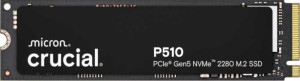
Crucial P510 2TB
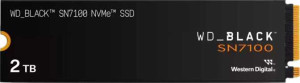
Western Digital WD Black SN7100 2TB

Crucial P510 2TB Western Digital WD Black SN7100 2TB

Overview

Welcome to our in-depth spec comparison between the Crucial P510 2TB and the Western Digital WD Black SN7100 2TB. Both drives share a strong common foundation — M.2 NVMe form factor, TLC NAND, HMB cache, a 1200 TBW endurance rating, and a 5-year warranty — but they diverge sharply when it comes to raw transfer speeds and PCIe generation. Read on to see how every specification stacks up between these two popular 2TB SSDs.

Common Features

  • Both drives use the M.2 form factor.
  • Both drives use HMB (Host Memory Buffer) as SSD cache.
  • Both drives are NVMe SSDs.
  • Both drives offer 2000GB of internal storage.
  • Both drives use TLC NAND storage type.
  • Both drives have 4 controller channels.
  • Both drives have a Terabytes Written (TBW) rating of 1200.
  • Both drives come with a 5-year warranty period.

Main Differences

  • Sequential read speed is 10000 MB/s on Crucial P510 2TB and 7250 MB/s on Western Digital WD Black SN7100 2TB.
  • Sequential write speed is 8700 MB/s on Crucial P510 2TB and 6900 MB/s on Western Digital WD Black SN7100 2TB.
  • Random read speed is 1500000 IOPS on Crucial P510 2TB and 1000000 IOPS on Western Digital WD Black SN7100 2TB.
  • Random write speed is 1500000 IOPS on Crucial P510 2TB and 1400000 IOPS on Western Digital WD Black SN7100 2TB.
  • The controller is Phison PS5031-E31T on Crucial P510 2TB and Polaris 3 A101-000172-A1 on Western Digital WD Black SN7100 2TB.
  • The PCIe version is 5 on Crucial P510 2TB and 4 on Western Digital WD Black SN7100 2TB.
Specs Comparison
Crucial P510 2TB

Crucial P510 2TB

Western Digital WD Black SN7100 2TB

Western Digital WD Black SN7100 2TB

Read speed:
sequential read speed 10000 MB/s 7250 MB/s
random read speed 1500000 IOPS 1000000 IOPS

In read performance, the Crucial P510 2TB holds a substantial lead across both sequential and random metrics. Its sequential read speed of 10000 MB/s outpaces the WD Black SN7100's 7250 MB/s by roughly 38% — a gap large enough to meaningfully shorten transfer times when moving large files like video projects, disk images, or game installations.

The random read advantage is equally pronounced: 1500000 IOPS versus 1000000 IOPS represents a 50% lead for the P510. Random IOPS matter most in real-world OS responsiveness, multitasking, and loading many small files simultaneously — so this gap translates into a noticeably snappier feel under demanding workloads, not just in synthetic benchmarks.

Based strictly on the provided specs, the Crucial P510 2TB has a clear and consistent read performance advantage over the WD Black SN7100 2TB in both sequential and random scenarios. Buyers prioritizing raw read throughput — particularly for content creation pipelines or high-queue-depth workloads — will find the P510 the stronger choice here.

Write speed:
sequential write speed 8700 MB/s 6900 MB/s
random write speed 1500000 IOPS 1400000 IOPS

Write performance tells a similar story to reads: the Crucial P510 2TB leads on sequential writes at 8700 MB/s compared to the WD Black SN7100's 6900 MB/s — a roughly 26% advantage. For sustained large-file writes such as encoding video directly to the drive, capturing high-bitrate footage, or cloning disks, this gap is tangible and will consistently favor the P510 in throughput-heavy workflows.

Random write performance, however, tells a more nuanced story. The P510 again leads at 1500000 IOPS versus the SN7100's 1400000 IOPS, but the margin here is only about 7%. In practice, that delta is unlikely to produce a perceptible difference during typical random-write tasks like database transactions, system writes, or application installs — both drives operate at an exceptionally high tier for this metric.

Overall, the Crucial P510 2TB retains a clear edge in write performance, driven primarily by its stronger sequential write speed. The SN7100 closes the gap considerably on random writes, making it competitive for mixed workloads — but for users who regularly push large sequential data to the drive, the P510's advantage is meaningful.

General info:
type M2 M2
SSD cache HMB (Host Memory Buffer) HMB (Host Memory Buffer)
Is an NVMe SSD
internal storage 2000GB 2000GB
release date January 2025 March 2025
controller Phison PS5031-E31T Polaris 3 A101-000172-A1
SSD storage type TLC TLC
PCI Express (PCIe) version 5 4
Controller channels 4 4
Terabytes Written (TBW) 1200 1200
warranty period 5 years 5 years
Has an integrated heatsink
has RGB lighting

At the foundational level, these two drives share a striking amount of common ground: both are M.2 NVMe SSDs using TLC NAND, rely on HMB (Host Memory Buffer) in place of dedicated DRAM, feature a 4-channel controller, carry identical 1200 TBW endurance ratings, and are backed by the same 5-year warranty. For most buyers, this means long-term reliability and longevity expectations are essentially equivalent.

The single most consequential differentiator here is the PCIe generation: the Crucial P510 runs on PCIe 5.0, while the WD Black SN7100 operates on PCIe 4.0. This is the architectural reason behind the large performance gaps seen in the speed groups — PCIe 5.0 doubles the available bandwidth per lane over PCIe 4.0, which is what enables the P510's higher sequential ceiling. It also means the P510 requires a PCIe 5.0-compatible M.2 slot to realize its full potential; in a PCIe 4.0 system, its advantage narrows significantly.

On balance, the two drives are well-matched in durability and platform fundamentals, but the Crucial P510 holds a structural advantage for users on PCIe 5.0-capable platforms. The WD Black SN7100 remains a highly competitive choice for systems that top out at PCIe 4.0, where the interface gap between them disappears entirely.

Comparison Summary & Verdict

After reviewing all the specifications, the two drives share a solid baseline: identical capacity, endurance, cache technology, and warranty coverage. However, the Crucial P510 2TB pulls decisively ahead in performance, delivering 10,000 MB/s sequential reads and 8,700 MB/s sequential writes over a PCIe 5.0 interface — making it a compelling pick for demanding workloads. The Western Digital WD Black SN7100 2TB, while slower on paper at 7,250 MB/s sequential reads over PCIe 4.0, remains a highly capable drive for mainstream users and is likely the better fit for systems that do not yet support PCIe 5.0. Choose based on your platform and your need for cutting-edge throughput.

Crucial P510 2TB
Buy Crucial P510 2TB if...

Buy the Crucial P510 2TB if you have a PCIe 5.0-compatible system and need the absolute highest sequential and random read and write speeds available in a 2TB M.2 NVMe SSD.

Western Digital WD Black SN7100 2TB
Buy Western Digital WD Black SN7100 2TB if...

Buy the Western Digital WD Black SN7100 2TB if your system runs PCIe 4.0 and you want a reliable, high-performance 2TB NVMe SSD without requiring next-generation platform support.