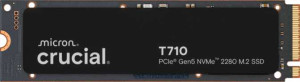
Crucial T710 1TB
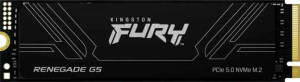
Kingston Fury Renegade G5 1TB

Crucial T710 1TB Kingston Fury Renegade G5 1TB

Overview

Welcome to our in-depth specification comparison between the Crucial T710 1TB and the Kingston Fury Renegade G5 1TB. Both drives share a strong common foundation — PCIe 5.0, NVMe 2.0, TLC NAND, a Silicon Motion SM2508 controller, and DRAM cache — yet they diverge in meaningful ways across sequential and random performance, endurance ratings, and long-term reliability metrics. Read on to find out which drive best fits your needs.

Common Features

  • Both drives use the M.2 form factor.
  • Both drives feature a DRAM cache.
  • Both drives are NVMe SSDs.
  • Both drives use NVMe version 2.
  • Both drives offer 1000GB of internal storage.
  • Both drives use the Silicon Motion SM2508 controller.
  • Both drives use TLC NAND flash storage.
  • Both drives connect via PCIe version 5.

Main Differences

  • Sequential read speed is 14900 MB/s on Crucial T710 1TB and 14200 MB/s on Kingston Fury Renegade G5 1TB.
  • Random read speed is 1800000 IOPS on Crucial T710 1TB and 2200000 IOPS on Kingston Fury Renegade G5 1TB.
  • Sequential write speed is 13700 MB/s on Crucial T710 1TB and 11000 MB/s on Kingston Fury Renegade G5 1TB.
  • Random write speed is 2200000 IOPS on Crucial T710 1TB and 2150000 IOPS on Kingston Fury Renegade G5 1TB.
  • Terabytes Written (TBW) is 600 TB on Crucial T710 1TB and 1000 TB on Kingston Fury Renegade G5 1TB.
  • MTBF is 1.5 million hours on Crucial T710 1TB and 2 million hours on Kingston Fury Renegade G5 1TB.
Specs Comparison
Crucial T710 1TB

Crucial T710 1TB

Kingston Fury Renegade G5 1TB

Kingston Fury Renegade G5 1TB

Read speed:
sequential read speed 14900 MB/s 14200 MB/s
random read speed 1800000 IOPS 2200000 IOPS

Both drives operate at the cutting edge of consumer NVMe storage, but they prioritize different aspects of read performance. The Crucial T710 leads in sequential reads at 14,900 MB/s versus the Kingston Fury Renegade G5's 14,200 MB/s — a 700 MB/s gap that, while measurable, is unlikely to be felt in most real-world workflows. Sequential speed matters most when transferring large contiguous files, such as 4K video footage or large disc images.

The more meaningful differentiator is random read performance, where the roles reverse sharply. The Fury Renegade G5 pulls ahead with 2,200,000 IOPS compared to the T710's 1,800,000 IOPS — a roughly 22% advantage. Random IOPS governs how fast a drive handles the thousands of small, scattered read requests generated by everyday tasks: booting an OS, launching applications, loading game assets, or running a database. For most users, this metric has a far more tangible impact on perceived snappiness than sequential throughput.

The edge here goes to the Kingston Fury Renegade G5. Its commanding lead in random reads makes it the stronger performer for general-purpose and latency-sensitive workloads, which represent the bulk of real-world usage. The T710's sequential advantage is real but narrow, and only becomes relevant in sustained large-file transfer scenarios.

Write speed:
sequential write speed 13700 MB/s 11000 MB/s
random write speed 2200000 IOPS 2150000 IOPS

Write performance is where the Crucial T710 reclaims ground lost in random reads. Its sequential write speed of 13,700 MB/s is a substantial 25% faster than the Kingston Fury Renegade G5's 11,000 MB/s — a gap wide enough to matter in practice. When writing large files continuously, such as rendering video exports, cloning drives, or ingesting high-bitrate captures, that extra throughput translates directly into measurable time savings.

Random write IOPS tell a different story: at 2,200,000 IOPS for the T710 versus 2,150,000 IOPS for the Fury Renegade G5, the two drives are essentially identical. A 50,000 IOPS difference at this scale is statistically negligible and will produce no discernible difference in workloads driven by small random writes, such as compiling code, writing database transactions, or saving incremental application state.

The clear winner in this group is the Crucial T710, and the decisive factor is sequential write speed. For content creators, data movers, or anyone whose workflows involve pushing large volumes of data onto the drive, the T710's advantage here is meaningful and consistent. The Fury Renegade G5 remains competitive on random writes, but that near-parity is not enough to offset the significant sequential deficit.

General info:
type M2 M2
SSD cache DRAM cache DRAM cache
Is an NVMe SSD
NVMe version 2 2
internal storage 1000GB 1000GB
release date May 2025 April 2025
controller Silicon Motion SM2508 Silicon Motion SM2508
SSD storage type TLC TLC
PCI Express (PCIe) version 5 5
Controller channels 8 8
Terabytes Written (TBW) 600 1000
MTBF 1.5million hours 2million hours
warranty period 5 years 5 years
Has an integrated heatsink
has RGB lighting

At the architectural level, these two drives are remarkably alike. Both share the same M.2 PCIe 5.0 interface, NVMe 2.0 protocol, Silicon Motion SM2508 controller with 8 channels, DRAM cache, and TLC NAND — meaning their underlying hardware foundation is essentially identical. For a buyer trying to differentiate them on platform compatibility or fundamental design, there is nothing to separate them here.

Where the two drives diverge meaningfully is in longevity metrics. The Kingston Fury Renegade G5 is rated for 1,000 TBW versus the Crucial T710's 600 TBW — a 67% higher endurance rating. Paired with an MTBF of 2 million hours against the T710's 1.5 million hours, Kingston's drive is positioned as the more durable option on paper. TBW is particularly relevant for write-intensive users: heavy video editors, developers running frequent large builds, or anyone using the drive as a primary working scratch disk will exhaust a lower TBW rating sooner.

For the average consumer workload, both drives' endurance figures are generous enough that neither will likely be the limiting factor over a typical ownership period. That said, the edge in this group belongs to the Kingston Fury Renegade G5 — its higher TBW and MTBF offer a more comfortable reliability margin, and both products back their claims with an identical 5-year warranty.

Comparison Summary & Verdict

After examining all the evidence, both drives are clearly high-end PCIe 5.0 SSDs built on identical core technology, making the differences a matter of priority rather than quality. The Crucial T710 1TB holds the edge in sequential read and write speeds — reaching 14900 MB/s read and 13700 MB/s write — making it the stronger pick for workloads that demand raw throughput. The Kingston Fury Renegade G5 1TB, on the other hand, wins on random read IOPS (2200000 vs 1800000), and significantly outpaces its rival in endurance with a 1000 TBW rating and a 2 million hour MTBF, versus 600 TBW and 1.5 million hours for the Crucial. For users who write heavily or demand long-term reliability, the Kingston is the more durable investment.

Crucial T710 1TB
Buy Crucial T710 1TB if...

Buy the Crucial T710 1TB if your workloads demand the highest possible sequential read and write throughput, and raw transfer speed is your top priority.

Kingston Fury Renegade G5 1TB
Buy Kingston Fury Renegade G5 1TB if...

Buy the Kingston Fury Renegade G5 1TB if you prioritize higher random read performance, greater write endurance (1000 TBW), and a longer rated lifespan (2 million hour MTBF).