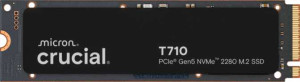
Crucial T710 1TB
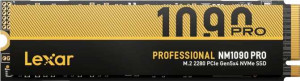
Lexar NM1090 Pro 2TB

Crucial T710 1TB Lexar NM1090 Pro 2TB

Overview

Welcome to our detailed spec comparison between the Crucial T710 1TB and the Lexar NM1090 Pro 2TB, two high-performance PCIe 5.0 NVMe SSDs sharing the same Silicon Motion SM2508 controller and TLC NAND foundation. While both drives target enthusiast and prosumer workloads, they diverge in key areas such as sequential throughput, random I/O performance, storage capacity, and endurance ratings. Read on to see how these two drives stack up across every major specification.

Common Features

  • Both products use the M2 form factor.
  • Both products include a DRAM cache.
  • Both products are NVMe SSDs.
  • Both products support NVMe version 2.
  • Both products use the Silicon Motion SM2508 controller.
  • Both products use TLC storage type.
  • Both products support PCIe version 5.
  • Both products have 8 controller channels.

Main Differences

  • Sequential read speed is 14900 MB/s on Crucial T710 1TB and 12000 MB/s on Lexar NM1090 Pro 2TB.
  • Random read speed is 1800000 IOPS on Crucial T710 1TB and 2100000 IOPS on Lexar NM1090 Pro 2TB.
  • Sequential write speed is 13700 MB/s on Crucial T710 1TB and 11000 MB/s on Lexar NM1090 Pro 2TB.
  • Random write speed is 2200000 IOPS on Crucial T710 1TB and 1800000 IOPS on Lexar NM1090 Pro 2TB.
  • Internal storage capacity is 1000GB on Crucial T710 1TB and 2000GB on Lexar NM1090 Pro 2TB.
  • Terabytes Written (TBW) endurance rating is 600 TBW on Crucial T710 1TB and 1400 TBW on Lexar NM1090 Pro 2TB.
Specs Comparison
Crucial T710 1TB

Crucial T710 1TB

Lexar NM1090 Pro 2TB

Lexar NM1090 Pro 2TB

Read speed:
sequential read speed 14900 MB/s 12000 MB/s
random read speed 1800000 IOPS 2100000 IOPS

Read speed splits into two distinct dimensions here: sequential and random. The Crucial T710 1TB leads on sequential reads at 14,900 MB/s versus the Lexar NM1090 Pro 2TB's 12,000 MB/s — a roughly 24% advantage that matters most for large, contiguous data transfers like moving big video files, disk images, or game installs.

The picture flips for random reads, where the Lexar NM1090 Pro pulls ahead with 2,100,000 IOPS compared to the T710's 1,800,000 IOPS — about a 17% edge. Random IOPS govern how snappy a drive feels during everyday OS use, multitasking, and database-style workloads, since those tasks constantly access many small, scattered files rather than one large stream.

Neither drive dominates across the board: the T710 is the stronger choice for throughput-heavy creative or backup workloads, while the NM1090 Pro has a real-world responsiveness edge in mixed, latency-sensitive environments. For most desktop and gaming users the random IOPS gap will be imperceptible, making the T710's sequential lead the more tangible everyday differentiator — giving it a slight overall edge in this group.

Write speed:
sequential write speed 13700 MB/s 11000 MB/s
random write speed 2200000 IOPS 1800000 IOPS

On write performance, the Crucial T710 1TB holds a consistent advantage across both metrics. Its sequential write speed of 13,700 MB/s outpaces the Lexar NM1090 Pro 2TB's 11,000 MB/s by around 25% — meaningful for anyone regularly ingesting large amounts of data, such as video editors writing raw footage to the drive or users running frequent large backups.

More striking is the random write gap: the T710 reaches 2,200,000 IOPS against the NM1090 Pro's 1,800,000 IOPS, a roughly 22% lead. Unlike the read side where the two drives split honors, here the T710 wins on both dimensions simultaneously. High random write IOPS reduce latency during write-heavy OS operations, virtual machine activity, and any workload that hammers the drive with many small, unpredictable writes in parallel.

Unlike the read comparison where each drive had its own strength, write performance tells a one-sided story — the T710 holds a clear and consistent edge across both sequential and random writes. For workloads where sustained write throughput and low-latency random writes matter, the T710 is the stronger performer in this group.

General info:
type M2 M2
SSD cache DRAM cache DRAM cache
Is an NVMe SSD
NVMe version 2 2
internal storage 1000GB 2000GB
release date May 2025 April 2025
controller Silicon Motion SM2508 Silicon Motion SM2508
SSD storage type TLC TLC
PCI Express (PCIe) version 5 5
Controller channels 8 8
Terabytes Written (TBW) 600 1400
MTBF 1.5million hours 1.5million hours
warranty period 5 years 5 years
Has an integrated heatsink
has RGB lighting

At the architectural level, these two drives are virtually twins. Both use the same Silicon Motion SM2508 controller with 8 channels, the same PCIe 5.0 interface, NVMe 2.0 protocol, TLC NAND with a DRAM cache, and identical M.2 form factors. Shared foundations like these mean any performance differences between the two stem from configuration and capacity, not fundamental design choices.

The most meaningful divergence in this group is endurance. The Lexar NM1090 Pro 2TB is rated for 1,400 TBW versus the Crucial T710 1TB's 600 TBW — more than double. Capacity alone explains much of this gap, since larger drives naturally distribute writes across more NAND cells, extending longevity. For heavy write users — think NAS, video production scratch disks, or frequent large backups — the NM1090 Pro's higher endurance rating provides a meaningfully longer expected service life under sustained workloads.

Reliability and warranty specs are identical: both carry a 1.5 million hour MTBF and a 5-year warranty, so neither has a durability edge on paper beyond the TBW difference. The clear takeaway here is that the two drives share the same premium-tier DNA; the NM1090 Pro's advantage in this group is its higher endurance ceiling, which is directly tied to its larger capacity rather than a superior design.

Comparison Summary & Verdict

Both the Crucial T710 1TB and the Lexar NM1090 Pro 2TB are built on a strong shared foundation — PCIe 5.0, NVMe 2.0, the Silicon Motion SM2508 controller, DRAM cache, and TLC NAND — making either drive a compelling choice for demanding users. However, they each carve out a distinct niche. The Crucial T710 1TB leads in raw sequential throughput (14900 MB/s read, 13700 MB/s write) and random write IOPS (2200000 IOPS), making it ideal for workloads that depend on burst transfer speeds. The Lexar NM1090 Pro 2TB counters with a higher random read speed of 2100000 IOPS, double the storage capacity at 2TB, and a significantly more robust endurance rating of 1400 TBW, making it better suited for write-heavy workloads and users who need long-term reliability at scale.

Crucial T710 1TB
Buy Crucial T710 1TB if...

Buy the Crucial T710 1TB if you prioritize the highest sequential read and write speeds, or need superior random write performance for latency-sensitive applications.

Lexar NM1090 Pro 2TB
Buy Lexar NM1090 Pro 2TB if...

Buy the Lexar NM1090 Pro 2TB if you need more storage capacity, faster random read performance, or a higher endurance rating for sustained, write-intensive workloads.