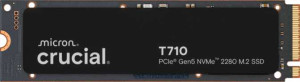
Crucial T710 1TB
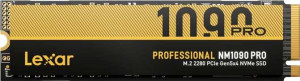
Lexar NM1090 Pro 2TB (With Heatsink)

Crucial T710 1TB Lexar NM1090 Pro 2TB (With Heatsink)

Overview

Welcome to our in-depth spec comparison between the Crucial T710 1TB and the Lexar NM1090 Pro 2TB (With Heatsink), two high-performance PCIe 5.0 NVMe SSDs sharing the same controller and storage technology. While both drives have a great deal in common under the hood, key battlegrounds emerge around sequential transfer speeds, random I/O performance, storage capacity, and endurance ratings. Read on to see which drive suits your needs best.

Common Features

  • Both products use the M2 form factor.
  • Both products feature a DRAM cache.
  • Both products are NVMe SSDs.
  • Both products support NVMe version 2.
  • Both products use the Silicon Motion SM2508 controller.
  • Both products use TLC NAND storage.
  • Both products support PCIe version 5.
  • Both products have 8 controller channels.

Main Differences

  • Sequential read speed is 14900 MB/s on Crucial T710 1TB and 12000 MB/s on Lexar NM1090 Pro 2TB (With Heatsink).
  • Random read speed is 1800000 IOPS on Crucial T710 1TB and 2100000 IOPS on Lexar NM1090 Pro 2TB (With Heatsink).
  • Sequential write speed is 13700 MB/s on Crucial T710 1TB and 11000 MB/s on Lexar NM1090 Pro 2TB (With Heatsink).
  • Random write speed is 2200000 IOPS on Crucial T710 1TB and 1800000 IOPS on Lexar NM1090 Pro 2TB (With Heatsink).
  • Internal storage capacity is 1000GB on Crucial T710 1TB and 2000GB on Lexar NM1090 Pro 2TB (With Heatsink).
  • Terabytes Written (TBW) is 600 on Crucial T710 1TB and 1400 on Lexar NM1090 Pro 2TB (With Heatsink).
  • An integrated heatsink is present on Lexar NM1090 Pro 2TB (With Heatsink) but not available on Crucial T710 1TB.
Specs Comparison
Crucial T710 1TB

Crucial T710 1TB

Lexar NM1090 Pro 2TB (With Heatsink)

Lexar NM1090 Pro 2TB (With Heatsink)

Read speed:
sequential read speed 14900 MB/s 12000 MB/s
random read speed 1800000 IOPS 2100000 IOPS

Read speed splits into two distinct dimensions here: sequential and random. The Crucial T710 1TB leads decisively on sequential reads at 14,900 MB/s versus the Lexar NM1090 Pro 2TB's 12,000 MB/s — a roughly 24% advantage. Sequential speed governs large, contiguous file transfers: moving massive video files, loading large game assets, or reading disk images. In those workloads, the T710 holds a meaningful real-world edge.

The picture flips on random reads. The Lexar NM1090 Pro counters with 2,100,000 IOPS against the T710's 1,800,000 IOPS — a ~17% lead. Random IOPS governs how quickly a drive handles thousands of small, scattered read requests simultaneously, which is exactly what happens during OS boot, application launches, database queries, and multitasking. For workloads typical of a primary system drive, high random read IOPS often has more perceptible impact day-to-day than peak sequential throughput.

The verdict depends on use case. For sustained large-file throughput — content creation pipelines, video editing, or bulk data transfers — the T710 has the clear edge. For a high-responsiveness system drive under mixed, latency-sensitive workloads, the NM1090 Pro's IOPS advantage gives it the upper hand. Neither product dominates across both dimensions, making the right choice a direct function of the user's primary workload.

Write speed:
sequential write speed 13700 MB/s 11000 MB/s
random write speed 2200000 IOPS 1800000 IOPS

Unlike read speeds — where the two drives split honors — write performance tells a more one-sided story. The Crucial T710 1TB outpaces the Lexar NM1090 Pro 2TB on both fronts: sequential writes reach 13,700 MB/s versus 11,000 MB/s, and random writes come in at 2,200,000 IOPS versus 1,800,000 IOPS. That is a ~25% sequential lead and a ~22% random write advantage — consistent margins that paint a clear picture.

Sequential write speed matters most when committing large volumes of data to disk: exporting a rendered video, writing a large backup, or cloning a drive. At nearly 2.7 GB/s faster, the T710 completes those tasks measurably quicker. The random write gap is arguably more significant for sustained system use — high IOPS under write pressure determines how well a drive handles database transactions, frequent small file saves, and compiler output during heavy builds. A 400,000 IOPS advantage here is not marginal.

Across both write dimensions, the T710 holds a clear and consistent edge. Notably, this is the reverse of the NM1090 Pro's random read advantage, suggesting the two drives are built around different controller and NAND tuning philosophies. For write-intensive workloads specifically, the T710 is the stronger performer by a meaningful degree.

General info:
type M2 M2
SSD cache DRAM cache DRAM cache
Is an NVMe SSD
NVMe version 2 2
internal storage 1000GB 2000GB
release date May 2025 April 2025
controller Silicon Motion SM2508 Silicon Motion SM2508
SSD storage type TLC TLC
PCI Express (PCIe) version 5 5
Controller channels 8 8
Terabytes Written (TBW) 600 1400
MTBF 1.5million hours 1.5million hours
warranty period 5 years 5 years
Has an integrated heatsink
has RGB lighting

At the platform level, these two drives are essentially identical twins: same Silicon Motion SM2508 controller, same PCIe 5.0 interface, same NVMe 2.0 protocol, same 8-channel architecture, same TLC NAND, and same DRAM cache configuration. Shared hardware at this depth means performance characteristics are shaped primarily by firmware tuning and NAND capacity — not fundamental design differences. Neither drive offers RGB lighting, and both carry a solid 5-year warranty backed by a 1.5 million hour MTBF rating.

The meaningful differentiators come down to three factors. First, capacity: 1TB versus 2TB is straightforward — the Lexar NM1090 Pro simply offers twice the storage. Second, and more nuanced, is endurance: the NM1090 Pro's 1,400 TBW rating against the T710's 600 TBW. TBW scales roughly with NAND quantity, so the gap is expected, but it does mean the NM1090 Pro is rated to absorb more than twice the cumulative write load over its lifetime — relevant for write-intensive or archival use cases. Third, the NM1090 Pro ships with an integrated heatsink, which can help sustain peak performance during prolonged workloads by managing thermal throttling.

For a buyer comparing these two specifically on general specifications, the NM1090 Pro holds the broader advantage in this group: more capacity, higher endurance, and included thermal management. The T710 matches it on every platform-level spec but concedes on all three differentiating points. Whether those differences justify the likely price gap depends on the buyer's storage needs and workload intensity.

Comparison Summary & Verdict

Both the Crucial T710 1TB and the Lexar NM1090 Pro 2TB (With Heatsink) are built on a very similar technical foundation, sharing the Silicon Motion SM2508 controller, PCIe 5.0 interface, TLC NAND, and DRAM cache. However, their differences reveal distinct strengths. The Crucial T710 1TB pulls ahead in sequential read and write speeds (14900 MB/s and 13700 MB/s respectively) and random write performance at 2200000 IOPS, making it ideal for users who demand peak throughput in a compact drive. The Lexar NM1090 Pro 2TB (With Heatsink) counters with a larger 2TB capacity, superior random read speed of 2100000 IOPS, a higher TBW rating of 1400, and an integrated heatsink for sustained workloads. Choose based on whether raw speed or capacity and longevity matter more to you.

Crucial T710 1TB
Buy Crucial T710 1TB if...

Buy the Crucial T710 1TB if you prioritize the highest sequential read and write speeds, or need top-tier random write performance in a drive without a built-in heatsink.

Lexar NM1090 Pro 2TB (With Heatsink)
Buy Lexar NM1090 Pro 2TB (With Heatsink) if...

Buy the Lexar NM1090 Pro 2TB (With Heatsink) if you need more storage capacity, greater endurance with a higher TBW rating, faster random reads, and the added thermal protection of an integrated heatsink.