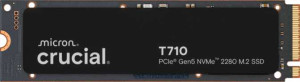
Crucial T710 1TB
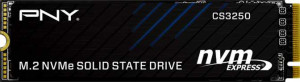
PNY CS3250 2TB

Crucial T710 1TB PNY CS3250 2TB

Common Features

  • Both products are M2 type SSDs.
  • Both products are NVMe SSDs.
  • Both products use TLC SSD storage type.
  • Both products support PCI Express version 5.
  • Both products have 8 controller channels.
  • Both products have a 5-year warranty period.
  • Neither product has an integrated heatsink.
  • Neither product has RGB lighting.
  • Both products have DRAM cache or equivalent.
  • Both products have an internal storage capacity of at least 1TB.
  • Both products have an SSD controller from a different manufacturer.
  • Both products have a sequential read speed of 14900 MB/s.

Main Differences

  • Sequential write speed is 13700 MB/s on Crucial T710 1TB and 14000 MB/s on PNY CS3250 2TB.
  • SSD cache is DRAM cache on Crucial T710 1TB and HMB (Host Memory Buffer) on PNY CS3250 2TB.
  • Internal storage is 1000GB on Crucial T710 1TB and 2000GB on PNY CS3250 2TB.
  • The controller is Silicon Motion SM2508 on Crucial T710 1TB and Phison PS5028-E28-86 on PNY CS3250 2TB.
  • Terabytes Written (TBW) is 600 on Crucial T710 1TB and 1400 on PNY CS3250 2TB.
Specs Comparison
Crucial T710 1TB

Crucial T710 1TB

PNY CS3250 2TB

PNY CS3250 2TB

Read speed:
sequential read speed 14900 MB/s 14900 MB/s

Both the Crucial T710 1TB and the PNY CS3250 2TB feature the same sequential read speed of 14900 MB/s. This means that when it comes to read performance, there is no difference between these two products, as both deliver identical speeds in sequential reads.

With both drives offering the same read speed, users can expect comparable performance for tasks that involve large, sequential data transfers, such as file transfers or gaming. However, the key distinction between these two drives lies in other specifications like storage capacity, which may influence the choice depending on the user's needs.

In summary, if read speed is the primary consideration, the Crucial T710 1TB and the PNY CS3250 2TB perform equally well, with both achieving a sequential read speed of 14900 MB/s.

Write speed:
sequential write speed 13700 MB/s 14000 MB/s

The Crucial T710 1TB offers a sequential write speed of 13700 MB/s, while the PNY CS3250 2TB has a slightly higher sequential write speed of 14000 MB/s. While the difference is small, the PNY CS3250 provides a marginally faster write performance in sequential write operations.

Both drives are likely to perform well for tasks requiring high write speeds, such as video editing, large file transfers, or gaming. However, if write speed is a crucial factor, the PNY CS3250 2TB edges ahead with its 14000 MB/s speed compared to the Crucial T710's 13700 MB/s.

In summary, while both drives offer impressive sequential write speeds, the PNY CS3250 2TB has a slight advantage over the Crucial T710 1TB in terms of write performance.

General info:
type M2 M2
SSD cache DRAM cache HMB (Host Memory Buffer)
Is an NVMe SSD
internal storage 1000GB 2000GB
release date May 2025 October 2025
controller Silicon Motion SM2508 Phison PS5028-E28-86
SSD storage type TLC TLC
PCI Express (PCIe) version 5 5
Controller channels 8 8
Terabytes Written (TBW) 600 1400
warranty period 5 years 5 years
Has an integrated heatsink
has RGB lighting

The Crucial T710 1TB and PNY CS3250 2TB both use the M.2 form factor and support NVMe connectivity, offering high-speed data transfer. However, there are some key differences between the two. The Crucial T710 uses DRAM cache, while the PNY CS3250 relies on HMB (Host Memory Buffer) for its cache, which can impact performance depending on workload.

In terms of storage capacity, the Crucial T710 has 1000GB of internal storage, while the PNY CS3250 provides 2000GB, making the PNY model a better option for users needing more space. Both products use TLC (Triple-Level Cell) NAND for SSD storage and operate with PCIe 5.0, ensuring fast speeds and future-proofing for next-generation systems. Both also feature 8 controller channels, ensuring efficient data processing.

Regarding endurance, the PNY CS3250 has a significantly higher Terabytes Written (TBW) rating of 1400, compared to the Crucial T710's 600, indicating that the PNY model can handle more data written over its lifespan. Both drives come with a 5-year warranty, and neither includes an integrated heatsink or RGB lighting, making them both straightforward in terms of design and cooling.

Comparison Summary

This is a specification comparison between Crucial T710 1TB and PNY CS3250 2TB. Both products are M2 NVMe SSDs with PCI Express version 5 support, 8 controller channels, and a 5-year warranty period. The Crucial T710 1TB has a sequential write speed of 13700 MB/s, while the PNY CS3250 2TB reaches 14000 MB/s. The Crucial T710 1TB features DRAM cache, while the PNY CS3250 2TB uses HMB (Host Memory Buffer). The internal storage is 1000GB for the Crucial T710 1TB and 2000GB for the PNY CS3250 2TB. Additionally, the Crucial T710 1TB has a 600 TBW rating, compared to the 1400 TBW rating of the PNY CS3250 2TB.