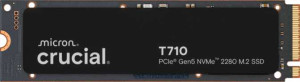
Crucial T710 1TB
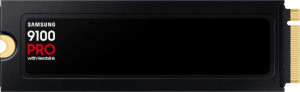
Samsung 9100 Pro 1TB

Crucial T710 1TB Samsung 9100 Pro 1TB

Overview

Welcome to our head-to-head comparison of the Crucial T710 1TB and the Samsung 9100 Pro 1TB, two high-performance PCIe 5.0 NVMe SSDs competing at the very top of the consumer storage market. Both drives share a strong common foundation, yet differ in key areas such as sequential throughput and random I/O performance. Read on to see how their specs stack up across every meaningful metric before you decide which one belongs in your build.

Common Features

  • Both use the M2 form factor.
  • Both feature a DRAM cache.
  • Both are NVMe SSDs.
  • Both support NVMe version 2.
  • Both have 1000GB of internal storage.
  • Both use TLC NAND flash storage.
  • Both use PCIe version 5.
  • Both have 8 controller channels.

Main Differences

  • Sequential read speed is 14900 MB/s on Crucial T710 1TB and 14700 MB/s on Samsung 9100 Pro 1TB.
  • Random read speed is 1800000 IOPS on Crucial T710 1TB and 1850000 IOPS on Samsung 9100 Pro 1TB.
  • Sequential write speed is 13700 MB/s on Crucial T710 1TB and 13300 MB/s on Samsung 9100 Pro 1TB.
  • Random write speed is 2200000 IOPS on Crucial T710 1TB and 2600000 IOPS on Samsung 9100 Pro 1TB.
  • The controller is Silicon Motion SM2508 on Crucial T710 1TB and Samsung Presto (S4LY027) on Samsung 9100 Pro 1TB.
Specs Comparison
Crucial T710 1TB

Crucial T710 1TB

Samsung 9100 Pro 1TB

Samsung 9100 Pro 1TB

Read speed:
sequential read speed 14900 MB/s 14700 MB/s
random read speed 1800000 IOPS 1850000 IOPS

In sequential read performance, the Crucial T710 holds a marginal lead at 14,900 MB/s versus 14,700 MB/s for the Samsung 9100 Pro — a gap of roughly 1.4%. At this tier of performance, sequential reads are relevant for large file transfers, video editing workflows, and OS imaging, but a difference this slim will be imperceptible in practice and will rarely, if ever, surface in real-world use.

The random read picture flips slightly: the 9100 Pro edges ahead with 1,850,000 IOPS compared to the T710's 1,800,000 IOPS — about a 2.8% advantage. Random IOPS matter far more for day-to-day responsiveness, including application launches, database queries, and multitasking under load. Even so, both drives operate at such extreme IOPS counts that neither figure represents a bottleneck in any consumer or prosumer scenario currently imaginable.

Overall, read performance between these two drives is effectively a dead heat. The T710 wins narrowly on sequential throughput; the 9100 Pro wins narrowly on random IOPS. Neither edge is large enough to be a deciding factor — users should look to other spec groups to differentiate these drives.

Write speed:
sequential write speed 13700 MB/s 13300 MB/s
random write speed 2200000 IOPS 2600000 IOPS

Sequential write speeds are close but favor the Crucial T710, which delivers 13,700 MB/s against the Samsung 9100 Pro's 13,300 MB/s — a ~3% lead. For workloads like writing large media files, cloning drives, or bulk data ingestion, this advantage is real but modest; in practice, neither drive will feel like a bottleneck at these speeds.

Where the comparison shifts decisively is random write IOPS. The 9100 Pro pulls significantly ahead with 2,600,000 IOPS versus the T710's 2,200,000 IOPS — an 18% gap that is meaningful in a way sequential figures rarely are. Random write performance governs how snappily a drive handles concurrent small writes: think compiling large codebases, running virtual machines, or heavy database write loads. An 18% edge here is large enough to translate into tangible responsiveness differences under sustained mixed workloads.

Write performance splits between the two drives depending on the workload. The T710 holds a slim sequential write lead, but the 9100 Pro claims a clear and practical advantage in random writes — and since random IOPS typically dictate real-world drive feel more than sequential throughput does, the 9100 Pro takes the edge in this group overall.

General info:
type M2 M2
SSD cache DRAM cache DRAM cache
Is an NVMe SSD
NVMe version 2 2
internal storage 1000GB 1000GB
release date May 2025 February 2025
controller Silicon Motion SM2508 Samsung Presto (S4LY027)
SSD storage type TLC TLC
PCI Express (PCIe) version 5 5
Controller channels 8 8
Terabytes Written (TBW) 600 600
MTBF 1.5million hours 1.5million hours
warranty period 5 years 5 years
Has an integrated heatsink
bits of encryption supported 256 256
has RGB lighting

At the platform level, these two drives are built on identical foundations: both are M.2 NVMe 2.0 SSDs running over PCIe 5.0 with DRAM cache, TLC NAND, and an 8-channel controller architecture. Shared specs like a 600 TBW endurance rating, 1.5 million hour MTBF, and a 5-year warranty mean long-term reliability expectations are exactly equal — neither drive has a durability or support advantage over the other.

The sole meaningful differentiator in this group is the controller. The Crucial T710 uses Silicon Motion's SM2508, a third-party silicon solution, while the Samsung 9100 Pro runs Samsung's in-house Presto (S4LY027) controller. Vertical integration — where the same manufacturer designs the controller, NAND, and firmware together — has historically allowed Samsung to optimize more aggressively across the full stack. Whether that translates into a real-world advantage is a question the performance spec groups answer more directly, but it is a relevant architectural distinction for buyers who weigh ecosystem cohesion.

On general specifications alone, this is essentially a tie. The platforms are mirror images of each other in every measurable reliability and compatibility dimension. The controller difference is the only factor worth noting, and its impact is reflected in the performance numbers rather than the general info specs themselves.

Comparison Summary & Verdict

Both the Crucial T710 1TB and the Samsung 9100 Pro 1TB are elite PCIe 5.0 NVMe drives that share the same form factor, TLC NAND flash, DRAM cache, and NVMe 2.0 standard, making either a formidable choice. The key differentiator lies in their performance profiles: the Crucial T710 1TB edges ahead in sequential read and write speeds (14,900 MB/s and 13,700 MB/s respectively), making it ideal for workloads that move large files rapidly, such as video editing or game loading. The Samsung 9100 Pro 1TB, powered by the Samsung Presto controller, counters with superior random write IOPS at 2,600,000 versus 2,200,000, giving it an advantage in demanding multitasking, database, and OS-intensive scenarios. Choose based on whether your workload favors raw throughput or deep random I/O responsiveness.

Crucial T710 1TB
Buy Crucial T710 1TB if...

Buy the Crucial T710 1TB if you prioritize the highest sequential read and write speeds for large file transfers and content creation workflows.

Samsung 9100 Pro 1TB
Buy Samsung 9100 Pro 1TB if...

Buy the Samsung 9100 Pro 1TB if your workload demands superior random write performance, making it the stronger pick for intensive multitasking and system-heavy tasks.