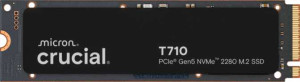
Crucial T710 1TB
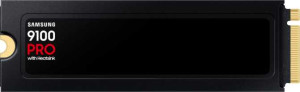
Samsung 9100 Pro 8TB

Crucial T710 1TB Samsung 9100 Pro 8TB

Overview

Welcome to our in-depth comparison of the Crucial T710 1TB and the Samsung 9100 Pro 8TB, two high-performance PCIe 5.0 NVMe SSDs that share a strong common foundation yet diverge in meaningful ways. Both drives bring DRAM caching, TLC NAND, and NVMe 2.0 to the table, but the real story lies in their storage capacity, random I/O performance, and endurance ratings. Read on to see how these two drives stack up across every key specification.

Common Features

  • Both use the M.2 form factor.
  • Both feature a DRAM cache.
  • Both are NVMe SSDs.
  • Both support NVMe version 2.
  • Both use TLC NAND flash storage.
  • Both use PCIe version 5.
  • Both have 8 controller channels.
  • Both have an MTBF rating of 1.5 million hours.

Main Differences

  • Sequential read speed is 14900 MB/s on Crucial T710 1TB and 14800 MB/s on Samsung 9100 Pro 8TB.
  • Random read speed is 1800000 IOPS on Crucial T710 1TB and 2200000 IOPS on Samsung 9100 Pro 8TB.
  • Sequential write speed is 13700 MB/s on Crucial T710 1TB and 13400 MB/s on Samsung 9100 Pro 8TB.
  • Random write speed is 2200000 IOPS on Crucial T710 1TB and 2600000 IOPS on Samsung 9100 Pro 8TB.
  • Internal storage capacity is 1000 GB on Crucial T710 1TB and 8000 GB on Samsung 9100 Pro 8TB.
  • The controller is Silicon Motion SM2508 on Crucial T710 1TB and Samsung Presto (S4LY027) on Samsung 9100 Pro 8TB.
  • Terabytes Written (TBW) endurance is 600 TBW on Crucial T710 1TB and 4800 TBW on Samsung 9100 Pro 8TB.
Specs Comparison
Crucial T710 1TB

Crucial T710 1TB

Samsung 9100 Pro 8TB

Samsung 9100 Pro 8TB

Read speed:
sequential read speed 14900 MB/s 14800 MB/s
random read speed 1800000 IOPS 2200000 IOPS

In sequential read performance, the two drives are virtually identical: the Crucial T710 1TB edges ahead at 14900 MB/s versus the Samsung 9100 Pro 8TB at 14800 MB/s. A 100 MB/s gap at this tier is negligible in practice — both drives will saturate a PCIe 5.0 interface and deliver near-indistinguishable transfer times when moving large files like videos or disk images.

The more meaningful differentiator is random read performance, where the Samsung 9100 Pro 8TB holds a clear advantage at 2,200,000 IOPS versus the Crucial T710 1TB's 1,800,000 IOPS — a roughly 22% lead. Random IOPS directly impacts responsiveness under real-world mixed workloads: loading operating systems, launching applications, handling database queries, or running virtual machines. This gap is large enough to be felt in demanding, latency-sensitive environments.

Overall, the Samsung 9100 Pro 8TB holds the edge in this group. While sequential reads are a near-tie, its commanding lead in random read IOPS makes it the stronger performer for workloads that matter most in everyday and professional use. The Crucial T710 1TB offers no meaningful read-speed advantage to offset this difference.

Write speed:
sequential write speed 13700 MB/s 13400 MB/s
random write speed 2200000 IOPS 2600000 IOPS

Sequential write speeds tell a similar story to reads: both drives operate at the same stratospheric tier, with the Crucial T710 1TB at 13700 MB/s and the Samsung 9100 Pro 8TB at 13400 MB/s. A 300 MB/s difference here is statistically insignificant — when ingesting large media files or writing multi-gigabyte backups, users will not perceive any difference between the two.

Random write IOPS, however, reveal a more consequential gap. The Samsung 9100 Pro 8TB pulls ahead at 2,600,000 IOPS compared to the Crucial T710 1TB's 2,200,000 IOPS — an 18% advantage. In write-heavy scenarios such as logging, transactional databases, or compiling large codebases, higher random write IOPS translate to reduced latency and better sustained throughput under queue depth pressure. This is the kind of metric that distinguishes enterprise-grade endurance from consumer-tier performance.

The Samsung 9100 Pro 8TB takes the edge in write performance for the same reason it leads in reads: its random IOPS advantage is substantial enough to matter in real workloads, while the sequential write gap favoring the T710 is too slim to be practically relevant. For write-intensive use cases, the 9100 Pro is the stronger choice based on these specs alone.

General info:
type M2 M2
SSD cache DRAM cache DRAM cache
Is an NVMe SSD
NVMe version 2 2
internal storage 1000GB 8000GB
release date May 2025 February 2025
controller Silicon Motion SM2508 Samsung Presto (S4LY027)
SSD storage type TLC TLC
PCI Express (PCIe) version 5 5
Controller channels 8 8
Terabytes Written (TBW) 600 4800
MTBF 1.5million hours 1.5million hours
warranty period 5 years 5 years
Has an integrated heatsink
bits of encryption supported 256 256
has RGB lighting

At the architectural level, these two drives share a remarkably similar foundation: both are M.2 NVMe SSDs built on PCIe 5.0 with NVMe 2.0, DRAM cache, TLC NAND, and an 8-channel controller. This common platform explains why their peak performance figures are so close — they are fundamentally similar designs targeting the same interface ceiling.

The most significant divergence is capacity and, consequently, endurance. The Samsung 9100 Pro 8TB offers eight times the storage of the Crucial T710 1TB, and its TBW rating of 4800 dwarfs the T710's 600 TBW — an 8x difference that directly reflects the greater NAND volume available to distribute write wear. For archival workloads, NAS deployments, or any environment with sustained write pressure, the 9100 Pro's endurance headroom is a decisive practical advantage. The controller choice also differs — Crucial uses the Silicon Motion SM2508 while Samsung deploys its in-house Presto controller — though both achieve comparable channel counts and throughput, making this a distinction in manufacturing philosophy rather than a clear performance separator.

Where reliability and warranty are concerned, the drives are evenly matched: identical 1.5 million hour MTBF, 5-year warranties, and 256-bit encryption support. The Samsung 9100 Pro 8TB holds the clear edge in this group purely on capacity and longevity — the T710 1TB is a compelling option only where storage density is not a priority.
Comparison Summary & Verdict

After examining every specification, it is clear that both drives are built on a near-identical technological foundation — PCIe 5.0, NVMe 2.0, DRAM cache, TLC NAND, and a shared 1.5 million hour MTBF. Where they diverge is in scale and endurance. The Crucial T710 1TB edges ahead in sequential speeds and offers a compact, cost-efficient entry point into PCIe 5.0 storage. The Samsung 9100 Pro 8TB, however, dominates in random read and write IOPS, delivers a massive 8TB capacity, and backs heavy workloads with a 4800 TBW endurance rating — eight times that of its rival. The T710 1TB suits everyday power users and gamers, while the 9100 Pro 8TB is purpose-built for professionals and workstations demanding vast, high-endurance storage.

Crucial T710 1TB
Buy Crucial T710 1TB if...

Buy the Crucial T710 1TB if you want a fast PCIe 5.0 NVMe SSD with leading sequential read and write speeds in a lower-capacity, more accessible package.

Samsung 9100 Pro 8TB
Buy Samsung 9100 Pro 8TB if...

Buy the Samsung 9100 Pro 8TB if you need massive 8TB storage, superior random read and write IOPS, and a significantly higher 4800 TBW endurance rating for demanding workloads.