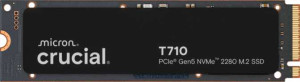
Crucial T710 1TB
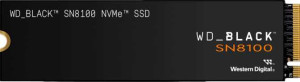
Western Digital WD Black SN8100 1TB

Crucial T710 1TB Western Digital WD Black SN8100 1TB

Overview

Welcome to this in-depth specification comparison between the Crucial T710 1TB and the Western Digital WD Black SN8100 1TB. Both drives share a strong common foundation — PCIe 5.0, NVMe 2.0, TLC NAND, a DRAM cache, and the Silicon Motion SM2508 controller — making this a closely matched contest. The real battlegrounds lie in sequential and random write performance, random read speeds, and long-term reliability ratings, where each drive carves out its own distinct advantage.

Common Features

  • Both drives share the same sequential read speed of 14900 MB/s.
  • Both use the M.2 form factor.
  • Both include a DRAM cache.
  • Both are NVMe SSDs.
  • Both support NVMe version 2.
  • Both offer 1000GB of internal storage.
  • Both use the Silicon Motion SM2508 controller.
  • Both use TLC NAND flash storage.
  • Both use PCIe version 5.

Main Differences

  • Random read speed is 1800000 IOPS on Crucial T710 1TB and 1600000 IOPS on Western Digital WD Black SN8100 1TB.
  • Sequential write speed is 13700 MB/s on Crucial T710 1TB and 11000 MB/s on Western Digital WD Black SN8100 1TB.
  • Random write speed is 2200000 IOPS on Crucial T710 1TB and 2400000 IOPS on Western Digital WD Black SN8100 1TB.
  • MTBF is 1.5 million hours on Crucial T710 1TB and 1.8 million hours on Western Digital WD Black SN8100 1TB.
Specs Comparison
Crucial T710 1TB

Crucial T710 1TB

Western Digital WD Black SN8100 1TB

Western Digital WD Black SN8100 1TB

Read speed:
sequential read speed 14900 MB/s 14900 MB/s
random read speed 1800000 IOPS 1600000 IOPS

When it comes to sequential read performance, both drives are perfectly matched at 14900 MB/s — a ceiling that reflects the current limits of the PCIe Gen 5 interface. For large file transfers like moving video projects or game assets, users will see no practical difference between the two.

The real differentiator emerges in random read speed, which matters far more for everyday workloads like OS boot times, application launches, and database queries. Here, the Crucial T710 pulls ahead with 1,800,000 IOPS versus 1,600,000 IOPS for the WD Black SN8100 — a gap of 200,000 IOPS, or roughly 12.5%. In latency-sensitive tasks involving many small, scattered file reads, this advantage can translate into measurably snappier system responsiveness.

Overall, the Crucial T710 holds a clear edge in this group. While sequential performance is a dead heat, its superior random read throughput gives it a meaningful advantage in the mixed, real-world workloads that most users actually experience day to day.

Write speed:
sequential write speed 13700 MB/s 11000 MB/s
random write speed 2200000 IOPS 2400000 IOPS

Sequential write speed is where the Crucial T710 asserts a commanding lead: 13,700 MB/s versus 11,000 MB/s for the WD Black SN8100 — a gap of nearly 25%. For sustained, large-block writes such as capturing high-bitrate video, transferring large backups, or compiling massive codebases, the T710 will consistently finish the job faster.

The tables turn on random write performance, where the SN8100 edges ahead at 2,400,000 IOPS compared to the T710's 2,200,000 IOPS — roughly a 9% advantage. Random writes drive real-world tasks like saving documents, writing database transactions, and handling OS-level operations, so the SN8100's lead here is not purely academic. That said, the margin is relatively modest and unlikely to be perceptible in most consumer workloads.

Taken together, this group is split: the T710 wins convincingly on sequential writes, while the SN8100 has a slight but real advantage in random writes. Users who frequently push large files — video editors, content creators, or power users doing bulk data transfers — will benefit more from the T710's sequential headroom. For general-purpose, mixed-use workloads with lots of small writes, the SN8100's random write edge gives it a marginal advantage. Neither drive has an outright win, but the T710's sequential lead covers a wider range of demanding use cases.

General info:
type M2 M2
SSD cache DRAM cache DRAM cache
Is an NVMe SSD
NVMe version 2 2
internal storage 1000GB 1000GB
release date May 2025 May 2025
controller Silicon Motion SM2508 Silicon Motion SM2508
SSD storage type TLC TLC
PCI Express (PCIe) version 5 5
Controller channels 8 8
Terabytes Written (TBW) 600 600
MTBF 1.5million hours 1.8million hours
warranty period 5 years 5 years
Has an integrated heatsink
has RGB lighting

At the platform level, these two drives are virtually identical twins. Both are M.2 NVMe SSDs built on PCIe Gen 5, running NVMe 2.0, equipped with DRAM cache, and using the exact same Silicon Motion SM2508 controller with 8 channels. Even the NAND type (TLC) and endurance rating (600 TBW) match perfectly. For buyers, this means both drives are built on the same fundamental architecture and will behave similarly under the same workloads.

The only meaningful differentiator in this group is reliability as expressed by MTBF: the WD Black SN8100 is rated at 1.8 million hours versus 1.5 million hours for the Crucial T710 — a 20% higher figure. MTBF is a statistical estimate of average time between failures across a large population of drives, not a guarantee for any individual unit, but a higher rating does signal that WD is specifying its drive for a longer operational lifespan under sustained use. Both carry a matching 5-year warranty, so real-world coverage is equal.

On general specifications, the WD Black SN8100 holds a narrow edge purely on account of its higher MTBF rating, which may matter to users running the drive in always-on or high-write-cycle environments. For most consumers, however, the shared architecture, identical endurance, and equal warranty make this group essentially a tie in practical terms.

Comparison Summary & Verdict

After examining the full specification set, both the Crucial T710 1TB and the Western Digital WD Black SN8100 1TB are elite PCIe 5.0 NVMe drives that share the same platform, yet differ in meaningful ways. The Crucial T710 1TB leads in sequential write speed at 13700 MB/s and random read speed at 1800000 IOPS, making it the stronger choice for workloads that demand sustained large-file transfers and rapid data retrieval. The WD Black SN8100 1TB, on the other hand, edges ahead with a higher random write speed of 2400000 IOPS and a superior MTBF of 1.8 million hours, giving it an advantage in write-intensive tasks and long-term durability. Choose based on your primary workload and reliability expectations.

Crucial T710 1TB
Buy Crucial T710 1TB if...

Buy the Crucial T710 1TB if you prioritize faster sequential write speeds and higher random read performance for large-file transfers and data-heavy workloads.

Western Digital WD Black SN8100 1TB
Buy Western Digital WD Black SN8100 1TB if...

Buy the Western Digital WD Black SN8100 1TB if you need superior random write performance and a higher MTBF rating for write-intensive tasks and long-term reliability.