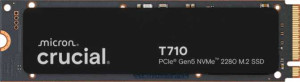
Crucial T710 2TB
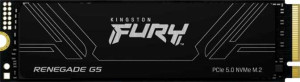
Kingston Fury Renegade G5 2TB

Crucial T710 2TB Kingston Fury Renegade G5 2TB

Overview

Welcome to our in-depth spec comparison between the Crucial T710 2TB and the Kingston Fury Renegade G5 2TB. Both drives share a strong common foundation — PCIe 5.0, NVMe 2, a Silicon Motion SM2508 controller, and TLC NAND — making this a closely contested match. The key battlegrounds come down to peak sequential throughput, endurance ratings, and long-term reliability, where subtle but meaningful differences emerge between these two flagship-tier M.2 SSDs.

Common Features

  • Both drives use the M.2 form factor.
  • Both drives include a DRAM cache.
  • Both drives are NVMe SSDs.
  • Both drives use NVMe version 2.
  • Both drives offer 2000GB of internal storage.
  • Both drives are powered by the Silicon Motion SM2508 controller.
  • Both drives use TLC NAND flash storage.
  • Both drives connect via PCIe version 5.
  • Both drives achieve a random read speed of 2,200,000 IOPS.

Main Differences

  • Sequential read speed is 14,500 MB/s on Crucial T710 2TB and 14,700 MB/s on Kingston Fury Renegade G5 2TB.
  • Sequential write speed is 13,800 MB/s on Crucial T710 2TB and 14,000 MB/s on Kingston Fury Renegade G5 2TB.
  • Random write speed is 2,300,000 IOPS on Crucial T710 2TB and 2,200,000 IOPS on Kingston Fury Renegade G5 2TB.
  • Terabytes Written (TBW) endurance rating is 1,200 TBW on Crucial T710 2TB and 2,000 TBW on Kingston Fury Renegade G5 2TB.
  • MTBF is 1.5 million hours on Crucial T710 2TB and 2 million hours on Kingston Fury Renegade G5 2TB.
Specs Comparison
Crucial T710 2TB

Crucial T710 2TB

Kingston Fury Renegade G5 2TB

Kingston Fury Renegade G5 2TB

Read speed:
sequential read speed 14500 MB/s 14700 MB/s
random read speed 2200000 IOPS 2200000 IOPS

In read speed performance, the Crucial T710 2TB and Kingston Fury Renegade G5 2TB are remarkably close across both sequential and random workloads. Sequential read speeds sit at 14,500 MB/s and 14,700 MB/s respectively — a gap of just 200 MB/s, which represents roughly a 1.4% difference. At these extreme throughput levels, that margin is effectively imperceptible in real-world usage, whether you're transferring large video files, loading game assets, or running OS-intensive tasks.

Where the two drives converge completely is random read performance: both deliver an identical 2,200,000 IOPS. Random IOPS is often more impactful than sequential speed for everyday workloads — it governs how quickly a drive handles the small, scattered read requests typical of application launches, database queries, and multitasking. A tie here means neither drive has a practical edge in the use cases most users encounter daily.

Overall, read speed is essentially a dead heat. The Kingston Fury Renegade G5 holds a marginal sequential lead on paper, but the difference is too small to manifest in any measurable real-world scenario. Users should treat these two drives as equivalent in this category and base their decision on other spec groups.

Write speed:
sequential write speed 13800 MB/s 14000 MB/s
random write speed 2300000 IOPS 2200000 IOPS

Write speed is where an interesting split emerges between these two drives. Sequentially, the Kingston Fury Renegade G5 edges ahead at 14,000 MB/s versus the Crucial T710's 13,800 MB/s — a 200 MB/s gap that, much like the read comparison, is negligible for most sustained transfer workloads such as writing large media files or disk imaging.

The more meaningful differentiator here is random write IOPS. The T710 actually flips the script, delivering 2,300,000 IOPS versus the Renegade G5's 2,200,000 IOPS — a 100,000 IOPS advantage. Random write performance is critical for write-intensive workloads like database transactions, virtual machine storage, and compiling large codebases, where the drive constantly handles bursts of small, non-sequential write operations. A 4.5% edge in this metric is modest but real.

On balance, write speed is a split decision: the Renegade G5 leads on sequential throughput while the T710 counters with higher random write IOPS. For users doing bulk file transfers, the difference is academic. For those running write-heavy professional workloads where random IOPS matter, the T710 holds a slight but tangible functional advantage.

General info:
type M2 M2
SSD cache DRAM cache DRAM cache
Is an NVMe SSD
NVMe version 2 2
internal storage 2000GB 2000GB
release date May 2025 April 2025
controller Silicon Motion SM2508 Silicon Motion SM2508
SSD storage type TLC TLC
PCI Express (PCIe) version 5 5
Controller channels 8 8
Terabytes Written (TBW) 1200 2000
MTBF 1.5million hours 2million hours
warranty period 5 years 5 years
Has an integrated heatsink
has RGB lighting

At the architectural level, these two drives are virtually identical twins: same M.2 form factor, PCIe 5.0 interface, NVMe 2.0 protocol, TLC NAND, DRAM cache, and — notably — the exact same Silicon Motion SM2508 controller driving the same 8 channels. Sharing a controller means both drives operate on the same fundamental processing foundation, which largely explains their near-identical performance figures seen in other spec categories.

Where the drives diverge meaningfully is in long-term endurance. The Kingston Fury Renegade G5 is rated for 2,000 TBW versus the Crucial T710's 1,200 TBW — a 67% higher write endurance rating. Paired with an MTBF of 2 million hours compared to the T710's 1.5 million hours, the Renegade G5 is positioned as the more durable option on paper. For most consumer users, 1,200 TBW over a 5-year warranty is still more than sufficient, but for NAS deployments, content creation workflows with constant rewrites, or any write-intensive professional use, the Renegade G5's headroom is a genuine advantage.

The 5-year warranty is identical on both, so the durability edge of the Renegade G5 is not reflected in official coverage terms — it's purely a spec-level distinction. Still, on general info as a whole, the Kingston Fury Renegade G5 holds a clear edge for endurance-focused buyers, while the T710 remains competitive for everyday and prosumer use where the TBW ceiling is unlikely to be reached.
Comparison Summary & Verdict

After a thorough look at the specs, both drives are undeniably top-tier PCIe 5.0 performers, but they cater to slightly different priorities. The Crucial T710 2TB edges ahead in random write speed at 2,300,000 IOPS, making it a compelling pick for workloads that hammer the drive with small random writes. However, the Kingston Fury Renegade G5 2TB pulls ahead in every other differentiating metric: higher sequential read and write speeds, a significantly larger TBW endurance rating of 2,000 TBW versus 1,200 TBW, and a stronger MTBF of 2 million hours compared to 1.5 million. For users who prioritize longevity, sustained workloads, and long-term reliability, the Kingston is the safer investment.

Crucial T710 2TB
Buy Crucial T710 2TB if...

Buy the Crucial T710 2TB if you prioritize higher random write performance and are looking for a slightly more affordable PCIe 5.0 drive that still delivers flagship-level speeds.

Kingston Fury Renegade G5 2TB
Buy Kingston Fury Renegade G5 2TB if...

Buy the Kingston Fury Renegade G5 2TB if long-term endurance and reliability matter most to you, as it offers a higher TBW rating of 2,000, a longer MTBF, and marginally faster sequential read and write speeds.