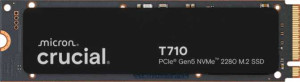
Crucial T710 2TB
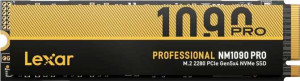
Lexar NM1090 Pro 1TB

Crucial T710 2TB Lexar NM1090 Pro 1TB

Overview

Welcome to our in-depth specification comparison between the Crucial T710 2TB and the Lexar NM1090 Pro 1TB. Both drives share a strong common foundation — the same M2 form factor, PCIe 5.0 interface, Silicon Motion SM2508 controller, and NVMe 2.0 standard — making this a closely matched battle. The key battlegrounds in this comparison are sequential and random read/write speeds, storage capacity, and long-term endurance ratings, where meaningful gaps between the two drives begin to emerge.

Common Features

  • Both products use the M2 form factor.
  • Both products include a DRAM cache.
  • Both products are NVMe SSDs.
  • Both products support NVMe version 2.
  • Both products use the Silicon Motion SM2508 controller.
  • Both products use TLC SSD storage type.
  • Both products use PCIe version 5.
  • Both products have 8 controller channels.

Main Differences

  • Sequential read speed is 14500 MB/s on Crucial T710 2TB and 14000 MB/s on Lexar NM1090 Pro 1TB.
  • Random read speed is 2200000 IOPS on Crucial T710 2TB and 1650000 IOPS on Lexar NM1090 Pro 1TB.
  • Sequential write speed is 13800 MB/s on Crucial T710 2TB and 10000 MB/s on Lexar NM1090 Pro 1TB.
  • Random write speed is 2300000 IOPS on Crucial T710 2TB and 1800000 IOPS on Lexar NM1090 Pro 1TB.
  • Internal storage capacity is 2000GB on Crucial T710 2TB and 1000GB on Lexar NM1090 Pro 1TB.
  • Terabytes Written (TBW) is 1200 on Crucial T710 2TB and 700 on Lexar NM1090 Pro 1TB.
Specs Comparison
Crucial T710 2TB

Crucial T710 2TB

Lexar NM1090 Pro 1TB

Lexar NM1090 Pro 1TB

Read speed:
sequential read speed 14500 MB/s 14000 MB/s
random read speed 2200000 IOPS 1650000 IOPS

Both drives occupy the upper echelon of consumer NVMe performance, but the Crucial T710 2TB holds a measurable edge across both read metrics. Its sequential read speed of 14500 MB/s edges out the Lexar NM1090 Pro's 14000 MB/s — a 3.6% gap that, in practice, translates to marginally faster large-file transfers such as loading game assets, moving high-resolution video projects, or decompressing archives.

The more meaningful differentiator is random read performance. The T710's 2,200,000 IOPS versus the NM1090 Pro's 1,650,000 IOPS represents a roughly 33% advantage — and random IOPS is the metric that governs real-world responsiveness: OS boot times, application launches, database queries, and multitasking under load. In day-to-day use, a gap of this magnitude is far more perceptible than a few hundred MB/s of sequential throughput.

The Crucial T710 2TB holds a clear advantage in this category. While the NM1090 Pro is by no means slow, the T710 outperforms it on both fronts, with the random read lead being the more impactful of the two differences for most workloads.

Write speed:
sequential write speed 13800 MB/s 10000 MB/s
random write speed 2300000 IOPS 1800000 IOPS

Write performance is where the gap between these two drives widens considerably. The Crucial T710 2TB achieves a sequential write speed of 13800 MB/s, compared to 10000 MB/s for the Lexar NM1090 Pro 1TB — a 38% advantage that becomes tangible during sustained write-heavy operations like ingesting large RAW photo libraries, writing 4K/8K video captures directly to the drive, or cloning disk images.

On the random write side, the T710 again leads with 2,300,000 IOPS versus the NM1090 Pro's 1,800,000 IOPS — a 28% difference. Random write IOPS governs how well a drive handles fragmented, simultaneous write requests, which matters during tasks like compiling large codebases, running virtual machines, or operating under mixed read/write workloads typical of content creation pipelines. A lead of this size is unlikely to be hidden by the OS or controller buffering under sustained pressure.

Across both write metrics, the Crucial T710 2TB holds a decisive advantage. The sequential gap is particularly striking and makes the T710 the stronger choice for throughput-intensive workflows, while its random write lead reinforces its edge in complex, real-world mixed workloads.

General info:
type M2 M2
SSD cache DRAM cache DRAM cache
Is an NVMe SSD
NVMe version 2 2
internal storage 2000GB 1000GB
release date May 2025 April 2025
controller Silicon Motion SM2508 Silicon Motion SM2508
SSD storage type TLC TLC
PCI Express (PCIe) version 5 5
Controller channels 8 8
Terabytes Written (TBW) 1200 700
MTBF 1.5million hours 1.5million hours
warranty period 5 years 5 years
Has an integrated heatsink
has RGB lighting

At the architectural level, these two drives are remarkably similar — both use the Silicon Motion SM2508 controller with 8 channels, PCIe 5.0 interface, NVMe 2.0 protocol, TLC NAND, and a DRAM cache. This shared foundation explains much of their comparable performance profiles and means neither holds a structural advantage in terms of platform compatibility or low-level design.

Where they diverge meaningfully is capacity and endurance. The Crucial T710 offers 2TB of storage versus 1TB on the NM1090 Pro — straightforwardly double the space for larger game libraries, media collections, or professional project storage. More telling is the TBW rating: 1200 TBW on the T710 versus 700 TBW on the NM1090 Pro. TBW (Terabytes Written) is the manufacturer's rated lifespan for write endurance; the T710's higher figure reflects both its larger NAND pool and a longer projected working life under heavy write loads, which matters for users who frequently write and overwrite large datasets.

Reliability metrics — a 1.5 million hour MTBF and a 5-year warranty — are identical, so neither drive has an edge on paper support or rated reliability. Overall, the Crucial T710 2TB holds the advantage in this category purely on capacity and endurance; the NM1090 Pro is its technical twin in almost every other regard, making it the logical choice only where 1TB suffices and a lower price point is the deciding factor.

Comparison Summary & Verdict

After examining all available specifications, both drives prove to be high-performance NVMe SSDs built on the same core platform, sharing TLC storage, DRAM cache, and a PCIe 5.0 interface. However, the Crucial T710 2TB consistently pulls ahead in raw performance, posting higher sequential read (14500 MB/s) and write (13800 MB/s) speeds, along with superior random IOPS figures. It also doubles the storage capacity and offers a notably higher TBW endurance rating of 1200, making it the better fit for power users, content creators, or professionals demanding maximum throughput and long-term reliability. The Lexar NM1090 Pro 1TB, while slightly behind on peak speeds and endurance, still delivers competitive performance and may appeal to users who need a capable PCIe 5.0 drive at a potentially lower cost or in a smaller capacity footprint.

Crucial T710 2TB
Buy Crucial T710 2TB if...

Buy the Crucial T710 2TB if you need maximum sequential and random read/write performance, larger storage capacity, and higher long-term endurance for demanding workloads.

Lexar NM1090 Pro 1TB
Buy Lexar NM1090 Pro 1TB if...

Buy the Lexar NM1090 Pro 1TB if a 1TB capacity meets your needs and you are looking for a competitive PCIe 5.0 NVMe drive with solid performance at a potentially more accessible price point.