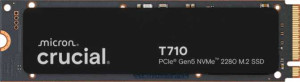
Crucial T710 2TB
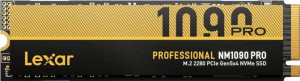
Lexar NM1090 Pro 4TB

Crucial T710 2TB Lexar NM1090 Pro 4TB

Overview

Welcome to our in-depth spec comparison between the Crucial T710 2TB and the Lexar NM1090 Pro 4TB, two high-performance PCIe 5.0 NVMe SSDs sharing a remarkable amount of DNA under the hood. Both drives run on the same Silicon Motion SM2508 controller, use TLC NAND with a DRAM cache, and target the absolute top tier of consumer storage speed. Yet key differences in sequential and random write performance, storage capacity, and endurance ratings mean one may suit your needs better than the other.

Common Features

  • Both products use the M2 form factor.
  • Both products feature a DRAM cache.
  • Both products are NVMe SSDs.
  • Both products use NVMe version 2.
  • Both products are powered by the Silicon Motion SM2508 controller.
  • Both products use TLC NAND storage.
  • Both products use PCIe version 5.
  • Both products have a controller with 8 channels.

Main Differences

  • Sequential read speed is 14500 MB/s on Crucial T710 2TB and 14000 MB/s on Lexar NM1090 Pro 4TB.
  • Random read speed is 2200000 IOPS on Crucial T710 2TB and 2100000 IOPS on Lexar NM1090 Pro 4TB.
  • Sequential write speed is 13800 MB/s on Crucial T710 2TB and 13000 MB/s on Lexar NM1090 Pro 4TB.
  • Random write speed is 2300000 IOPS on Crucial T710 2TB and 1700000 IOPS on Lexar NM1090 Pro 4TB.
  • Internal storage capacity is 2000GB on Crucial T710 2TB and 4000GB on Lexar NM1090 Pro 4TB.
  • Terabytes Written (TBW) endurance rating is 1200 TBW on Crucial T710 2TB and 2800 TBW on Lexar NM1090 Pro 4TB.
Specs Comparison
Crucial T710 2TB

Crucial T710 2TB

Lexar NM1090 Pro 4TB

Lexar NM1090 Pro 4TB

Read speed:
sequential read speed 14500 MB/s 14000 MB/s
random read speed 2200000 IOPS 2100000 IOPS

Both drives operate at the absolute frontier of consumer NVMe performance, but the Crucial T710 2TB holds a measurable edge in read speed across both key metrics. Its sequential read reaches 14500 MB/s versus 14000 MB/s for the Lexar NM1090 Pro 4TB — a 500 MB/s gap that, while modest in percentage terms, places the T710 slightly ahead for large sequential workloads like transferring massive video files or game installations.

On the random read side, the T710 again leads with 2200000 IOPS compared to 2100000 IOPS for the NM1090 Pro — a 100K IOPS difference. Random read performance is arguably more impactful in day-to-day use, governing how fast an OS boots, applications launch, or databases query scattered data. That said, at this tier of IOPS, the real-world perceptible difference for most users will be negligible, as both figures far exceed what typical desktop workloads can saturate.

The Crucial T710 takes a narrow but consistent edge across all provided read metrics. For users engaged in professional content pipelines or heavy multitasking where theoretical peaks matter, it is the stronger choice on paper. For the vast majority of users, both drives will feel effectively identical in practice — the read performance gap here is more meaningful as a spec-sheet advantage than a tangible daily-use differentiator.

Write speed:
sequential write speed 13800 MB/s 13000 MB/s
random write speed 2300000 IOPS 1700000 IOPS

Write performance is where the gap between these two drives becomes genuinely significant. The Crucial T710 2TB achieves 13800 MB/s sequential write versus 13000 MB/s for the Lexar NM1090 Pro 4TB — an 800 MB/s difference that is more pronounced than the read-side delta. For workflows involving sustained large writes, such as capturing high-bitrate RAW video, backing up large datasets, or writing out rendered project files, this gap translates into measurably faster completion times.

More telling, however, is the random write disparity. The T710 delivers 2300000 IOPS against the NM1090 Pro's 1700000 IOPS — a difference of 600K IOPS, or roughly 35% more throughput. Random write performance governs how efficiently a drive handles fragmented, bursty operations: think virtual machine disk activity, database transactions, or compiling large codebases. At this magnitude of difference, real-world impact is far less abstract than the negligible read IOPS gap; workloads that hammer the drive with small, scattered writes will notice the T710 pulling ahead meaningfully.

Across both sequential and random write metrics, the Crucial T710 holds a clear and unambiguous advantage. The random write lead in particular is substantial enough to matter beyond benchmarks, making the T710 the stronger pick for write-intensive professional use cases.

General info:
type M2 M2
SSD cache DRAM cache DRAM cache
Is an NVMe SSD
NVMe version 2 2
internal storage 2000GB 4000GB
release date May 2025 April 2025
controller Silicon Motion SM2508 Silicon Motion SM2508
SSD storage type TLC TLC
PCI Express (PCIe) version 5 5
Controller channels 8 8
Terabytes Written (TBW) 1200 2800
MTBF 1.5million hours 1.5million hours
warranty period 5 years 5 years
Has an integrated heatsink
has RGB lighting

At their core, these two drives share an identical architectural foundation: same M.2 PCIe 5.0 interface, same Silicon Motion SM2508 controller with 8 channels, same NVMe 2.0 protocol, same TLC NAND with DRAM cache, and identical reliability ratings of 1.5 million hours MTBF with a 5-year warranty. For a buyer evaluating platform fundamentals, these two drives are essentially twins — the performance differences seen in read and write metrics stem from tuning and capacity, not architectural divergence.

The two meaningful differentiators in this group are raw capacity and endurance. The Lexar NM1090 Pro offers 4TB of storage versus 2TB on the Crucial T710 — a straightforward doubling that makes the Lexar the clear choice for users with large media libraries, game collections, or archival needs. Directly tied to this, the NM1090 Pro carries a 2800 TBW endurance rating against the T710's 1200 TBW. TBW reflects how much data can be written to the drive over its lifetime before wear becomes a concern; the Lexar's significantly higher figure is partly a natural consequence of its larger NAND pool, but it also signals meaningfully greater longevity for write-heavy workloads like video editing or server-adjacent tasks.

On general specifications, the Lexar NM1090 Pro 4TB holds the advantage — not through superior technology, but through greater capacity and substantially higher endurance. Users who need the extra space or push high write volumes over time will find the NM1090 Pro the more practical long-term investment in this category.

Comparison Summary & Verdict

After examining all available specifications, both drives are elite performers built on an identical platform, but they serve subtly different priorities. The Crucial T710 2TB edges ahead in every speed metric, offering faster sequential write speeds of 13800 MB/s and a notably higher random write rate of 2300000 IOPS, making it the sharper choice for workloads where sustained peak throughput is paramount. The Lexar NM1090 Pro 4TB, meanwhile, doubles the storage capacity and nearly triples the TBW endurance rating at 2800 TBW, making it the stronger long-term investment for users who need to store large libraries of data and write heavily to the drive over years of use. Neither drive is a wrong choice; the decision comes down to whether raw speed or capacity and longevity matter most to you.

Crucial T710 2TB
Buy Crucial T710 2TB if...

Buy the Crucial T710 2TB if you want the fastest possible sequential and random write performance and do not need more than 2TB of storage capacity.

Lexar NM1090 Pro 4TB
Buy Lexar NM1090 Pro 4TB if...

Buy the Lexar NM1090 Pro 4TB if you need double the storage capacity and a significantly higher endurance rating of 2800 TBW for heavy, long-term workloads.