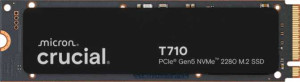
Crucial T710 2TB
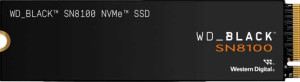
Western Digital WD Black SN8100 2TB

Crucial T710 2TB Western Digital WD Black SN8100 2TB

Overview

Welcome to our in-depth specification comparison between the Crucial T710 2TB and the Western Digital WD Black SN8100 2TB. Both drives share a strong common foundation — PCIe 5.0, NVMe 2.0, TLC NAND, a DRAM cache, and the Silicon Motion SM2508 controller — making this a close, nuanced battle. The key battlegrounds come down to peak sequential and random read speeds and long-term reliability ratings, where subtle but meaningful differences emerge between these two high-performance M.2 SSDs.

Common Features

  • Both drives use the M.2 form factor.
  • Both drives feature a DRAM cache.
  • Both drives are NVMe SSDs.
  • Both drives use NVMe version 2.
  • Both drives offer 2000GB of internal storage.
  • Both drives use the Silicon Motion SM2508 controller.
  • Both drives use TLC NAND flash storage.
  • Both drives use PCIe version 5.
  • Both drives achieve a random write speed of 2300000 IOPS.

Main Differences

  • Sequential read speed is 14500 MB/s on Crucial T710 2TB and 14900 MB/s on Western Digital WD Black SN8100 2TB.
  • Random read speed is 2200000 IOPS on Crucial T710 2TB and 2300000 IOPS on Western Digital WD Black SN8100 2TB.
  • Sequential write speed is 13800 MB/s on Crucial T710 2TB and 14000 MB/s on Western Digital WD Black SN8100 2TB.
  • MTBF is 1.5 million hours on Crucial T710 2TB and 1.8 million hours on Western Digital WD Black SN8100 2TB.
Specs Comparison
Crucial T710 2TB

Crucial T710 2TB

Western Digital WD Black SN8100 2TB

Western Digital WD Black SN8100 2TB

Read speed:
sequential read speed 14500 MB/s 14900 MB/s
random read speed 2200000 IOPS 2300000 IOPS

Both drives operate at the absolute cutting edge of NVMe performance, with sequential read speeds of 14500 MB/s and 14900 MB/s respectively — a gap of just 400 MB/s. At these extreme throughput levels, both will saturate a PCIe 5.0 interface and deliver near-instantaneous large file transfers, whether you are moving multi-gigabyte video projects, game libraries, or OS images.

On random read performance, the WD Black SN8100 edges ahead with 2300000 IOPS versus the Crucial T710's 2200000 IOPS. Random IOPS matter most in real-world workloads involving many small files simultaneously — think OS boot times, application launches, or database queries. The 100K IOPS difference is roughly 4.5%, which in practice translates to a barely perceptible advantage in everyday desktop use, though it could be meaningful in sustained, I/O-intensive professional or server-adjacent workloads.

The WD Black SN8100 holds a slim but consistent read speed edge across both sequential and random metrics. For most users, the difference will be imperceptible in day-to-day tasks, but for workloads that are genuinely bottlenecked by read throughput — such as real-time 8K media editing or high-frequency small-file access — the SN8100 has a marginal read speed advantage.

Write speed:
sequential write speed 13800 MB/s 14000 MB/s
random write speed 2300000 IOPS 2300000 IOPS

Write performance tells a more straightforward story than read: both drives are remarkably close across the board. Sequential write speeds of 13800 MB/s for the Crucial T710 and 14000 MB/s for the WD Black SN8100 represent a difference of just 200 MB/s — under 1.5% — which is functionally irrelevant when ingesting large files, rendering outputs, or writing VM snapshots. Either drive will sustain these speeds comfortably on a PCIe 5.0 connection.

Random write IOPS are identical at 2300000 IOPS on both drives. This matters most for write-heavy workloads involving many concurrent small operations — compiling large codebases, database transactions, or logging under load. The parity here means neither drive has any architectural edge in mixed or random write scenarios.

This group is effectively a tie. The SN8100's 200 MB/s sequential write advantage is too narrow to influence any real-world workload, and the matched random write performance removes any remaining basis for differentiation. Users whose primary concern is write throughput can choose between these two drives on other criteria with full confidence.

General info:
type M2 M2
SSD cache DRAM cache DRAM cache
Is an NVMe SSD
NVMe version 2 2
internal storage 2000GB 2000GB
release date May 2025 May 2025
controller Silicon Motion SM2508 Silicon Motion SM2508
SSD storage type TLC TLC
PCI Express (PCIe) version 5 5
Controller channels 8 8
Terabytes Written (TBW) 1200 1200
MTBF 1.5million hours 1.8million hours
warranty period 5 years 5 years
Has an integrated heatsink
has RGB lighting

At the architectural level, these two drives are virtually twins. Both are M.2 NVMe SSDs built on the same Silicon Motion SM2508 controller with 8 channels, PCIe 5.0, NVMe 2.0, DRAM cache, and TLC NAND — meaning they share the same fundamental design philosophy and are subject to the same real-world performance characteristics and endurance trade-offs that come with TLC-based storage at this tier.

Endurance ratings are identical at 1200 TBW, which at typical consumer write loads of 50–100GB per day would take well over a decade to exhaust. The one measurable divergence in this group is MTBF: the WD Black SN8100 is rated at 1.8 million hours versus the Crucial T710's 1.5 million hours. MTBF is a statistical reliability projection rather than a guaranteed lifespan, but a 20% higher figure does signal that WD has qualified its drive to a more demanding reliability standard — a meaningful consideration for always-on workstation or light NAS use cases.

Both carry a 5-year warranty, so the practical ownership experience is protected equally. The SN8100 holds a narrow edge in this group purely on the basis of its higher MTBF rating; for users prioritizing long-term reliability confidence, that distinction is worth noting, even if the two drives are otherwise indistinguishable at the architectural level.

Comparison Summary & Verdict

After a thorough comparison, both the Crucial T710 2TB and the Western Digital WD Black SN8100 2TB prove to be elite PCIe 5.0 NVMe drives that share the same controller, storage type, and capacity. However, the WD Black SN8100 2TB holds measurable advantages in sequential read speed (14900 MB/s vs 14500 MB/s), random read speed (2300000 IOPS vs 2200000 IOPS), sequential write speed (14000 MB/s vs 13800 MB/s), and notably a higher MTBF of 1.8 million hours versus 1.5 million hours on the Crucial. The Crucial T710 2TB remains an outstanding drive for users who want top-tier PCIe 5.0 performance and may find it at a more accessible price point. The WD Black SN8100 2TB is the better fit for those who demand every last bit of speed and the highest reliability rating available.

Crucial T710 2TB
Buy Crucial T710 2TB if...

Buy the Crucial T710 2TB if you want exceptional PCIe 5.0 NVMe performance and are comfortable with a slightly lower peak speed and MTBF rating in exchange for potentially better value.

Western Digital WD Black SN8100 2TB
Buy Western Digital WD Black SN8100 2TB if...

Buy the Western Digital WD Black SN8100 2TB if you want the highest sequential and random read speeds, faster sequential writes, and the best MTBF reliability rating of the two drives.