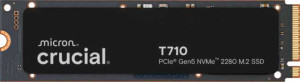
Crucial T710 4TB
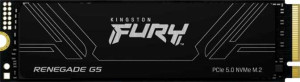
Kingston Fury Renegade G5 2TB

Crucial T710 4TB Kingston Fury Renegade G5 2TB

Overview

Choosing between the Crucial T710 4TB and the Kingston Fury Renegade G5 2TB means weighing two high-performance PCIe 5.0 NVMe drives that share a common foundation yet differ in meaningful ways. Both rely on the Silicon Motion SM2508 controller, TLC NAND, and a DRAM cache, making the real battlegrounds storage capacity, endurance ratings, and the finer points of sequential and random write performance. Read on to see which drive best fits your needs.

Common Features

  • Both drives have a random read speed of 2200000 IOPS.
  • Both drives use the M.2 form factor.
  • Both drives feature a DRAM cache.
  • Both drives are NVMe SSDs.
  • Both drives use NVMe version 2.
  • Both drives are powered by the Silicon Motion SM2508 controller.
  • Both drives use TLC NAND storage.
  • Both drives use PCIe version 5.
  • Both drives have 8 controller channels.

Main Differences

  • Sequential read speed is 14500 MB/s on Crucial T710 4TB and 14700 MB/s on Kingston Fury Renegade G5 2TB.
  • Sequential write speed is 13800 MB/s on Crucial T710 4TB and 14000 MB/s on Kingston Fury Renegade G5 2TB.
  • Random write speed is 2300000 IOPS on Crucial T710 4TB and 2200000 IOPS on Kingston Fury Renegade G5 2TB.
  • Internal storage capacity is 4000 GB on Crucial T710 4TB and 2000 GB on Kingston Fury Renegade G5 2TB.
  • Terabytes Written (TBW) is 2400 TB on Crucial T710 4TB and 2000 TB on Kingston Fury Renegade G5 2TB.
  • MTBF is 1.5 million hours on Crucial T710 4TB and 2 million hours on Kingston Fury Renegade G5 2TB.
Specs Comparison
Crucial T710 4TB

Crucial T710 4TB

Kingston Fury Renegade G5 2TB

Kingston Fury Renegade G5 2TB

Read speed:
sequential read speed 14500 MB/s 14700 MB/s
random read speed 2200000 IOPS 2200000 IOPS

In sequential read performance, the two drives are essentially neck and neck. The Kingston Fury Renegade G5 2TB edges ahead at 14700 MB/s versus 14500 MB/s for the Crucial T710 4TB — a gap of just 200 MB/s, or roughly 1.4%. At these stratospheric speeds, that difference is imperceptible in any real-world workload, including large file transfers, video editing timelines, or game asset streaming.

Where the two drives fully converge is random read performance: both deliver 2200000 IOPS, meaning their ability to handle the small, scattered read requests typical of OS operations, application launches, and database queries is identical. This is often the more practically meaningful metric for everyday responsiveness, and here there is zero differentiation between them.

Overall, read speed is effectively a tie. The Kingston holds a marginal sequential lead on paper, but it carries no actionable advantage. Buyers should not let this group of specs influence their decision — the real differentiators lie elsewhere, such as capacity, write performance, or pricing.

Write speed:
sequential write speed 13800 MB/s 14000 MB/s
random write speed 2300000 IOPS 2200000 IOPS

Sequential write performance tells a similar story to reads: the Kingston Fury Renegade G5 leads at 14000 MB/s against 13800 MB/s for the Crucial T710 4TB, a margin of just 200 MB/s (under 1.5%). For sustained writes — think large video captures, bulk file copies, or backup operations — neither drive will feel meaningfully faster than the other at these figures.

Random write performance is where the dynamic flips. The Crucial T710 4TB pulls ahead with 2300000 IOPS versus the Kingston's 2200000 IOPS — a 100K IOPS advantage that mirrors the exact gap by which Kingston led in random reads. Random write IOPS matter most in write-intensive workloads like database transactions, virtual machine storage, and compiling large codebases, where the drive must constantly juggle small, non-sequential write requests. The T710's edge here is modest but real.

The write speed category produces a split verdict: Kingston holds a negligible sequential lead, while the Crucial T710 counters with a slightly higher random write ceiling. Neither advantage is large enough to be decisive in isolation, making this group effectively evenly matched for most users — though workloads dominated by random writes give the T710 a marginal practical edge.

General info:
type M2 M2
SSD cache DRAM cache DRAM cache
Is an NVMe SSD
NVMe version 2 2
internal storage 4000GB 2000GB
release date May 2025 April 2025
controller Silicon Motion SM2508 Silicon Motion SM2508
SSD storage type TLC TLC
PCI Express (PCIe) version 5 5
Controller channels 8 8
Terabytes Written (TBW) 2400 2000
MTBF 1.5million hours 2million hours
warranty period 5 years 5 years
Has an integrated heatsink
has RGB lighting

At their architectural core, these two drives are remarkably alike: both are M.2 PCIe 5.0 NVMe 2.0 SSDs built on the same Silicon Motion SM2508 controller with identical 8-channel configurations, DRAM caches, and TLC NAND. Sharing a controller and interface generation means their theoretical performance ceiling is set by the same silicon — which explains why their speed numbers are so close. Neither features an integrated heatsink, so thermal management falls entirely to the motherboard or aftermarket solutions.

The most consequential difference in this group is simply capacity: the Crucial T710 offers 4TB versus the Kingston's 2TB. Beyond raw storage space, this has a direct bearing on endurance — the T710 is rated for 2400 TBW compared to 2000 TBW for the Kingston Fury Renegade G5. More TBW means the Crucial can absorb a greater lifetime volume of writes before NAND wear becomes a concern, making it better suited to write-heavy professional workloads over the long haul.

Reliability ratings introduce a subtle counter-point: the Kingston carries a higher MTBF of 2 million hours against the T710's 1.5 million hours, suggesting a slightly more conservative reliability estimate for the Crucial. Both ship with a 5-year warranty, so practical support coverage is equal. Overall, the T710 wins on capacity and total write endurance, while the Kingston claims a modest MTBF edge — making the choice here largely about whether sheer storage volume or reliability margin matters more to the buyer.

Comparison Summary & Verdict

After examining the full spec sheet, both drives are elite PCIe 5.0 performers, but they cater to different priorities. The Crucial T710 4TB doubles the usable space and delivers a higher random write speed of 2,300,000 IOPS, making it the stronger pick for power users, content creators, and professionals who need serious storage room and write-heavy workload endurance backed by a 2,400 TBW rating. The Kingston Fury Renegade G5 2TB, on the other hand, edges ahead in sequential read and write speeds and posts a notably higher MTBF of 2 million hours, signaling greater rated long-term reliability in a more compact 2TB footprint. Choose the Crucial if raw capacity and write throughput are your top concerns; choose the Kingston if peak sequential speeds and a higher reliability rating matter most to you.

Crucial T710 4TB
Buy Crucial T710 4TB if...

Buy the Crucial T710 4TB if you need maximum storage capacity and higher random write performance, backed by a greater overall endurance rating of 2,400 TBW.

Kingston Fury Renegade G5 2TB
Buy Kingston Fury Renegade G5 2TB if...

Buy the Kingston Fury Renegade G5 2TB if you prioritize faster sequential read and write speeds and a higher MTBF reliability rating in a 2TB form factor.