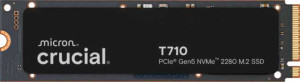
Crucial T710 4TB
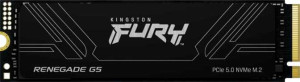
Kingston Fury Renegade G5 4TB

Crucial T710 4TB Kingston Fury Renegade G5 4TB

Overview

Welcome to our in-depth specification comparison between the Crucial T710 4TB and the Kingston Fury Renegade G5 4TB. Both drives share a strong common foundation — PCIe 5.0, NVMe 2.0, the Silicon Motion SM2508 controller, and TLC NAND — yet they diverge in meaningful ways across sequential throughput, endurance ratings, and random write performance. Read on to find out which drive best suits your needs.

Common Features

  • Both products share a random read speed of 2200000 IOPS.
  • Both products use the M.2 form factor.
  • Both products feature a DRAM cache.
  • Both products are NVMe SSDs.
  • Both products use NVMe version 2.
  • Both products offer 4000GB of internal storage.
  • Both products are powered by the Silicon Motion SM2508 controller.
  • Both products use TLC NAND flash storage.
  • Both products connect via PCI Express (PCIe) version 5.

Main Differences

  • Sequential read speed is 14500 MB/s on Crucial T710 4TB and 14800 MB/s on Kingston Fury Renegade G5 4TB.
  • Sequential write speed is 13800 MB/s on Crucial T710 4TB and 14000 MB/s on Kingston Fury Renegade G5 4TB.
  • Random write speed is 2300000 IOPS on Crucial T710 4TB and 2200000 IOPS on Kingston Fury Renegade G5 4TB.
  • Terabytes Written (TBW) endurance rating is 2400 TBW on Crucial T710 4TB and 4000 TBW on Kingston Fury Renegade G5 4TB.
  • MTBF is 1.5 million hours on Crucial T710 4TB and 2 million hours on Kingston Fury Renegade G5 4TB.
Specs Comparison
Crucial T710 4TB

Crucial T710 4TB

Kingston Fury Renegade G5 4TB

Kingston Fury Renegade G5 4TB

Read speed:
sequential read speed 14500 MB/s 14800 MB/s
random read speed 2200000 IOPS 2200000 IOPS

In sequential read performance, the two drives are nearly identical, with the Kingston Fury Renegade G5 edging ahead at 14800 MB/s versus 14500 MB/s for the Crucial T710 — a difference of just 2%. At this tier of performance, both drives are operating at the upper boundary of what PCIe Gen 5 x4 bandwidth can realistically sustain, meaning the gap will be imperceptible in any real-world workload, including large file transfers, video editing timelines, or game asset streaming.

Where it truly matters for day-to-day responsiveness — random reads — both drives land at exactly 2,200,000 IOPS. Random read speed governs how quickly a drive handles the small, scattered requests typical of OS boots, application launches, and database queries. A tie here means neither drive holds a practical advantage in the workloads most users actually feel.

Overall, read speed is essentially a tie. The Kingston Fury Renegade G5′s marginal sequential lead exists on paper but delivers no meaningful real-world benefit. Users prioritizing read performance can choose either drive with full confidence.

Write speed:
sequential write speed 13800 MB/s 14000 MB/s
random write speed 2300000 IOPS 2200000 IOPS

Sequential write performance tells a split story here. The Kingston Fury Renegade G5 holds a slim lead at 14000 MB/s versus 13800 MB/s for the Crucial T710 — a 1.4% margin that, much like the read side, will never surface in real-world sustained transfers. Both figures represent class-leading throughput, and neither drive will bottleneck workflows involving large media exports, disk imaging, or backup operations.

Random write speed, however, flips the script. The Crucial T710 pulls ahead with 2,300,000 IOPS compared to the Renegade G5′s 2,200,000 IOPS — a 100K IOPS advantage that is proportionally more meaningful than the sequential gap. Random writes govern performance in write-intensive scenarios like database transactions, virtual machine storage, and compile caches. A 4.5% edge in this metric gives the T710 a tangible, if modest, advantage for users pushing these kinds of professional or prosumer workloads.

On balance, write speed is too close to call decisively, but the nuance matters depending on use case. The Renegade G5 leads on sequential writes while the Crucial T710 counters with a higher random write ceiling — making the T710 the marginally better pick for latency-sensitive, mixed-write environments.

General info:
type M2 M2
SSD cache DRAM cache DRAM cache
Is an NVMe SSD
NVMe version 2 2
internal storage 4000GB 4000GB
release date May 2025 April 2025
controller Silicon Motion SM2508 Silicon Motion SM2508
SSD storage type TLC TLC
PCI Express (PCIe) version 5 5
Controller channels 8 8
Terabytes Written (TBW) 2400 4000
MTBF 1.5million hours 2million hours
warranty period 5 years 5 years
Has an integrated heatsink
has RGB lighting

At the architectural level, these two drives are built from the same blueprint: identical M.2 form factor, PCIe 5.0 interface, NVMe 2.0 protocol, the same Silicon Motion SM2508 controller with 8 channels, DRAM cache, and TLC NAND. For the vast majority of buyers, this shared foundation means platform-level performance parity is guaranteed regardless of which drive they choose.

The meaningful separation appears in longevity metrics. The Kingston Fury Renegade G5 carries a substantially higher endurance rating at 4000 TBW versus 2400 TBW for the Crucial T710 — a 67% advantage. Similarly, its MTBF stands at 2 million hours compared to 1.5 million for the T710. TBW directly quantifies how much data can be written to the drive over its lifetime before wear becomes a concern; for a power user writing hundreds of gigabytes daily, or a professional workstation running continuous write-heavy tasks, the Renegade G5′s headroom is a concrete, not theoretical, benefit. Both carry a 5-year warranty, so neither manufacturer hedges on coverage.

For general consumers or gaming use cases where daily write volumes are modest, the T710′s 2400 TBW is more than adequate and unlikely to ever be reached. But for NAS-adjacent workflows, content creation pipelines, or any environment with sustained heavy writes, the Kingston Fury Renegade G5 holds a clear and decisive edge in long-term durability.

Comparison Summary & Verdict

After a thorough look at the specifications, both drives are clearly high-end PCIe 5.0 competitors built on identical core technology. The Kingston Fury Renegade G5 4TB pulls ahead in sequential read and write speeds (14800 MB/s and 14000 MB/s respectively), and offers a substantially higher TBW endurance rating of 4000 TBW alongside a superior MTBF of 2 million hours, making it the stronger choice for power users, content creators, or anyone running write-intensive workloads who need long-term reliability. The Crucial T710 4TB, on the other hand, edges ahead with a slightly higher random write speed of 2300000 IOPS, which can benefit latency-sensitive tasks, and may appeal to users seeking strong all-round performance at a potentially more accessible price point.

Crucial T710 4TB
Buy Crucial T710 4TB if...

Buy the Crucial T710 4TB if you prioritize higher random write performance and want a top-tier PCIe 5.0 NVMe drive for latency-sensitive workloads.

Kingston Fury Renegade G5 4TB
Buy Kingston Fury Renegade G5 4TB if...

Buy the Kingston Fury Renegade G5 4TB if you need superior sequential throughput, a significantly higher endurance rating, and greater long-term reliability for write-intensive use.