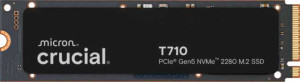
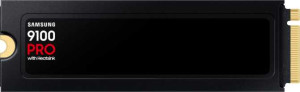
At the platform level, these two drives are built on virtually the same foundation. Both are M.2 NVMe SSDs leveraging PCIe 5.0 with NVMe 2.0, both use TLC NAND with a DRAM cache, and both deploy an 8-channel controller architecture. The shared specs extend to endurance and reliability too — identical 2,400 TBW ratings, 1.5 million hours MTBF, and 5-year warranties — meaning neither drive has a longevity or coverage advantage on paper.
The only meaningful differentiator in this group is the controller. The Crucial T710 uses the Silicon Motion SM2508, a third-party flagship controller that has earned strong credibility across multiple Gen 5 drives. The Samsung 9100 Pro, by contrast, runs Samsung's proprietary Presto (S4LY027) controller, developed and manufactured entirely in-house alongside Samsung's own NAND. Vertical integration of this kind historically gives Samsung tighter control over firmware optimization and the controller-NAND interface, which can translate to more consistent behavior under sustained load — though the specs alone do not quantify this.
For general configuration, this category is essentially a tie. The platform parity is striking, and neither drive holds a structural advantage in form factor, cache type, endurance, or warranty. The controller difference is the one thread worth pulling, and it is a qualitative distinction rather than a numerical one — making it a factor to weigh alongside real-world benchmark behavior rather than spec sheet values alone.