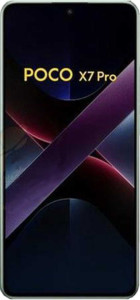
Cellular and wireless connectivity mark another decisive split. The Poco X7 Pro supports 5G, while the Cubot A40 is limited to 4G, capping its maximum download speed at 300 Mbits/s versus the X7 Pro's 5700 Mbits/s — a near 19x theoretical ceiling difference. Beyond cellular, the X7 Pro also adds Wi-Fi 6 (802.11ax) to its stack, whereas the A40 tops out at Wi-Fi 5. Wi-Fi 6 delivers better performance in congested environments, improved throughput, and lower latency, making it a tangible upgrade for busy households or public networks. Bluetooth tells a similar story: the X7 Pro's Bluetooth 6 versus the A40's Bluetooth 5 brings improvements in connection stability and ranging precision.
The sensor and feature gap is equally notable. The X7 Pro includes a fingerprint scanner, gyroscope, compass, and infrared sensor — none of which are present on the A40. The absence of a fingerprint scanner on the A40 is arguably the most impactful omission for everyday usability, as it removes the most common biometric unlock method. The gyroscope matters for gaming and augmented reality applications, while the infrared sensor enables the phone to function as a universal remote — a niche but genuine utility. The A40 does offer an external memory slot, which the X7 Pro lacks, giving it a practical advantage for users who need expandable storage on a budget.
Shared features — NFC, GPS, Galileo, accelerometer, dual SIM, and USB-C — provide a reasonable common baseline, but they do not offset the X7 Pro's breadth of advantages. The A40's microSD slot is a meaningful consolation for storage flexibility, but it cannot swing the overall verdict. The Poco X7 Pro wins this category convincingly, offering more capable wireless connectivity and a substantially richer sensor suite.