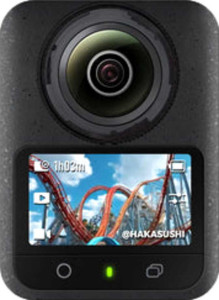
DJI Osmo 360
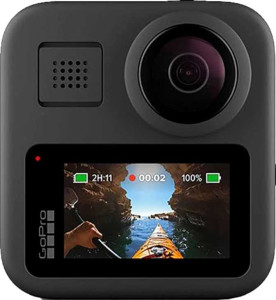
GoPro Max2

DJI Osmo 360 GoPro Max2

Common Features

  • Both products have a touch screen.
  • Both products have an external memory slot.
  • Both products have a display.
  • Both products are compatible with Android.
  • Both products are compatible with iOS.
  • Both products have first-party support for live streaming.
  • Both products support Wi-Fi.
  • Both products support a remote smartphone.
  • Both products have voice commands.
  • Both products have a removable battery.
  • Both products have a rechargeable battery.
  • Both products have a battery level indicator.
  • Both products support fast charging.
  • Both products have a stereo microphone.
  • Both products have an adjustable field of view.
  • Both products have a dual-lens main camera.
  • Both products have a BSI sensor.
  • Both products have a CMOS sensor.
  • Both products have manual shutter speed.
  • Both products have manual white balance.

Main Differences

  • Ingress Protection (IP) rating is IP68 on DJI Osmo 360 and IPX8 on GoPro Max2.
  • Internal storage is 128GB on DJI Osmo 360 and 0GB on GoPro Max2.
  • Maximum operating temperature is 45 °C on DJI Osmo 360 and 40 °C on GoPro Max2.
  • Lowest potential operating temperature is -20 °C on DJI Osmo 360 and -10 °C on GoPro Max2.
  • Screen size is 2″ on DJI Osmo 360 and 1.82″ on GoPro Max2.
  • Volume is 179.3583 cm³ on DJI Osmo 360 and 217.24096 cm³ on GoPro Max2.
  • Weight is 183 g on DJI Osmo 360 and 195 g on GoPro Max2.
  • Thickness is 36.3 mm on DJI Osmo 360 and 48.7 mm on GoPro Max2.
  • Width is 61 mm on DJI Osmo 360 and 64 mm on GoPro Max2.
  • Height is 81 mm on DJI Osmo 360 and 69.7 mm on GoPro Max2.
  • Bluetooth version is 5.1 on DJI Osmo 360 and 5.3 on GoPro Max2.
  • USB version is 0 on DJI Osmo 360 and 3 on GoPro Max2.
  • DJI Osmo 360 does not have USB Type-C, whereas GoPro Max2 has USB Type-C.
  • DJI Osmo 360 includes a remote control, while GoPro Max2 does not.
  • GoPro Max2 has GPS, while DJI Osmo 360 does not.
  • Battery power is 1950 mAh on DJI Osmo 360 and 1960 mAh on GoPro Max2.
  • Number of microphones is 4 on DJI Osmo 360 and 6 on GoPro Max2.
  • Main camera megapixels are 120 MP on DJI Osmo 360 and 29 MP on GoPro Max2.
  • Wide aperture of the main camera is 1.9f on DJI Osmo 360 and 1.8f on GoPro Max2.
  • Maximum ISO is 51200 ISO on DJI Osmo 360 and 6400 ISO on GoPro Max2.
  • Video recording is 2160 x 120 fps on DJI Osmo 360 and 3840 x 30 fps on GoPro Max2.
  • Field of view is 170° on DJI Osmo 360 and 360° on GoPro Max2.
  • DJI Osmo 360 does not shoot raw video, while GoPro Max2 does.
Specs Comparison
DJI Osmo 360

DJI Osmo 360

GoPro Max2

GoPro Max2

Design:
Ingress Protection (IP) rating IP68 IPX8
has a touch screen
has an external memory slot
Has a display
internal storage 128GB 0GB
maximum operating temperature 45 °C 40 °C
lowest potential operating temperature -20 °C -10 °C
screen size 2" 1.82"
Has a secondary screen
Has a flip-out screen
volume 179.3583 cm³ 217.24096 cm³
weight 183 g 195 g
thickness 36.3 mm 48.7 mm
width 61 mm 64 mm
height 81 mm 69.7 mm

The DJI Osmo 360 and GoPro Max2 both offer IP-rated protection but differ in their ratings. The Osmo 360 comes with an IP68 rating, meaning it is fully dustproof and can be submerged in water beyond 1 meter, while the Max2 features an IPX8 rating, which is water-resistant but may not be as robust in extreme dust exposure.

In terms of physical design, the Osmo 360 is slightly smaller, with a volume of 179.36 cm³, and lighter at 183 g, compared to the Max2's larger size (217.24 cm³) and weight (195 g). The Osmo 360 is also thinner at 36.3 mm versus the Max2's 48.7 mm. However, the Max2 is more compact in height (69.7 mm) and width (64 mm) compared to the Osmo 360's height of 81 mm and width of 61 mm.

Both products have touch screens, external memory slots, and internal displays, but there are some key differences. The Osmo 360 has a 2″ screen, while the Max2’s screen is slightly smaller at 1.82″. The Osmo 360 offers 128GB of internal storage, while the Max2 lacks internal storage entirely. As for temperature tolerance, the Osmo 360 can operate in temperatures up to 45 °C and as low as -20 °C, while the Max2 has a slightly lower maximum of 40 °C and a minimum of -10 °C.

Connectivity & Features:
release date August 2025 September 2025
Is compatible with Android
Is compatible with iOS
Bluetooth version 5.1 5.3
has first-party support for live streaming
USB version 0 3
Has USB Type-C
has a remote control
has GPS
supports Wi-Fi
Wi-Fi version Wi-Fi 6 (802.11ax), Wi-Fi 5 (802.11ac), Wi-Fi 4 (802.11n) Wi-Fi 6 (802.11ax), Wi-Fi 5 (802.11ac), Wi-Fi 4 (802.11n)
supports a remote smartphone
has voice commands

Both the DJI Osmo 360 and GoPro Max2 are compatible with Android and iOS devices, making them flexible for various smartphone users. However, the Bluetooth versions differ slightly: the Osmo 360 uses Bluetooth 5.1, while the Max2 uses the slightly newer Bluetooth 5.3.

In terms of USB features, the Osmo 360 lacks a USB Type-C port and has a USB version of 0, whereas the Max2 includes a USB Type-C port and supports USB version 3, which may offer faster data transfer speeds. Additionally, the Osmo 360 supports live streaming natively, while the Max2 also supports this feature. The Osmo 360 includes a remote control, while the Max2 does not.

Both devices support Wi-Fi (with Wi-Fi 6, 5, and 4 compatibility), support remote smartphone control, and feature voice command functionality. The Max2 has built-in GPS, but the Osmo 360 does not provide GPS support.

Battery:
battery power 1950 mAh 1960 mAh
has a removable battery
has a rechargeable battery
has a battery level indicator
Supports fast charging

The DJI Osmo 360 and GoPro Max2 both feature similar battery capabilities. The Osmo 360 has a 1950 mAh battery, while the Max2 has a slightly higher 1960 mAh battery. Both cameras use removable and rechargeable batteries and include battery level indicators to keep track of power. Additionally, both devices support fast charging for quicker recharging times.

In terms of battery features, the two products are identical with no significant differences in performance or functionality regarding battery power and charging features.

Audio:
number of microphones 4 6
has a stereo microphone
has a microphone input
has a socket for a 3.5 mm audio jack

The DJI Osmo 360 features a total of 4 microphones, while the GoPro Max2 includes 6 microphones. Both cameras have stereo microphones for enhanced audio quality, but neither product offers a microphone input or a socket for a 3.5 mm audio jack.

In terms of microphone capabilities, the Max2 provides slightly more microphone coverage with 6 microphones compared to the Osmo 360's 4 microphones, but both devices are similar in terms of their lack of external microphone options.

Optics:
megapixels (main camera) 120 MP 29 MP
has an adjustable field of view
wide aperture (main camera) 1.9f 1.8f
Has a dual-lens (or multi-lens) main camera
has a BSI sensor
has a CMOS sensor
maximum ISO 51200 ISO 6400 ISO
has a flash
has manual shutter speed
has manual white balance

The DJI Osmo 360 boasts a significantly higher 120 MP main camera compared to the GoPro Max2’s 29 MP main camera. Both cameras feature an adjustable field of view, dual-lens (or multi-lens) main cameras, and use BSI and CMOS sensors for enhanced image quality in low light. The Osmo 360 has a wider aperture of 1.9f, while the Max2’s aperture is slightly narrower at 1.8f.

Both cameras have manual shutter speed and white balance settings for greater control over their image capture, but neither includes a flash. Additionally, the Osmo 360 has a much higher maximum ISO of 51200 compared to the Max2's 6400, indicating a broader range of sensitivity for better low-light performance on the Osmo 360.

Videography:
video recording (main camera) 2160 x 120 fps 3840 x 30 fps
field of view 170° 360°
Has timelapse function
supports slow-motion video recording
Has phase-detection autofocus for videos
has continuous autofocus when recording movies
supports horizon leveling
has a 24p cinema mode
shoots raw
has AF tracking
has a video light
has invisible selfie stick support

The DJI Osmo 360 and GoPro Max2 differ significantly in their video recording capabilities. The Osmo 360 supports video recording at 2160 x 120 fps, while the Max2 records at a lower resolution of 3840 x 30 fps. In terms of field of view, the Osmo 360 has a wide 170° field of view, whereas the Max2 offers a full 360° field of view, allowing for more immersive video capture.

Both cameras support timelapse, slow-motion video, phase-detection autofocus, continuous autofocus, horizon leveling, and a 24p cinema mode. However, the Max2 has the added advantage of shooting raw footage, while the Osmo 360 does not. Both cameras also feature AF tracking and invisible selfie stick support, but neither has a video light.

Comparison Summary

This is a specification comparison between the DJI Osmo 360 and the GoPro Max2. Both products feature a touch screen, external memory slot, and stereo microphone. The DJI Osmo 360 has 128GB of internal storage, while the GoPro Max2 has none. The DJI Osmo 360 also offers a higher maximum ISO of 51200 compared to the GoPro Max2's 6400. Additionally, the DJI Osmo 360 has a larger screen size at 2″ compared to the GoPro Max2's 1.82″. The DJI Osmo 360 offers an IP68 rating, while the GoPro Max2 has an IPX8 rating. The DJI Osmo 360 records video at 2160 x 120 fps, while the GoPro Max2 records at 3840 x 30 fps.