DJI Osmo Action 6
Insta360 X4 Air

DJI Osmo Action 6 Insta360 X4 Air

Overview

Welcome to our in-depth spec comparison of the DJI Osmo Action 6 and the Insta360 X4 Air — two compelling action cameras that take very different approaches to design and imaging. While both share a strong foundation of features like gyroscope stabilization, Wi-Fi connectivity, and manual controls, key battlegrounds emerge around battery endurance, form factor, video capabilities, and optics. Read on to discover which camera fits your shooting style.

Common Features

  • Both cameras feature a touch screen.
  • Both cameras have an external memory slot.
  • Both cameras have a display.
  • The lowest potential operating temperature is -20 °C on both cameras.
  • Neither camera has a flip-out screen.
  • Both cameras have a gyroscope.
  • Both cameras are compatible with Android.
  • Both cameras are compatible with iOS.
  • Both cameras have first-party support for live streaming.
  • Both cameras have a USB Type-C port.
  • Neither camera has an HDMI output.
  • Both cameras support Wi-Fi.
  • Neither camera supports aptX.
  • Neither camera supports wireless charging.
  • Both cameras have a removable and rechargeable battery.
  • Both cameras have a battery level indicator.
  • Both cameras have a stereo microphone.
  • Neither camera has a 3.5 mm audio jack socket.
  • Both cameras have an adjustable field of view, a BSI sensor, and a CMOS sensor.
  • Both cameras support manual exposure, manual ISO, manual shutter speed, and manual white balance.
  • Neither camera has a flash.
  • Both cameras have a timelapse function.
  • Both cameras support phase-detection autofocus and continuous autofocus when recording video.
  • Both cameras support horizon leveling.
  • Both cameras have a 24p cinema mode.
  • Neither camera has a video light.
  • Both cameras support invisible selfie stick.

Main Differences

  • Internal storage is 50GB on DJI Osmo Action 6 and 0GB on Insta360 X4 Air.
  • Maximum operating temperature is 45 °C on DJI Osmo Action 6 and 40 °C on Insta360 X4 Air.
  • A secondary screen is present on DJI Osmo Action 6 but not available on Insta360 X4 Air.
  • Waterproof depth rating is 20 m on DJI Osmo Action 6 and 15 m on Insta360 X4 Air.
  • Volume is 113.74 cm³ on DJI Osmo Action 6 and 193.69 cm³ on Insta360 X4 Air.
  • Weight is 149 g on DJI Osmo Action 6 and 165 g on Insta360 X4 Air.
  • Thickness is 33.1 mm on DJI Osmo Action 6 and 37 mm on Insta360 X4 Air.
  • Width is 72.8 mm on DJI Osmo Action 6 and 46 mm on Insta360 X4 Air.
  • Height is 47.2 mm on DJI Osmo Action 6 and 113.8 mm on Insta360 X4 Air.
  • Bluetooth version is 5.1 on DJI Osmo Action 6 and 5.2 on Insta360 X4 Air.
  • USB version is 3.1 on DJI Osmo Action 6 and 3.0 on Insta360 X4 Air.
  • Battery life is 4 hours on DJI Osmo Action 6 and 1 hour on Insta360 X4 Air.
  • Battery power is 1950 mAh on DJI Osmo Action 6 and 2010 mAh on Insta360 X4 Air.
  • Main camera resolution is 38 MP on DJI Osmo Action 6 and 29 MP on Insta360 X4 Air.
  • Wide aperture on the main camera is f/2.0 on DJI Osmo Action 6 and f/1.95 on Insta360 X4 Air.
  • A dual-lens main camera is present on Insta360 X4 Air but not available on DJI Osmo Action 6.
  • Maximum video resolution and frame rate is 2880p at 120 fps on DJI Osmo Action 6 and 3840p at 30 fps on Insta360 X4 Air.
  • Field of view is 155° on DJI Osmo Action 6 and 170° on Insta360 X4 Air.
  • Movie bitrate is 120 Mbps on DJI Osmo Action 6 and 180 Mbps on Insta360 X4 Air.
Specs Comparison
DJI Osmo Action 6

DJI Osmo Action 6

Insta360 X4 Air

Insta360 X4 Air

Design:
has a touch screen
has an external memory slot
Has a display
internal storage 50GB 0GB
maximum operating temperature 45 °C 40 °C
lowest potential operating temperature -20 °C -20 °C
Has a secondary screen
waterproof depth rating 20 m 15 m
Has a flip-out screen
has a gyroscope
volume 113.736896 cm³ 193.6876 cm³
weight 149 g 165 g
thickness 33.1 mm 37 mm
width 72.8 mm 46 mm
height 47.2 mm 113.8 mm

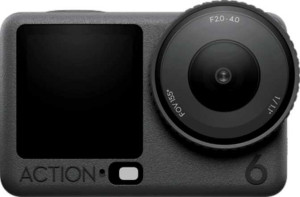
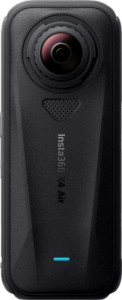
The most fundamental design difference here is form factor. The DJI Osmo Action 6 follows a classic action camera silhouette — wide and short at 72.8 × 47.2 × 33.1 mm — while the Insta360 X4 Air is tall and narrow at 46 × 113.8 × 37 mm, resembling a slim remote control. This isn't just aesthetic: the X4 Air's elongated shape is optimized for 360° lens placement, whereas the Action 6's compact block form makes it easier to mount low-profile on helmets or handlebars. The Action 6 also wins on overall bulk, with a volume of 113.7 cm³ versus 193.7 cm³ for the X4 Air, and comes in lighter at 149 g compared to 165 g — a meaningful difference when mounting on gimbals or drones.

The Action 6 holds a clear edge in two practical design specs. First, it includes a secondary screen (front-facing display) that the X4 Air lacks entirely — critical for vloggers or solo shooters who need to frame themselves. Second, it ships with 50 GB of internal storage, while the X4 Air offers none, making the X4 Air fully dependent on a memory card from the outset. The Action 6 also edges out on environmental resilience: it is waterproof to 20 m versus 15 m, and handles higher ambient heat up to 45 °C versus 40 °C, while both share the same cold-weather floor of -20 °C.

Overall, the DJI Osmo Action 6 has a clear design advantage for users who prioritize compactness, self-shooting convenience, and built-in storage headroom. The Insta360 X4 Air's taller profile is a deliberate trade-off suited to its 360° capture purpose, but on purely physical and usability design criteria, the Action 6 is the more versatile and self-sufficient package.
Connectivity & Features:
release date November 2025 October 2025
Is compatible with Android
Is compatible with iOS
Bluetooth version 5.1 5.2
has first-party support for live streaming
USB version 3.1 3
Has USB Type-C
has an HDMI output
supports Wi-Fi
Wi-Fi version Wi-Fi 6 (802.11ax), Wi-Fi 5 (802.11ac), Wi-Fi 4 (802.11n) Wi-Fi 4 (802.11n), Wi-Fi 5 (802.11ac), Wi-Fi 6 (802.11ax)
has aptX
has wireless charging
is DLNA-certified
supports a remote smartphone
has NFC

Connectivity parity is the dominant story here — both cameras support the same Wi-Fi standards (Wi-Fi 4, 5, and 6), both use USB Type-C, both are compatible with Android and iOS via a companion app, and both offer first-party live streaming support. For the vast majority of users, the day-to-day wireless experience will be functionally identical.

Zooming into the fine-print differences, the Insta360 X4 Air carries Bluetooth 5.2 versus 5.1 on the DJI Osmo Action 6. In practice, 5.2 introduces improvements to audio synchronization and connection stability in congested environments, but the real-world gap between these two successive minor versions is negligible for typical action camera use cases like remote triggering or app pairing. More tangibly, the Action 6 specifies USB 3.1 against the X4 Air's USB 3.0 — USB 3.1 Gen 1 doubles the theoretical transfer ceiling to 10 Gbps, which can meaningfully cut the time needed to offload large high-resolution video files to a computer, a relevant advantage for heavy shooters.

On balance, this group is essentially a near-tie, with the Action 6 holding a marginal practical edge thanks to its faster USB transfer spec. Neither device is disadvantaged in any meaningful connectivity dimension, so this group alone should not drive a purchasing decision.

Battery:
Battery life 4 hours 1 hours
battery power 1950 mAh 2010 mAh
has a removable battery
has a rechargeable battery
has a battery level indicator

Despite carrying nearly identical battery capacities — 1950 mAh for the DJI Osmo Action 6 versus 2010 mAh for the Insta360 X4 Air — the two cameras deliver dramatically different battery life: 4 hours versus just 1 hour respectively. This is one of the starkest divergences in the entire comparison. The X4 Air's far greater power consumption is almost certainly a direct consequence of its dual 360° lens system, which requires two wide-angle sensors and the computational overhead of real-time stitching — a fundamentally more demanding workload than the single-lens pipeline of the Action 6.

In practical terms, the gap is session-defining. Four hours comfortably covers a full day of intermittent shooting, a long hike, or a sporting event without a battery swap. One hour, by contrast, means the X4 Air user needs to carry multiple spare batteries for any extended outing — and while the battery is removable on both devices (allowing hot-swapping as a mitigation), that adds cost, bulk, and logistical friction in the field.

The DJI Osmo Action 6 holds a commanding advantage in this group. The battery capacity figures are essentially equal, so the 4× difference in runtime reflects a fundamental architectural efficiency gap, not a hardware investment one. For users who prioritize shooting endurance, the Action 6 is the clear choice.

Audio:
has a stereo microphone
has a socket for a 3.5 mm audio jack

Audio specs are a complete dead heat between these two cameras. Both the DJI Osmo Action 6 and the Insta360 X4 Air feature a built-in stereo microphone and neither offers a 3.5 mm audio jack for connecting an external microphone directly. This is a meaningful shared limitation for users who prioritize clean, professional audio — without a jack, wired lavalier or shotgun microphones are simply not an option via a direct cable connection.

This group is an unambiguous tie. Based strictly on the provided specs, there is no differentiator to analyze — both cameras offer the same audio input configuration. Users with serious audio requirements will face identical constraints on either device.

Optics:
megapixels (main camera) 38 MP 29 MP
has an adjustable field of view
wide aperture (main camera) 2f 1.95f
Has a dual-lens (or multi-lens) main camera
has a BSI sensor
has a CMOS sensor
has manual exposure
has a flash
has manual ISO
has manual shutter speed
has manual white balance

The sharpest optical differentiator is sensor resolution: the DJI Osmo Action 6 captures at 38 MP versus 29 MP on the Insta360 X4 Air. For a single-lens action camera this is a straightforward advantage — more pixels means finer detail retention and greater flexibility to crop or reframe footage in post. The X4 Air's 29 MP, however, must be understood in the context of its dual-lens configuration: both lenses contribute to stitched 360° output, so the effective resolution per capture angle is inherently split across two sensors working in tandem. Comparing raw megapixel counts between a single-lens and a 360° dual-lens system is therefore not a direct equivalence.

On aperture, the gap is razor-thin: the X4 Air's f/1.95 lenses are fractionally wider than the Action 6's f/2.0, which in theory allows marginally more light per lens — a negligible real-world difference. Both cameras share the same sensor architecture (BSI CMOS), the same adjustable field of view, and an identical full manual control suite covering ISO, shutter speed, white balance, and exposure. For shooters who want hands-on control, neither camera is at a disadvantage.

This group reflects a genuine trade-off rather than a clean winner. The Action 6 has the edge in raw single-lens resolution, which benefits standard wide-angle or linear shooting. The X4 Air trades some of that resolution headroom for its dual-lens 360° capability — a fundamentally different optical mission. The better choice depends entirely on whether the user needs immersive spherical capture or maximum detail from a single perspective.

Videography:
video recording (main camera) 2880 x 120 fps 3840 x 30 fps
field of view 155° 170°
Has timelapse function
Has phase-detection autofocus for videos
has continuous autofocus when recording movies
supports horizon leveling
has a 24p cinema mode
movie bitrate 120 Mbps 180 Mbps
has a video light
has invisible selfie stick support

The headline video specs reveal a deliberate trade-off in priorities. The DJI Osmo Action 6 tops out at 2880p at 120 fps, sacrificing some resolution in exchange for high-frame-rate capture — ideal for smooth slow-motion footage of fast-moving subjects. The Insta360 X4 Air, by contrast, pushes to 3840p (4K) at 30 fps, prioritizing pixel density over motion fluidity. Neither approach is strictly superior; the right choice depends on whether a user shoots action sports demanding slow-motion flexibility, or cinematic scenes where maximum sharpness at standard frame rates matters most.

Where the X4 Air pulls ahead more unambiguously is in movie bitrate: 180 Mbps versus the Action 6's 120 Mbps. A higher bitrate means more data captured per second, which translates to finer tonal gradations, less compression artifacting in high-detail scenes, and more latitude when color grading in post. The X4 Air also offers a marginally wider field of view at 170° compared to 155° on the Action 6 — a difference that becomes relevant in tight spaces or when capturing expansive environments where every degree of peripheral coverage counts.

Both cameras are well-matched on the fundamentals: phase-detection autofocus, continuous AF during recording, horizon leveling, timelapse, a 24p cinema mode, and invisible selfie stick support are all present on each. On balance, the X4 Air has a modest edge in this group — its higher bitrate and wider FOV give it more headroom for quality-conscious videographers, while the Action 6's high-fps capability is a meaningful counter for action-focused shooters who need slow-motion as a core tool.

Comparison Summary & Verdict

After examining every specification, it is clear that these two cameras serve distinct audiences. The DJI Osmo Action 6 stands out with its impressive 4-hour battery life, built-in 50GB internal storage, secondary screen, deeper waterproofing at 20 m, and a more compact and lighter body — making it the stronger companion for extended outdoor adventures and dive shoots. The Insta360 X4 Air, on the other hand, counters with a wider 170° field of view, a dual-lens main camera, a higher 180 Mbps movie bitrate, and a wider aperture of f/1.95, appealing to creators who prioritize cinematic image quality and immersive wide-angle capture. Choose the DJI Osmo Action 6 for durability and all-day shooting; choose the Insta360 X4 Air for richer video output and a broader perspective.

DJI Osmo Action 6
Buy DJI Osmo Action 6 if...

Buy the DJI Osmo Action 6 if you need a compact, lightweight camera with exceptional 4-hour battery life, built-in 50GB storage, a secondary screen, and deeper waterproofing for long outdoor or underwater shoots.

Insta360 X4 Air
Buy Insta360 X4 Air if...

Buy the Insta360 X4 Air if you prioritize a wider 170° field of view, a dual-lens camera, a higher 180 Mbps bitrate, and a wider f/1.95 aperture for richer, more cinematic footage.