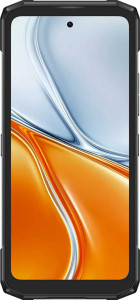
Camera versatility is where the Infinix Note 50 Pro Plus 5G pulls ahead most visibly. Both phones lead with a 50 MP main sensor, but the Infinix backs it up with a second 50 MP lens and an 8 MP tertiary shooter, compared to the Doogee's secondary 2 MP lens — a sensor that, at that resolution, typically serves only for depth mapping rather than capturing usable images. In practice, the Infinix's triple-camera array offers genuinely distinct shooting modes, while the Doogee's system is functionally a single-camera setup with a depth assist lens.
Three additional differentiators compound this gap significantly. First, the Infinix includes optical image stabilization (OIS), which physically compensates for hand movement during shots — particularly valuable in low light and video recording, where the Doogee's lack of OIS will result in more motion blur under the same conditions. Second, the Infinix supports 3x optical zoom, meaning it can close in on distant subjects without the image degradation that comes with digital zoom; the Doogee offers 0x optical zoom, so any zoom it applies is purely digital. Third, video capability diverges sharply: the Infinix records up to 4K at 60 fps, while the Doogee tops out at 1080p at 30 fps — a two-generation gap in video quality that matters for anyone shooting travel footage, events, or content.
On the front camera, the Infinix again leads with 32 MP versus 16 MP, offering greater detail for selfies and video calls. Both devices share a broad set of manual controls and shooting features, so the fundamentals of camera flexibility are present on both. But across every hardware-level differentiator — sensor count, stabilization, zoom, and video resolution — the Infinix Note 50 Pro Plus 5G holds a clear and well-rounded advantage in the camera department.