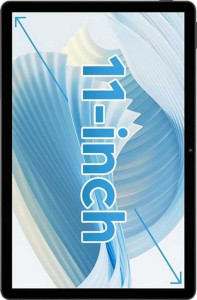
Doogee Tab G6
Doogee U11

Doogee Tab G6 Doogee U11

Overview

Welcome to our detailed spec comparison between the Doogee Tab G6 and the Doogee U11, two 11-inch Android tablets from the same manufacturer that take notably different approaches to performance and everyday usability. While they share a great deal in common, key battlegrounds emerge around processing power and RAM, camera capabilities, battery capacity, and connectivity features like GPS and FM radio. Read on to discover which tablet best suits your needs.

Common Features

  • Neither product includes a stylus.
  • Neither product has a detachable keyboard.
  • Neither product has a backlit keyboard.
  • Neither product offers water resistance.
  • Both products have an 11″ screen size.
  • Both products share a resolution of 1280 x 800 px.
  • Both products have a 90Hz refresh rate.
  • Neither product has branded damage-resistant glass.
  • HDR10 support is not available on either product.
  • Both products have a touchscreen.
  • Both products have an external memory slot.
  • Both products use a 12 nm semiconductor size.
  • Both products support 64-bit processing.
  • Both products have integrated LTE.
  • Both products use big.LITTLE technology.
  • Both products have 8 CPU threads.
  • Both products have a 5MP front camera.
  • Both products support 1080p video recording at 30 fps on the main camera.
  • Both products have stereo speakers and a 3.5 mm audio jack.
  • Both products support fast charging but do not offer wireless charging.
  • Both products support Wi-Fi 4 (802.11n) and Wi-Fi 5 (802.11ac).
  • Both products use DDR4 memory.
  • Both products have on-device machine learning capabilities.

Main Differences

  • Weight is 554 g on Doogee Tab G6 and 537 g on Doogee U11.
  • Thickness is 8.1 mm on Doogee Tab G6 and 7.9 mm on Doogee U11.
  • Pixel density is 138 ppi on Doogee Tab G6 and 137 ppi on Doogee U11.
  • Internal storage is 256GB on Doogee Tab G6 and 128GB on Doogee U11.
  • RAM is 6GB on Doogee Tab G6 and 4GB on Doogee U11.
  • The chipset is Unisoc T7250 on Doogee Tab G6 and Unisoc T606 on Doogee U11.
  • The GPU is Mali G57 on Doogee Tab G6 and Mali G57 MP1 on Doogee U11.
  • CPU speed is 2 x 1.8 & 6 x 1.6 GHz on Doogee Tab G6 and 2 x 1.6 & 6 x 1.6 GHz on Doogee U11.
  • Geekbench 6 multi-core score is 1461 on Doogee Tab G6 and 1391 on Doogee U11.
  • Geekbench 6 single-core score is 437 on Doogee Tab G6 and 371 on Doogee U11.
  • GPU clock speed is 850 MHz on Doogee Tab G6 and 650 MHz on Doogee U11.
  • RAM speed is 1866 MHz on Doogee Tab G6 and 1600 MHz on Doogee U11.
  • Maximum memory amount is 12GB on Doogee Tab G6 and 14GB on Doogee U11.
  • GPU execution units number 2 on Doogee Tab G6 and 1 on Doogee U11.
  • Main camera resolution is 8 MP on Doogee Tab G6 and 13 MP on Doogee U11.
  • Slow-motion video recording is supported on Doogee Tab G6 but not available on Doogee U11.
  • FM radio is available on Doogee U11 but not present on Doogee Tab G6.
  • Battery capacity is 8000 mAh on Doogee Tab G6 and 8580 mAh on Doogee U11.
  • GPS is available on Doogee U11 but not present on Doogee Tab G6.
  • Upload speed is 150 MBits/s on Doogee Tab G6 and 100 MBits/s on Doogee U11.
  • Geekbench 5 single-core score is 357 on Doogee Tab G6 and 313 on Doogee U11.
  • Geekbench 5 multi-core score is 1350 on Doogee Tab G6 and 1175 on Doogee U11.
Specs Comparison
Doogee Tab G6

Doogee Tab G6

Doogee U11

Doogee U11

Design:
weight 554 g 537 g
thickness 8.1 mm 7.9 mm
Stylus included
Has a detachable keyboard
Has a backlit keyboard
water resistance None None
Has tilt sensitivity

In terms of design, the Doogee Tab G6 and Doogee U11 are remarkably close, differing only in subtle physical dimensions. The U11 is marginally lighter at 537 g versus the Tab G6's 554 g, a difference of 17 g — roughly the weight of a few coins. Similarly, the U11 is fractionally thinner at 7.9 mm compared to the Tab G6's 8.1 mm. Neither gap is dramatic, but for users who hold their tablet for extended reading or media consumption sessions, the U11's slightly reduced mass and slimmer profile may translate to a marginally more comfortable long-term grip.

Both devices share an identical set of design feature omissions: no stylus, no detachable or backlit keyboard, no tilt sensitivity, and no water resistance. The absence of any water or dust resistance rating on either model means both should be kept away from liquids, which is a noteworthy limitation for users who might use a tablet in kitchens, outdoors, or other environments where exposure is likely.

Overall, the U11 holds a slight edge in design purely on the basis of its lower weight and reduced thickness, making it the marginally more portable and ergonomic of the two. However, the real-world difference is minimal, and neither product offers any standout design features that would set it apart. Users prioritizing build extras like stylus support or water resistance will find both devices equally lacking.

Display:
screen size 11" 11"
resolution 1280 x 800 px 1280 x 800 px
pixel density 138 ppi 137 ppi
Display type IPS, LCD LCD, IPS
refresh rate 90Hz 90Hz
has branded damage-resistant glass
supports HDR10
has a touch screen
Has sapphire glass display
supports HDR10+
supports Dolby Vision
Has an e-paper display

The display specs for the Doogee Tab G6 and Doogee U11 are, for all practical purposes, identical. Both feature an 11-inch IPS LCD panel running at a 1280 x 800 resolution with a 90Hz refresh rate. The pixel density difference — 138 ppi versus 137 ppi — is a rounding artifact of measurement rather than a meaningful distinction; no human eye could perceive the difference.

The shared 90Hz refresh rate is worth noting as a mild positive for this price tier, lending scrolling and light animations a smoother feel compared to standard 60Hz panels. However, the 1280 x 800 resolution on an 11-inch screen yields a relatively modest pixel density that won't satisfy users who prioritize sharp text or fine image detail — fine for video streaming and casual browsing, but noticeably soft next to higher-resolution competitors. Neither tablet supports HDR10, Dolby Vision, or any damage-resistant glass, which further underscores their entry-level positioning.

This category is a clear tie. There is no meaningful basis to prefer one display over the other — buyers should treat the screens of both devices as functionally equivalent and base their decision on other specification groups.

Performance:
internal storage 256GB 128GB
RAM 6GB 4GB
Chipset (SoC) name Unisoc T7250 Unisoc T606
GPU name Mali G57 Mali G57 MP1
CPU speed 2 x 1.8 & 6 x 1.6 GHz 2 x 1.6 & 6 x 1.6 GHz
Geekbench 6 result (multi) 1461 1391
Geekbench 6 result (single) 437 371
has an external memory slot
semiconductor size 12 nm 12 nm
Supports 64-bit
Has integrated LTE
Uses big.LITTLE technology
Has integrated graphics
GPU clock speed 850 MHz 650 MHz
CPU threads 8 threads 8 threads
RAM speed 1866 MHz 1600 MHz
Has TrustZone
maximum memory amount 12GB 14GB
Android version Android 15 Android 15
Thermal Design Power (TDP) 10W 10W
GPU execution units 2 1
L3 cache 1 MB 1 MB
OpenGL ES version 3.2 3.2
shading units 64 64
eMMC version 5.1 5.1
OpenCL version 2 2

When it comes to raw performance, the Doogee Tab G6 holds a clear and consistent advantage. Its Unisoc T7250 chipset outpaces the U11's Unisoc T606 across every measurable dimension: Geekbench 6 single-core score of 437 vs. 371 and multi-core of 1461 vs. 1391. While neither score is flagship-level, the Tab G6's lead in single-core performance is particularly meaningful for everyday responsiveness — app launches, UI interactions, and web browsing all rely heavily on single-threaded speed.

The GPU gap is equally notable. The Tab G6's Mali G57 runs at 850 MHz with 2 execution units, versus the U11's 650 MHz single-unit configuration — a meaningful difference for light gaming and GPU-accelerated tasks. Complementing this, the Tab G6 packs 6 GB of RAM at 1866 MHz compared to the U11's 4 GB at 1600 MHz, meaning the Tab G6 can keep more apps active in the background and handle multitasking with less slowdown. Its 256 GB of internal storage is also double the U11's 128 GB, a practical day-to-day advantage for media and app-heavy users — though both tablets support expandable storage.

The Tab G6 wins this category convincingly. Across CPU speed, GPU capability, RAM capacity, and storage, it outspecifies the U11 at every turn. The U11's only minor counterpoint — a higher maximum RAM ceiling of 14 GB versus 12 GB — is a theoretical spec unlikely to matter given its base 4 GB configuration. Users who prioritize performance should lean toward the Tab G6.

Cameras:
megapixels (main camera) 8 MP 13 MP
megapixels (front camera) 5MP 5MP
video recording (main camera) 1080 x 30 fps 1080 x 30 fps
has a flash
has a front camera
has a built-in HDR mode
can create panoramas in-camera
supports slow-motion video recording
has touch autofocus
optical zoom 0x 0x
has a BSI sensor
has manual white balance
has a CMOS sensor
supports HDR10 recording
has continuous autofocus when recording movies
supports Dolby Vision recording
Has a front-facing LED flash
number of flash LEDs 1 1
has manual ISO
has a video light
Shoots 360° panorama
has a serial shot mode
has built-in optical image stabilization
has 3D photo/video recording capabilities
Has a dual-tone LED flash
has manual focus
Has a RGB LED flash
has manual exposure
has manual shutter speed

The main camera is where these two tablets diverge most visibly. The Doogee U11 brings a 13 MP rear sensor versus the Tab G6's 8 MP, which on paper translates to more detail capture in still photography — useful for scanning documents, whiteboards, or grabbing reasonably detailed shots. That said, megapixel count alone doesn't determine image quality on tablet cameras, which are generally constrained by small sensor sizes regardless of resolution. Neither device includes optical image stabilization or a BSI sensor, so low-light and action shots will be a weakness on both.

The Tab G6 counters with one notable exclusive: slow-motion video recording, a feature absent on the U11. For users who want any creative flexibility in video capture, this is a tangible differentiator. Everything else in the camera suite is evenly matched — identical 5 MP front cameras, the same 1080p at 30fps video ceiling, and a shared set of manual controls including ISO, white balance, exposure, and focus.

This category produces a split verdict. The U11 edges ahead for still photography thanks to its higher-resolution main sensor, while the Tab G6 holds an advantage for video versatility with slow-motion support. Users who primarily use a tablet camera for document scanning or casual stills will favor the U11; those who value video features will find the Tab G6 more capable. Neither device, however, should be chosen primarily on camera merit.

Audio:
has aptX
has aptX HD
has LDAC
has aptX Low Latency
has aptX Adaptive
has aptX Lossless
has stereo speakers
has a socket for a 3.5 mm audio jack
Has a radio

Across most of the audio feature set, these two tablets are indistinguishable. Both offer stereo speakers and a 3.5 mm headphone jack — the latter a welcome inclusion in an era where many devices have dropped it, giving users the freedom to use wired headphones or earbuds without an adapter. Neither device supports any high-resolution Bluetooth audio codec such as aptX, LDAC, or their variants, which means wireless audio quality will be capped at standard Bluetooth SBC levels regardless of how premium a headset you pair with them.

The single differentiator in this category is the Doogee U11's built-in FM radio, a feature the Tab G6 lacks entirely. While radio is a niche capability for many users, it carries real practical value in specific scenarios — areas with poor data connectivity, emergencies, or simply for users who prefer tuning into local broadcasts without consuming mobile data.

The U11 takes a narrow edge here solely due to its FM radio inclusion. For the majority of users, both tablets will deliver an equivalent audio experience day-to-day, but the U11 offers a small but genuine extra for those who would make use of it.

Battery:
battery power 8000 mAh 8580 mAh
Supports fast charging
has wireless charging
has a battery level indicator
has a rechargeable battery
has a removable battery

Battery capacity is one area where the two tablets are close but not identical. The Doogee U11 carries a 8580 mAh cell versus the Tab G6's 8000 mAh — a difference of 580 mAh, or roughly 7%. On an 11-inch tablet used for media consumption, browsing, and light productivity, that margin could translate to an extra 30–60 minutes of screen-on time depending on usage patterns, though real-world results will also be influenced by each device's chipset efficiency and display brightness.

Both tablets support fast charging and share the same structural battery characteristics — non-removable, rechargeable, with no wireless charging on either side. The absence of wireless charging is unsurprising at this price tier and unlikely to disappoint buyers shopping in this segment.

The U11 holds a modest edge in this category by virtue of its larger battery. It is not a dramatic gap, but all else being equal, more capacity means longer time between charges — and the U11 consistently delivers that advantage over the Tab G6.

Connectivity & Features:
release date May 2025 February 2025
Wi-Fi version Wi-Fi 4 (802.11n), Wi-Fi 5 (802.11ac) Wi-Fi 4 (802.11n), Wi-Fi 5 (802.11ac)
SIM cards 1 SIM 1 SIM
has Mail Privacy Protection
has on-device machine learning
has clipboard warnings
has location privacy options
has camera/microphone privacy options
can block app tracking
blocks cross-site tracking
supports split screen
has Live Text
has notification permissions
has full-page screenshots
has Quick Start
has theme customization
has Wi-Fi password sharing
has PiP
Can play games while they download
has an extra dim mode
can offload apps
has focus modes
has media picker
has dynamic theming
has dark mode
has battery health check
Has USB Type-C
has a cellular module
has 5G support
is a multi-user system
gets direct OS updates
has GPS
has a child lock
has an HDMI output
has NFC
Has a fingerprint scanner
Supports widgets
Bluetooth version 5 5
download speed 300 MBits/s 300 MBits/s
has a gyroscope
Is free and open source
Has offline voice recognition
has a compass
upload speed 150 MBits/s 100 MBits/s
supports Wi-Fi
Has sharing intents
Has customizable notifications
Uses 3D facial recognition
supports Galileo
Has a barometer
has an accelerometer
has voice commands
Has an iris scanner
Has a built-in projector
supports Ethernet
Has an infrared sensor
Tracks the current position of a mobile device

Connectivity foundations are identical between the two tablets: both support Wi-Fi 5 (802.11ac), Bluetooth 5, a single SIM slot with LTE, and USB Type-C — a solid, if unremarkable, mid-range package. Neither device offers 5G, NFC, HDMI output, or Ethernet, and both share the same 300 Mbits/s download speed. Where they quietly diverge is on upload speed — the Tab G6 offers 150 Mbits/s upload versus the U11's 100 Mbits/s, a difference that matters for users who frequently push large files, video call at high quality, or rely on cloud backups over cellular.

The more consequential difference, however, is location: the U11 includes GPS with Galileo support, while the Tab G6 lacks GPS entirely — despite also listing Galileo support and position tracking. For users who intend to use their tablet for navigation, location-based apps, or field work, this is a meaningful gap. The U11's GPS makes it a functional standalone navigation device; the Tab G6 would depend entirely on network-based location approximation, which is far less accurate.

This category goes to the U11 by a clear margin. GPS is a feature with significant real-world utility, and its absence on the Tab G6 is a genuine limitation for a broad range of use cases. The Tab G6's upload speed advantage is real but narrow in practical impact by comparison. Users who need reliable location functionality should strongly favor the U11 here.

Miscellaneous:
Geekbench 5 result (single) 357 313
Geekbench 5 result (multi) 1350 1175
DDR memory version 4 4

The Miscellaneous group offers a compact but telling data set: Geekbench 5 benchmark scores and memory generation. The Doogee Tab G6 leads on both CPU metrics, posting a single-core score of 357 vs. 313 and a multi-core score of 1350 vs. 1175 against the Doogee U11. These figures reinforce what the Geekbench 6 results in the Performance group already indicated — the Tab G6 holds a consistent and reproducible advantage in raw processing throughput across benchmark suites.

The multi-core gap of 175 points (~15%) is the more practically significant figure, as it reflects the tablet's ability to handle concurrent workloads — think background sync, multitasking, or sustained app usage. The single-core lead of 44 points (~14%) similarly underlines the Tab G6's edge in snappy, responsive everyday interactions. Both devices use DDR4 memory, so there is no differentiation on that front.

The Tab G6 wins this group cleanly. The benchmark advantage is consistent and meaningful enough to reflect real-world differences in sustained performance, and it aligns with the broader pattern seen across the performance-related data for these two devices.

Comparison Summary & Verdict

After examining every specification, the two tablets serve slightly different audiences. The Doogee Tab G6 stands out with its faster chipset, more RAM, and double the internal storage at 256GB, making it the stronger choice for users who demand snappier multitasking and less reliance on external cards. Its slow-motion video recording and higher GPU clock speed add further appeal for media enthusiasts. The Doogee U11, on the other hand, counters with a larger 8580 mAh battery, a higher-resolution 13MP rear camera, built-in GPS, and an FM radio, making it a more well-rounded device for travelers and users who prioritize connectivity and endurance over raw performance.

Doogee Tab G6
Buy Doogee Tab G6 if...

Buy the Doogee Tab G6 if you prioritize stronger processing performance, more RAM, and larger built-in storage for demanding multitasking and media use.

Doogee U11
Buy Doogee U11 if...

Buy the Doogee U11 if you value a longer-lasting battery, a sharper rear camera, and essential connectivity features like GPS and FM radio.