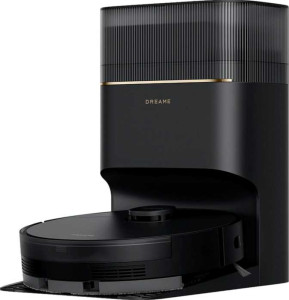
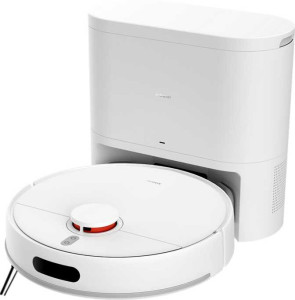
Both the Dreame D20 Pro Plus and the Xiaomi H40 share a solid foundation of features: HEPA and allergy filtration, plus compatibility with both Google Assistant and Alexa. The robot bodies are also similarly sized, though the D20 Pro Plus is marginally wider at 350 mm versus the H40's 340 mm, which could matter in tighter spaces under furniture. The H40 is notably heavier at 3,640 g compared to the D20 Pro Plus at 3,265 g, a gap that matters mainly during manual handling or maintenance.
Two differences stand out as genuinely impactful in daily use. First, noise: the H40 operates at 50 dB versus the D20 Pro Plus's 60 dB. A 10 dB gap is not subtle — it is perceived as roughly twice as loud, meaning the D20 Pro Plus will be noticeably more disruptive in quiet environments. Second, the docking stations differ dramatically in footprint: the D20 Pro Plus dock occupies 59,266 cm³, while the H40's base is just 17,734 cm³ — less than a third of the size. If floor space near the charging station is limited, the H40 has a clear practical edge. On the flip side, the D20 Pro Plus requires emptying only every 150 days on average, compared to 90 days for the H40, suggesting a significantly larger onboard dustbin capacity and less maintenance intervention.
On balance, neither product dominates outright, but priorities split the decision cleanly. The H40 wins on quieter operation, a much smaller dock footprint, and a longer 2-year warranty (versus 1 year for the D20 Pro Plus). The D20 Pro Plus counters with a substantially longer estimated empty cycle, meaning fewer trips to deal with the bin — a meaningful convenience for larger homes or infrequent users. Users in apartments or noise-sensitive households will lean toward the H40; those prioritizing low-maintenance autonomy may prefer the D20 Pro Plus.