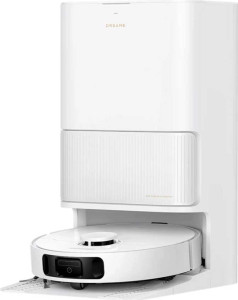
Dreame L40s Ultra AE
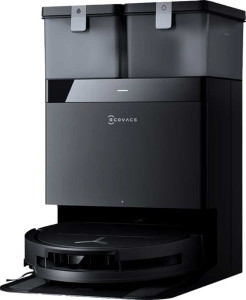
Ecovacs Deebot T50 Omni

Dreame L40s Ultra AE Ecovacs Deebot T50 Omni

Overview

Welcome to our in-depth spec comparison between the Dreame L40s Ultra AE and the Ecovacs Deebot T50 Omni, two high-end robot vacuums that share a surprising amount of common ground. Both offer self-emptying docking stations, mopping capabilities, HEPA filtration, and smart-home integration. Yet beneath the surface, key divergences in suction power, runtime, and design dimensions make the choice far from straightforward. Read on to see how these two contenders stack up across every major specification.

Common Features

  • Both products include a HEPA filter.
  • Both products include an allergy filter.
  • Both products are compatible with Google Assistant.
  • Both products work with Alexa.
  • Both products produce 63 dB of audible noise.
  • Both products support mapping.
  • Both products support no-go zones.
  • Both products support remote smartphone control.
  • Both products have an obstacle sensor.
  • Both products support problem area cleaning.
  • Both products are self-emptying.
  • Both products have carpet detection.
  • Both products do not get stuck easily.
  • Neither product has a display.
  • Neither product has twin side brushes.
  • Both products include washable filters.
  • Both products automatically adjust their height.
  • Neither product indicates when full.
  • Both products use bags.
  • Both products clean all floor types.
  • Both products offer 4 cleaning modes.
  • Both products can mop.
  • Neither product has UV light.
  • Both products have a 5200 mAh battery.
  • Neither product has a removable battery.
  • Both products have an auto-off feature.

Main Differences

  • Weight is 4230 g on Dreame L40s Ultra AE and 3700 g on Ecovacs Deebot T50 Omni.
  • Width is 350 mm on Dreame L40s Ultra AE and 351.6 mm on Ecovacs Deebot T50 Omni.
  • Height is 103.5 mm on Dreame L40s Ultra AE and 81 mm on Ecovacs Deebot T50 Omni.
  • Thickness is 350 mm on Dreame L40s Ultra AE and 352.7 mm on Ecovacs Deebot T50 Omni.
  • Volume is 12678.75 cm³ on Dreame L40s Ultra AE and 10044.75 cm³ on Ecovacs Deebot T50 Omni.
  • Docking station size is 91829.58 cm³ on Dreame L40s Ultra AE and 88984.35 cm³ on Ecovacs Deebot T50 Omni.
  • Dustbin capacity is 0.32 l on Dreame L40s Ultra AE and 0.26 l on Ecovacs Deebot T50 Omni.
  • Suction power is 19000 Pa on Dreame L40s Ultra AE and 12800 Pa on Ecovacs Deebot T50 Omni.
  • A dirt sensor is present on Ecovacs Deebot T50 Omni but not available on Dreame L40s Ultra AE.
  • Runtime is 160 min on Dreame L40s Ultra AE and 175 min on Ecovacs Deebot T50 Omni.
  • Charge time is 4 hours on Dreame L40s Ultra AE and 3.25 hours on Ecovacs Deebot T50 Omni.
  • Operating power consumption is 38W on Dreame L40s Ultra AE and 75W on Ecovacs Deebot T50 Omni.
Specs Comparison
Dreame L40s Ultra AE

Dreame L40s Ultra AE

Ecovacs Deebot T50 Omni

Ecovacs Deebot T50 Omni

General info:
has HEPA filter
audible noise 63 dB 63 dB
has an allergy filter
compatible with Google Assistant
works with Alexa
release date June 2025 March 2025
weight 4230 g 3700 g
width 350 mm 351.6 mm
height 103.5 mm 81 mm
thickness 350 mm 352.7 mm
volume 12678.75 cm³ 10044.75492 cm³
docking station size 91829.58 cm³ 88984.35 cm³

Both the Dreame L40s Ultra AE and the Ecovacs Deebot T50 Omni share a nearly identical feature baseline in this category: both carry HEPA and allergy filtration, operate at the same 63 dB audible noise level, and offer full smart-home integration with both Google Assistant and Alexa. For users prioritizing these criteria, neither product holds an advantage.

Where the two diverge is in their physical footprint. The Deebot T50 Omni is noticeably lighter at 3,700 g versus the L40s Ultra AE's 4,230 g — a difference of over 500 g that can matter when manually lifting or repositioning the unit. The T50 Omni also sits significantly lower at 81 mm in height compared to 103.5 mm, which translates directly into the ability to navigate under lower furniture such as beds or sofas. Its smaller robot body volume (~10,045 cm³ vs. ~12,679 cm³) reinforces this more compact profile. The docking stations follow a similar pattern, with the T50 Omni's base being marginally smaller as well.

On physical design, the Deebot T50 Omni holds a clear edge: it is lighter, meaningfully slimmer, and takes up less space — advantages that translate to better under-furniture reach and easier handling. The L40s Ultra AE matches it on all filtration and smart-home compatibility specs, so buyers who prioritize a lower-profile robot over other considerations will find the T50 Omni the stronger choice in this group.

Features:
has mapping
supports no-go zones
supports a remote smartphone
has an obstacle sensor
has problem area cleaning
is self-emptying
has carpet detection
doesn't get stuck
supports virtual barriers
has route mapping
Has voice prompts
auto docking
has anti-fall sensor
can be scheduled
has a remote control
has water level adjustment
supports Wi-Fi
has mop cleaning
has mop raising
has mop drying

Across the full features checklist, the Dreame L40s Ultra AE and the Ecovacs Deebot T50 Omni are in complete lockstep — every single capability present on one is present on the other. Both robots cover the essentials of modern autonomous cleaning: mapping, no-go zones, virtual barriers, and scheduled cleaning, alongside more advanced niceties like problem-area targeting and anti-fall sensors.

Notably, both units tackle the full mopping lifecycle — mop cleaning, mop raising, and mop drying — which means neither cuts corners on wet-floor maintenance. Mop raising is particularly significant in mixed-surface homes, as it prevents the mop pad from dragging across carpets when transitioning between floor types. The shared presence of carpet detection and self-emptying further underlines that both products are positioned as fully autonomous, minimal-intervention systems.

This group results in a complete tie. There is not a single feature differentiator between the two robots here — every capability is matched exactly. Buyers cannot use this spec group to distinguish one product from the other and should weigh the other specification groups — such as cleaning performance, suction power, or physical design — to make their decision.

Design:
dustbin capacity 0.32 l 0.26 l
Has a display
has twin side brushes
has included washable filters
automatically adjusts its height
Indicates when full
uses bags

The design specs for these two robots are nearly identical across the board — both lack a display, use bags for dust collection, include washable filters, automatically adjust their height, and forgo twin side brushes. The shared use of bags is worth noting: bagged systems generally contain allergens more effectively during disposal compared to bagless designs, which aligns with both units' allergy-filter credentials established in other spec groups.

The one tangible difference here is dustbin capacity: the Dreame L40s Ultra AE holds 0.32 l versus the Ecovacs Deebot T50 Omni's 0.26 l. In practice, since both robots are self-emptying, the on-board bin only needs to hold debris between docking cycles rather than for extended periods. However, a larger bin does provide a buffer in scenarios where the robot is running extended sessions far from the dock, reducing the risk of overflow before it can empty itself.

The L40s Ultra AE holds a narrow edge in this group solely on the basis of its larger dustbin. All other design attributes are evenly matched, so this advantage is modest in real-world terms — particularly for users who dock frequently — but it is the only differentiator the data supports.

Cleaning power:
suction power 19000 Pa 12800 Pa
cleans all floor types
cleaning modes 4 4
mops
has a dirt sensor
has UV light

Suction power is where this group's most significant gap emerges. The Dreame L40s Ultra AE delivers 19,000 Pa of suction against the Ecovacs Deebot T50 Omni's 12,800 Pa — a difference of over 48%. In practical terms, higher Pascal ratings translate to stronger pickup of deep-embedded debris, pet hair trapped in carpet fibers, and heavier particles that lower-powered units may struggle to lift. For households with thick-pile rugs or heavy shedding pets, this gap is meaningful.

The T50 Omni counters with one exclusive capability in this group: a dirt sensor, which the L40s Ultra AE lacks. A dirt sensor allows the robot to detect heavily soiled areas and automatically intensify cleaning passes on those spots, adding a layer of adaptive intelligence that can partially offset raw suction differences in lightly-to-moderately soiled environments. Both robots share the same number of cleaning modes (4), mop capability, and universal floor-type coverage, so neither holds a structural advantage in versatility.

On balance, the L40s Ultra AE holds the stronger edge in this group. Its suction advantage is substantial enough to matter in demanding cleaning scenarios, and while the T50 Omni's dirt sensor is a genuinely useful feature, it complements cleaning intelligence rather than compensating for a nearly 6,200 Pa deficit in raw power. Users with high-traffic or carpeted homes will find the Dreame's output advantage the more impactful differentiator here.
Power:
battery power 5200 mAh 5200 mAh
runtime 160 min 175 min
charge time 4 hours 3.25 hours
operating power consumption 38W 75W
has a removable battery
has auto-off

Starting from the same 5,200 mAh battery, the two robots diverge in telling ways. The Ecovacs Deebot T50 Omni ekes out a longer runtime at 175 minutes versus the Dreame L40s Ultra AE's 160 minutes — a 15-minute advantage that could be the difference between completing a large floor plan in a single run or requiring a mid-session recharge. It also charges faster, returning to full in 3.25 hours compared to the L40s Ultra AE's 4 hours, which matters for users who run cleaning cycles back-to-back or on tight schedules.

The sharpest contrast in this group, however, is operating power consumption. The L40s Ultra AE draws just 38W during operation, while the T50 Omni consumes 75W — nearly double. This means the Dreame is substantially more energy-efficient at the wall, which will reflect in electricity costs over time, particularly for users running daily cleaning cycles. It is also notable that the L40s achieves its runtime on significantly less power, suggesting a more efficient internal power management design, even if the T50 Omni ultimately runs longer on the same capacity.

This group presents a genuine trade-off rather than a clean winner. The T50 Omni has the practical edge for users prioritizing uninterrupted cleaning range and faster turnaround between charges. The L40s Ultra AE is the better choice for energy-conscious users, as its dramatically lower power draw makes it meaningfully cheaper to operate day-to-day. The right call depends squarely on which of those priorities matters more to the buyer.

Comparison Summary & Verdict

After reviewing every spec, both robots prove to be capable, feature-rich performers — but they cater to slightly different priorities. The Dreame L40s Ultra AE stands out with its dominant 19000 Pa suction power and larger 0.32 l dustbin, making it the stronger pick for homes with heavy debris loads or pet hair. However, it is taller, heavier, and takes longer to recharge. The Ecovacs Deebot T50 Omni counters with a slimmer 81 mm profile, longer 175-minute runtime, faster 3.25-hour charge time, and a built-in dirt sensor for smarter adaptive cleaning — all in a lighter chassis. If efficiency and under-furniture reach matter most, the Ecovacs wins on those fronts. Both share the same battery capacity, noise level, and smart features, so the decision ultimately comes down to raw cleaning muscle versus intelligent, energy-aware operation.

Dreame L40s Ultra AE
Buy Dreame L40s Ultra AE if...

Buy the Dreame L40s Ultra AE if you want the most powerful suction available and a larger dustbin capacity for heavy-duty cleaning sessions.

Ecovacs Deebot T50 Omni
Buy Ecovacs Deebot T50 Omni if...

Buy the Ecovacs Deebot T50 Omni if you prioritize a slimmer profile, longer runtime, faster charging, and smarter dirt-sensing for adaptive floor cleaning.