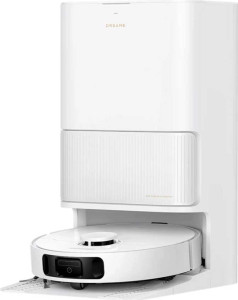
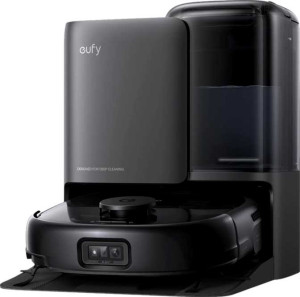
Both the Dreame L40s Ultra AE and the Eufy Omni E25 share a strong baseline of general features: both carry a HEPA allergy filter, support voice control via Google Assistant and Alexa, and come with a 1-year warranty. These are table-stakes features in this product category, so neither gains an edge here. Their robot body footprints are also nearly identical in volume (~12,600 cm³), meaning they navigate similar floor spaces and fit under comparable furniture.
The most striking differentiator in this group is weight: the L40s Ultra AE tips the scales at 4,230 g versus just 1,500 g for the Eufy Omni E25 — nearly three times heavier. For a robot that stays on the floor autonomously, this matters less during daily use, but it becomes very relevant when you need to manually lift, carry, or reposition the unit. The L40s also comes with a significantly larger docking station (91,829 cm³ vs 74,167 cm³), meaning it demands considerably more floor space in your home. The Eufy's more compact dock is a real-world advantage for users with tighter living spaces.
On the flip side, the L40s Ultra AE edges ahead with a longer estimated bin-empty cycle of 100 days versus the Eufy's 75 days, reducing how often you need to interact with the base station. The Eufy also holds a slight acoustic advantage at 60 dB versus 63 dB — a 3 dB difference which is perceptible and can matter in quieter environments or during nighttime runs. Overall, the Eufy Omni E25 has the edge in this group for space-conscious and noise-sensitive users, while the L40s Ultra AE offers a meaningful advantage in autonomy through its longer dust-emptying interval.