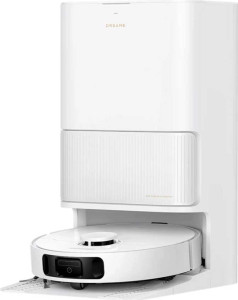
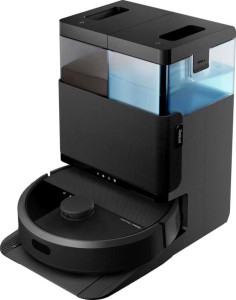
Dreame L40s Ultra AE
iRobot Roomba Plus 405 (G181)

Dreame L40s Ultra AE iRobot Roomba Plus 405 (G181)

Overview

Welcome to our detailed spec comparison between the Dreame L40s Ultra AE and the iRobot Roomba Plus 405 (G181) — two capable robot vacuums with a lot in common, yet some meaningful distinctions under the hood. Both tackle multiple floor types, offer mopping, and integrate with smart home assistants, but they diverge notably on self-emptying capability, dust management, and battery runtime. Read on to see which model aligns best with your cleaning needs.

Common Features

  • Both products include a HEPA filter.
  • Both products include an allergy filter.
  • Both products are compatible with Google Assistant.
  • Both products work with Alexa.
  • Both products come with a 1-year warranty.
  • Both products support no-go zones.
  • Both products support remote smartphone control.
  • Both products have an obstacle sensor.
  • Both products are designed to avoid getting stuck.
  • Both products support virtual barriers.
  • Both products have route mapping.
  • Both products have voice prompts.
  • Both products feature auto docking.
  • Neither product has a display.
  • Neither product has twin side brushes.
  • Neither product indicates when the dustbin is full.
  • Both products clean all floor types.
  • Both products offer 4 cleaning modes.
  • Both products are capable of mopping.
  • Neither product has UV light.
  • Both products have a 4-hour charge time.
  • Both products feature auto-off functionality.

Main Differences

  • Audible noise is 63 dB on Dreame L40s Ultra AE and 60 dB on iRobot Roomba Plus 405 (G181).
  • Weight is 4230 g on Dreame L40s Ultra AE and 4100 g on iRobot Roomba Plus 405 (G181).
  • Width is 350 mm on Dreame L40s Ultra AE and 351 mm on iRobot Roomba Plus 405 (G181).
  • Height is 103.5 mm on Dreame L40s Ultra AE and 106 mm on iRobot Roomba Plus 405 (G181).
  • Thickness is 350 mm on Dreame L40s Ultra AE and 357 mm on iRobot Roomba Plus 405 (G181).
  • Volume is 12678.75 cm³ on Dreame L40s Ultra AE and 13282.542 cm³ on iRobot Roomba Plus 405 (G181).
  • Estimated empty time is 100 days on Dreame L40s Ultra AE and 75 days on iRobot Roomba Plus 405 (G181).
  • Docking station size is 91829.58 cm³ on Dreame L40s Ultra AE and 13282.542 cm³ on iRobot Roomba Plus 405 (G181).
  • Self-emptying capability is present on Dreame L40s Ultra AE but not available on iRobot Roomba Plus 405 (G181).
  • Dustbin capacity is 0.32 l on Dreame L40s Ultra AE and 0.4 l on iRobot Roomba Plus 405 (G181).
  • Washable filters are included with Dreame L40s Ultra AE but not with iRobot Roomba Plus 405 (G181).
  • Automatic height adjustment is present on Dreame L40s Ultra AE but not available on iRobot Roomba Plus 405 (G181).
  • A dirt sensor is present on iRobot Roomba Plus 405 (G181) but not available on Dreame L40s Ultra AE.
  • Battery power is 5200 mAh on Dreame L40s Ultra AE and 5000 mAh on iRobot Roomba Plus 405 (G181).
  • Runtime is 160 minutes on Dreame L40s Ultra AE and 180 minutes on iRobot Roomba Plus 405 (G181).
  • Operating power consumption is 38W on Dreame L40s Ultra AE and 33W on iRobot Roomba Plus 405 (G181).
Specs Comparison
Dreame L40s Ultra AE

Dreame L40s Ultra AE

iRobot Roomba Plus 405 (G181)

iRobot Roomba Plus 405 (G181)

General info:
has HEPA filter
audible noise 63 dB 60 dB
has an allergy filter
compatible with Google Assistant
works with Alexa
release date June 2025 April 2025
weight 4230 g 4100 g
width 350 mm 351 mm
height 103.5 mm 106 mm
thickness 350 mm 357 mm
volume 12678.75 cm³ 13282.542 cm³
warranty period 1 years 1 years
estimated empty time 100 days 75 days
docking station size 91829.58 cm³ 13282.542 cm³

At a high level, the Dreame L40s Ultra AE and the iRobot Roomba Plus 405 share a remarkably similar hardware footprint — both weigh just over 4 kg, occupy nearly identical floor diameters, and stand under 107 mm tall, meaning neither will struggle with standard furniture clearances. Both also share HEPA and allergy filtration, full Google Assistant and Alexa compatibility, and a one-year warranty, so on those fronts the choice is a pure tie.

The most striking divergence in this group is the docking station size: the Dreame's base measures roughly 91,830 cm³, compared to just 13,283 cm³ for the Roomba — a difference of nearly 7×. In practical terms, a dock that large almost certainly houses significantly more infrastructure (such as clean and dirty water tanks or a self-washing mop pad system), which directly explains the Dreame's longer estimated empty time of 100 days versus the Roomba's 75 days. If you value infrequent manual intervention, the Dreame's base station architecture gives it a meaningful real-world edge. The trade-off is floor space: that dock will demand a noticeably larger footprint in your home.

On acoustics, the Roomba holds a slight advantage at 60 dB versus the Dreame's 63 dB — a 3 dB gap that, per the logarithmic nature of sound, represents roughly twice the perceived loudness increase. This may matter during nighttime runs or in noise-sensitive households. Overall, the Dreame edges ahead on autonomy and base station capability, while the Roomba offers a quieter operation and a far more compact docking solution.

Features:
supports no-go zones
supports a remote smartphone
has an obstacle sensor
is self-emptying
doesn't get stuck
supports virtual barriers
has route mapping
Has voice prompts
auto docking
has anti-fall sensor
can be scheduled
has a remote control
supports Wi-Fi
has mop cleaning
has mop raising
has mop drying

Across nearly the entire features checklist, these two robots are carbon copies of each other — both offer no-go zones, virtual barriers, route mapping, obstacle and anti-fall sensors, scheduling, auto-docking, Wi-Fi, smartphone control, voice prompts, and even a full mop suite including mop raising and mop drying. For the vast majority of smart home use cases, either robot delivers the same breadth of automation and floor-care capability.

The single differentiator in this group is self-emptying: the Dreame L40s Ultra AE has it, the Roomba Plus 405 does not. This is not a minor checkbox — self-emptying means the robot automatically transfers collected debris into the base station's bin after each run, so you may go weeks without manually touching the dustbin. The Roomba, by contrast, requires the user to empty its onboard bin after every one or two cleaning cycles, which adds a recurring hands-on chore that undermines the ″set and forget″ promise of a premium robot vacuum.

Given that every other feature in this group is identical, the Dreame L40s Ultra AE holds a clear and unambiguous edge here, solely on the strength of self-emptying. For users who prioritize truly low-maintenance operation, this single difference is highly consequential.

Design:
dustbin capacity 0.32 l 0.4 l
Has a display
has twin side brushes
has included washable filters
automatically adjusts its height
Indicates when full

Two design details separate these robots in a meaningful way. The Roomba Plus 405 carries a larger onboard dustbin at 0.4 l versus the Dreame's 0.32 l — a 25% capacity advantage. In isolation this matters, but context is critical: as established by the features data, the Dreame is self-emptying, meaning its smaller bin is regularly offloaded to the base station automatically. The Roomba's larger bin is essentially compensation for the fact that the user must empty it manually, so the real-world advantage largely cancels out.

Where the Dreame pulls ahead is in two practical design choices: included washable filters and automatic height adjustment. Washable filters reduce ongoing consumable costs and keep filtration performance consistent over time without requiring replacement purchases. Automatic height adjustment — the ability to raise or lower the robot's chassis to adapt to different floor surfaces like low-pile carpet versus hard floors — translates to more consistent suction contact and better cleaning results across a mixed-flooring home. The Roomba offers neither of these, which adds long-term maintenance costs and limits its adaptability.

Neither robot has a display or a full-bin indicator, so those are non-factors. On balance, the Dreame L40s Ultra AE has the stronger design profile for this group: the washable filters and auto height adjustment are genuinely useful real-world features, while the Roomba's bin-size edge is effectively neutralized by the Dreame's self-emptying capability.

Cleaning power:
cleans all floor types
cleaning modes 4 4
mops
has a dirt sensor
has UV light

Cleaning power fundamentals are evenly matched: both robots handle all floor types, offer 4 cleaning modes, and include mopping capability. Neither uses UV light, so that is a non-factor. The parity here means neither robot has a structural advantage in terms of cleaning versatility or mode flexibility.

The one differentiator is the dirt sensor, which the Roomba Plus 405 has and the Dreame does not. A dirt sensor allows the robot to detect high-debris areas in real time and automatically increase cleaning passes or suction intensity in those zones — particularly useful in high-traffic areas or homes with pets. Without it, the Dreame applies a more uniform cleaning strategy regardless of how dirty a specific patch of floor actually is.

For this group specifically, the Roomba Plus 405 holds a narrow but real edge. The dirt sensor is a practical intelligence feature that directly improves cleaning thoroughness in the spots that need it most. That said, the gap is limited to this single capability — everything else in this category is identical between the two.

Power:
battery power 5200 mAh 5000 mAh
runtime 160 min 180 min
charge time 4 hours 4 hours
operating power consumption 38W 33W
has auto-off

Battery capacity is close but not identical — the Dreame carries a 5200 mAh cell versus the Roomba's 5000 mAh — yet the runtime figures tell a counterintuitive story. Despite its larger battery, the Dreame delivers only 160 minutes of runtime compared to the Roomba's 180 minutes. The explanation lies in power draw: the Dreame consumes 38W during operation versus the Roomba's 33W. That 15% higher power consumption outweighs the modest battery size advantage, resulting in a 20-minute runtime deficit. In practical terms, the Roomba can cover more floor area on a single charge, which matters in larger homes.

Charge time is identical at 4 hours for both, so neither has a recovery advantage after the battery is depleted. Both also include auto-off, meaning neither wastes energy sitting idle — a minor but sensible shared efficiency feature.

The Roomba Plus 405 has the edge in this group. Its more efficient power consumption translates directly into longer uninterrupted cleaning sessions, which is a tangible real-world advantage regardless of the Dreame's marginally larger battery. For very large floor plans where a single charge determines whether a full clean completes in one pass, those extra 20 minutes can be the difference between a finished job and a mid-run dock return.

Comparison Summary & Verdict

After reviewing every specification, both robots share a strong foundation: smart mapping, obstacle avoidance, mopping, and voice assistant support. However, their differences point clearly to different users. The Dreame L40s Ultra AE stands out with its self-emptying station, included washable filters, automatic height adjustment, and a remarkable 100-day estimated empty time — making it the low-maintenance choice for hands-off cleaning. The iRobot Roomba Plus 405 (G181), on the other hand, offers a longer 180-minute runtime, lower power consumption, a built-in dirt sensor, and a larger 0.4 l dustbin, appealing to those who prefer manual oversight with extended cleaning sessions. Choose based on whether convenience automation or runtime endurance matters more to you.

Dreame L40s Ultra AE
Buy Dreame L40s Ultra AE if...

Buy the Dreame L40s Ultra AE if you want a truly hands-off experience thanks to its self-emptying station, washable filters, and an estimated 100-day bin empty cycle.

iRobot Roomba Plus 405 (G181)
Buy iRobot Roomba Plus 405 (G181) if...

Buy the iRobot Roomba Plus 405 (G181) if you prioritize a longer runtime of 180 minutes, lower power consumption, and a built-in dirt sensor for smarter cleaning decisions.