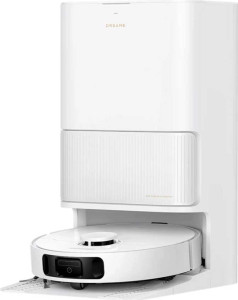
Dreame L40s Ultra AE
Mova P50 Pro Ultra

Dreame L40s Ultra AE Mova P50 Pro Ultra

Overview

Welcome to this detailed specification face-off between the Dreame L40s Ultra AE and the Mova P50 Pro Ultra, two premium robot vacuums sharing a surprising amount of common ground. Both machines deliver identical 19000 Pa suction power, self-emptying docking stations, and full smart-home integration, making the choice far from obvious. This comparison digs into the key battlegrounds where they actually diverge: noise levels and weight, battery capacity and runtime, cleaning intelligence features, and warranty coverage — so you can find the right fit for your home.

Common Features

  • Both products include a HEPA filter.
  • Both products include an allergy filter.
  • Both products are compatible with Google Assistant.
  • Both products work with Alexa.
  • Both products share the same width of 350 mm.
  • Both products share the same thickness of 350 mm.
  • Both products have an estimated empty time of 100 days.
  • Mapping is available on both products.
  • No-go zone support is available on both products.
  • Remote smartphone control is supported on both products.
  • An obstacle sensor is present on both products.
  • Problem area cleaning is supported on both products.
  • Both products are self-emptying.
  • Carpet detection is available on both products.
  • Neither product gets stuck during operation.
  • Both products have a dustbin capacity of 0.32 l.
  • Neither product has a display.
  • Twin side brushes are not included on either product.
  • Washable filters are included with both products.
  • Both products automatically adjust their height.
  • Neither product indicates when the dustbin is full.
  • Both products use bags.
  • Both products deliver 19000 Pa of suction power.
  • Both products clean all floor types.
  • Both products offer 4 cleaning modes.
  • Both products are capable of mopping.
  • UV light is not available on either product.
  • Neither product has an overheating indicator.
  • Neither product has a removable battery.
  • Auto-off is supported on both products.

Main Differences

  • Audible noise is 63 dB on Dreame L40s Ultra AE and 74 dB on Mova P50 Pro Ultra.
  • Weight is 4230 g on Dreame L40s Ultra AE and 4600 g on Mova P50 Pro Ultra.
  • Height is 103.5 mm on Dreame L40s Ultra AE and 103.8 mm on Mova P50 Pro Ultra.
  • Volume is 12678.75 cm³ on Dreame L40s Ultra AE and 12715.5 cm³ on Mova P50 Pro Ultra.
  • Warranty period is 1 year on Dreame L40s Ultra AE and 3 years on Mova P50 Pro Ultra.
  • Docking station size is 91829.58 cm³ on Dreame L40s Ultra AE and 90409.2 cm³ on Mova P50 Pro Ultra.
  • A dirt sensor is present on Mova P50 Pro Ultra but not available on Dreame L40s Ultra AE.
  • An electrostatic filtration system is present on Dreame L40s Ultra AE but not available on Mova P50 Pro Ultra.
  • Battery power is 5200 mAh on Dreame L40s Ultra AE and 6400 mAh on Mova P50 Pro Ultra.
  • Runtime is 160 minutes on Dreame L40s Ultra AE and 170 minutes on Mova P50 Pro Ultra.
  • Charge time is 4 hours on Dreame L40s Ultra AE and 3.5 hours on Mova P50 Pro Ultra.
Specs Comparison
Dreame L40s Ultra AE

Dreame L40s Ultra AE

Mova P50 Pro Ultra

Mova P50 Pro Ultra

General info:
has HEPA filter
audible noise 63 dB 74 dB
has an allergy filter
compatible with Google Assistant
works with Alexa
release date June 2025 March 2025
weight 4230 g 4600 g
width 350 mm 350 mm
height 103.5 mm 103.8 mm
thickness 350 mm 350 mm
volume 12678.75 cm³ 12715.5 cm³
warranty period 1 years 3 years
estimated empty time 100 days 100 days
docking station size 91829.58 cm³ 90409.2 cm³

Both the Dreame L40s Ultra AE and the Mova P50 Pro Ultra share a strong baseline of general features: HEPA and allergy filtration, compatibility with both Google Assistant and Alexa, and identical footprints (350 × 350 mm) with nearly the same profile height (~103–104 mm). Their 100-day estimated dustbin empty cycle is also identical, meaning neither has an edge in how often you interact with the dock for maintenance. For most households, these shared traits already place both robots in a premium, hands-off category.

Where things diverge meaningfully is in audible noise and warranty coverage. The L40s Ultra AE operates at 63 dB versus the P50 Pro Ultra's 74 dB — an 11 dB gap that is not subtle. Because decibels follow a logarithmic scale, this difference means the Mova is perceived as roughly three times louder during operation. For open-plan living spaces or households with young children or remote workers, this is a genuine quality-of-life distinction. On the other hand, the Mova counters with a 3-year warranty against the Dreame's 1-year warranty, offering significantly more long-term purchase protection and a signal of confidence in the product's durability. The Mova is also slightly heavier at 4600 g vs 4230 g, though at this weight class neither robot is handled frequently enough for that gap to matter in practice.

On balance, the Dreame L40s Ultra AE holds a clear edge in day-to-day liveability thanks to its substantially quieter operation — a spec that affects every single cleaning cycle. The Mova P50 Pro Ultra fights back with a compelling long-term value argument via its superior warranty, which matters most if reliability over several years is a priority. Buyers who run their robot while at home will likely favor the Dreame; those prioritizing peace of mind over time may lean toward the Mova.

Features:
has mapping
supports no-go zones
supports a remote smartphone
has an obstacle sensor
has problem area cleaning
is self-emptying
has carpet detection
doesn't get stuck
supports virtual barriers
has route mapping
Has voice prompts
auto docking
has anti-fall sensor
can be scheduled
has a remote control
has water level adjustment
supports Wi-Fi
has mop cleaning
has mop raising
has mop drying

Across the full feature set provided, the Dreame L40s Ultra AE and the Mova P50 Pro Ultra are in complete lockstep — every single capability listed is present on both robots. This is actually a meaningful finding in itself: both machines sit firmly in the premium autonomous cleaning tier, offering the full modern suite of mapping, no-go zones, virtual barriers, and route mapping that define serious hands-off floor care.

The mopping system deserves particular attention, as it represents the most complex cluster of features here. Both robots support mop cleaning, mop raising, and mop drying — the trifecta that separates capable wet-cleaning robots from basic ones. Mop raising ensures carpets are not dampened when the robot transitions between floor types, while auto mop drying prevents mildew buildup in the dock. Combined with water level adjustment, both units give users meaningful control over how aggressively surfaces are mopped. Similarly, the shared carpet detection and ″doesn't get stuck″ capabilities point to obstacle and terrain intelligence that reduces the need for human intervention.

With zero differentiation across all twenty features listed, this group is a complete tie. Neither robot holds any advantage here — a user choosing between them on features alone would have no basis for preference. The decision will need to rest on the distinctions found in other spec groups, such as the noise and warranty differences identified previously.

Design:
dustbin capacity 0.32 l 0.32 l
Has a display
has twin side brushes
has included washable filters
automatically adjusts its height
Indicates when full
uses bags

On the design front, the Dreame L40s Ultra AE and the Mova P50 Pro Ultra are once again indistinguishable — every spec in this group is identical. Both robots carry a 0.32 l onboard dustbin, rely on bags for debris collection at the dock, include washable filters, and automatically adjust their height to adapt to different floor surfaces. Neither features a display or twin side brushes, and neither signals when the bin is full.

A few of these shared traits carry real practical weight. The use of bags in the docking station is a deliberate hygienic choice — bagged collection seals debris during disposal, reducing the cloud of dust and allergens that bagless systems can release. This aligns well with the HEPA and allergy filtration noted in the General Info group, reinforcing that both robots are designed with allergy-conscious users in mind. The inclusion of washable filters also reduces ongoing consumable costs compared to filter-replacement-only designs. Meanwhile, automatic height adjustment ensures consistent suction contact across hard floors and low-pile carpets without manual intervention.

As with the Features group, this is a complete tie — the design specifications provide no basis for differentiation between the two products. Buyers sensitive to design-level decisions like bagged collection or filter maintenance will find both robots equally equipped.

Cleaning power:
suction power 19000 Pa 19000 Pa
cleans all floor types
cleaning modes 4 4
mops
has a dirt sensor
Has an electrostatic filtration system
has UV light

At the core cleaning level, these two robots are evenly matched: both deliver 19,000 Pa of suction, cover all floor types, offer 4 cleaning modes, and include mopping capability. That suction figure places both firmly at the high end of the consumer market, where anything above 10,000 Pa is generally sufficient for deep pile carpet and embedded debris — so real-world cleaning muscle is essentially identical here.

The meaningful split comes down to two mutually exclusive technologies. The Mova P50 Pro Ultra includes a dirt sensor, which allows the robot to dynamically detect heavily soiled areas and intensify cleaning effort in those zones — a genuinely useful feature for homes with pets or high-traffic corridors, as it reduces the need to manually schedule spot cleans. The Dreame L40s Ultra AE, meanwhile, foregoes the dirt sensor but adds an electrostatic filtration system, which uses static charge to capture fine particles that might otherwise pass through standard filter media. This is particularly relevant for ultrafine dust and microscopic allergens, reinforcing the allergy-focused profile already established by its HEPA filtration.

Neither advantage is objectively superior — they address different user needs. The Mova's dirt sensor optimizes cleaning thoroughness in real time, making it the stronger pick for visibly dirty floors. The Dreame's electrostatic filtration targets air quality during and after cleaning, benefiting allergy sufferers who care about what gets recirculated into the room. This group is effectively a contextual tie that splits along use case: reactive cleaning performance versus passive air hygiene.

Power:
battery power 5200 mAh 6400 mAh
runtime 160 min 170 min
charge time 4 hours 3.5 hours
Has an overheating indicator
has a removable battery
has auto-off

Battery performance is where the Mova P50 Pro Ultra pulls ahead in a measurable, if modest, way. Its 6,400 mAh battery outpaces the Dreame's 5,200 mAh — a 23% larger cell — yet the runtime gap it produces is comparatively small: 170 minutes versus 160 minutes. This suggests the Mova draws more power during operation, likely a consequence of its higher motor load, which aligns with the louder noise profile identified earlier. In practical terms, both robots can comfortably clean large homes in a single session, and for most apartments or mid-sized houses, neither would exhaust its battery before finishing a full run.

The more tangible daily-use advantage the Mova holds is in charge time. Returning to a full charge in 3.5 hours versus the Dreame's 4 hours, the Mova is ready for its next cycle 30 minutes sooner. For users who run scheduled cleans once or twice a day, this faster turnaround means less risk of the robot being unavailable when needed — a subtle but real operational benefit. Both units share auto-off and non-removable batteries, so there is no difference in safety features or maintenance flexibility on those fronts.

Overall, the Mova P50 Pro Ultra holds a narrow edge in this group — not because the runtime difference is dramatic, but because faster recharging adds genuine scheduling flexibility with no corresponding downside in endurance. The Dreame's 5,200 mAh battery remains entirely adequate, but it cannot match the combination of higher capacity and quicker recovery that the Mova offers here.
Comparison Summary & Verdict

After examining every specification, both robots prove to be well-matched flagship cleaners, but each has a distinct edge. The Dreame L40s Ultra AE stands out for its notably quieter operation at 63 dB, its lighter 4230 g body, and its electrostatic filtration system — advantages that matter most in noise-sensitive households or for allergy-focused users who want an extra filtration layer. The Mova P50 Pro Ultra counters with a larger 6400 mAh battery delivering 170 minutes of runtime, faster 3.5-hour charging, a built-in dirt sensor for smarter cleaning decisions, and a reassuring 3-year warranty that significantly outpaces its rival. For buyers who prioritize long-term value, endurance, and adaptive cleaning intelligence, the Mova is the stronger pick. For those who value quieter daily operation and advanced filtration, the Dreame earns its place.

Dreame L40s Ultra AE
Buy Dreame L40s Ultra AE if...

Buy the Dreame L40s Ultra AE if you prioritize quieter operation at 63 dB and want an electrostatic filtration system for enhanced air cleaning performance.

Mova P50 Pro Ultra
Buy Mova P50 Pro Ultra if...

Buy the Mova P50 Pro Ultra if you want a longer 3-year warranty, extended battery runtime, faster recharging, and a built-in dirt sensor for smarter adaptive cleaning.