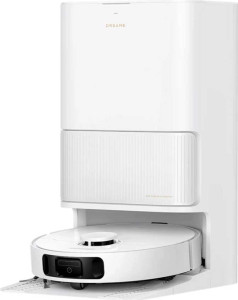
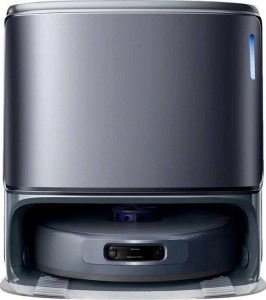
Both robots share a strong baseline of general features: HEPA and allergy filtration, full smart home integration via Google Assistant and Alexa, and a 1-year warranty. These are table-stakes features at this price tier, so neither product gains an edge here. Where things diverge is in the details that affect daily living.
The most impactful difference is operating noise. The Narwal Freo Z10 Ultra runs at 55 dB versus the Dreame L40s Ultra AE's 63 dB — an 8 dB gap that is not subtle. Because the decibel scale is logarithmic, this translates to the Narwal sounding roughly 2.5× quieter in perceived loudness, which is a genuine quality-of-life advantage if the robot runs while you are home or sleeping. On the other hand, the Dreame is 270 g lighter (4230 g vs 4500 g) and has a noticeably smaller robot footprint, which can matter for navigating tighter spaces and doorways.
For the docking station, the picture flips: the Narwal's base is significantly more compact at ~77,223 cm³ compared to the Dreame's ~91,830 cm³ — about 19% less volume — making it easier to tuck into a corner. The Narwal also edges ahead on the estimated empty time at 120 days versus 100 days, meaning less frequent manual intervention with the dustbin. Overall, the Narwal Freo Z10 Ultra holds the advantage in this group, primarily due to its substantially quieter operation, longer auto-empty cycle, and smaller dock footprint — despite carrying a slightly heavier and larger robot body.