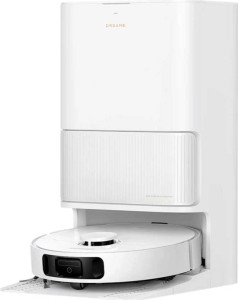
Dreame L40s Ultra CE
Ecovacs Deebot X8 Pro Omni

Dreame L40s Ultra CE Ecovacs Deebot X8 Pro Omni

Overview

Welcome to our in-depth specification comparison between the Dreame L40s Ultra CE and the Ecovacs Deebot X8 Pro Omni. Both are premium self-emptying robot vacuums sharing a strong feature set, yet they diverge in meaningful ways across suction power, battery performance, smart assistant compatibility, and sensor technology. Read on to discover which model best suits your cleaning needs and lifestyle.

Common Features

  • Both products include a HEPA filter.
  • Both products include an allergy filter.
  • Both products are compatible with Alexa.
  • Both products come with a 1-year warranty.
  • Both products support mapping.
  • Both products support no-go zones.
  • Both products support remote smartphone control.
  • Both products have an obstacle sensor.
  • Both products support problem area cleaning.
  • Both products are self-emptying.
  • Both products have carpet detection.
  • Both products are designed to avoid getting stuck.
  • Neither product has a display.
  • Neither product has twin side brushes.
  • Both products include washable filters.
  • Both products automatically adjust their height.
  • Both products use bags.
  • Both products clean all floor types.
  • Both products offer 4 cleaning modes.
  • Both products are capable of mopping.
  • Neither product has UV light.
  • Neither product has a removable battery.

Main Differences

  • Audible noise is 63 dB on Dreame L40s Ultra CE and 65 dB on Ecovacs Deebot X8 Pro Omni.
  • Google Assistant compatibility is available on Dreame L40s Ultra CE but not on Ecovacs Deebot X8 Pro Omni.
  • Weight is 4230 g on Dreame L40s Ultra CE and 4100 g on Ecovacs Deebot X8 Pro Omni.
  • Width is 350 mm on Dreame L40s Ultra CE and 353 mm on Ecovacs Deebot X8 Pro Omni.
  • Height is 103.5 mm on Dreame L40s Ultra CE and 98 mm on Ecovacs Deebot X8 Pro Omni.
  • Thickness is 350 mm on Dreame L40s Ultra CE and 351 mm on Ecovacs Deebot X8 Pro Omni.
  • Volume is 12678.75 cm³ on Dreame L40s Ultra CE and 12142.494 cm³ on Ecovacs Deebot X8 Pro Omni.
  • Estimated empty time is 100 days on Dreame L40s Ultra CE and 75 days on Ecovacs Deebot X8 Pro Omni.
  • Docking station size is 91829.58 cm³ on Dreame L40s Ultra CE and 88984.35 cm³ on Ecovacs Deebot X8 Pro Omni.
  • Dustbin capacity is 0.32 l on Dreame L40s Ultra CE and 0.3 l on Ecovacs Deebot X8 Pro Omni.
  • A full-bin indicator is present on Ecovacs Deebot X8 Pro Omni but not available on Dreame L40s Ultra CE.
  • Suction power is 13000 Pa on Dreame L40s Ultra CE and 18000 Pa on Ecovacs Deebot X8 Pro Omni.
  • A dirt sensor is present on Ecovacs Deebot X8 Pro Omni but not available on Dreame L40s Ultra CE.
  • Battery power is 5200 mAh on Dreame L40s Ultra CE and 6400 mAh on Ecovacs Deebot X8 Pro Omni.
  • Runtime is 160 min on Dreame L40s Ultra CE and 145 min on Ecovacs Deebot X8 Pro Omni.
  • Charge time is 4 hours on Dreame L40s Ultra CE and 4.5 hours on Ecovacs Deebot X8 Pro Omni.
  • Operating power consumption is 38W on Dreame L40s Ultra CE and 45W on Ecovacs Deebot X8 Pro Omni.
Specs Comparison
Dreame L40s Ultra CE

Dreame L40s Ultra CE

Ecovacs Deebot X8 Pro Omni

Ecovacs Deebot X8 Pro Omni

General info:
has HEPA filter
audible noise 63 dB 65 dB
has an allergy filter
compatible with Google Assistant
works with Alexa
release date May 2025 February 2025
weight 4230 g 4100 g
width 350 mm 353 mm
height 103.5 mm 98 mm
thickness 350 mm 351 mm
volume 12678.75 cm³ 12142.494 cm³
warranty period 1 years 1 years
estimated empty time 100 days 75 days
docking station size 91829.58 cm³ 88984.35 cm³

Both the Dreame L40s Ultra CE and the Ecovacs Deebot X8 Pro Omni share a solid baseline of core features: HEPA and allergy filtration, Alexa compatibility, and a one-year warranty. For allergy sufferers, neither has a clear edge here — both are well-equipped to trap fine particles. Where they begin to diverge is in the details that affect daily usability.

On noise, the L40s Ultra CE operates at 63 dB versus the X8 Pro Omni's 65 dB — a small but perceptible difference in a quiet home environment. The X8 Pro Omni is marginally slimmer at 98 mm tall (versus 103.5 mm), which may help it slide under slightly lower furniture, while the L40s Ultra CE is fractionally wider at 350 mm versus 353 mm, making them near-identical in footprint. The Dreame does not support Google Assistant, whereas the Ecovacs does not — actually it's the reverse: the L40s Ultra CE supports Google Assistant while the X8 Pro Omni does not, which is a meaningful smart-home advantage if your household runs on a Google ecosystem.

Perhaps the most practically important differentiator in this group is the estimated dustbin empty time: the L40s Ultra CE goes 100 days between empties versus the X8 Pro Omni's 75 days — a 33% advantage that translates directly to less maintenance hassle. Overall, the Dreame L40s Ultra CE holds a clear edge in this general category, thanks to quieter operation, broader voice-assistant compatibility, and a significantly longer auto-empty interval.
Features:
has mapping
supports no-go zones
supports a remote smartphone
has an obstacle sensor
has problem area cleaning
is self-emptying
has carpet detection
doesn't get stuck
supports virtual barriers
has route mapping
Has voice prompts
auto docking
has anti-fall sensor
can be scheduled
has a remote control
has water level adjustment
supports Wi-Fi
has mop cleaning
has mop raising
has mop drying

Across every feature in this group, the Dreame L40s Ultra CE and the Ecovacs Deebot X8 Pro Omni are in complete lockstep — every single capability is shared identically by both robots. This is actually a meaningful signal: both machines sit firmly at the top tier of consumer robot vacuum feature sets, offering the full suite of modern autonomy tools.

The highlights worth understanding in real-world terms are the mop raising, mop cleaning, and mop drying capabilities — together, these form a complete wet-cleaning lifecycle that eliminates the need for manual mop maintenance between sessions. Equally important is the combination of obstacle sensing, anti-fall sensors, and the ″doesn't get stuck″ feature, which collectively indicate sophisticated navigation systems that minimize intervention in complex home environments. No-go zones and virtual barriers add a layer of customizable control that complements automated scheduling.

With no differentiating data points in this group, the verdict is a complete tie. Neither product holds a feature advantage over the other here — buyers can choose between them on this dimension without compromise, and the decision should rest on the specs from other categories.

Design:
dustbin capacity 0.32 l 0.3 l
Has a display
has twin side brushes
has included washable filters
automatically adjusts its height
Indicates when full
uses bags

From a design standpoint, these two robots share nearly identical construction choices: both use bags for dust collection, include washable filters, automatically adjust their height, and forgo a physical display or twin side brushes. The bag-based system is worth noting — it keeps dust contained during emptying, which is particularly beneficial for allergy-sensitive households.

The two meaningful divergences in this group come down to dustbin capacity and a single but practical usability feature. The Dreame L40s Ultra CE holds 0.32 l versus the Ecovacs Deebot X8 Pro Omni's 0.3 l — a negligible real-world difference given both are self-emptying units that rarely rely on onboard bin size alone. More consequential is that the X8 Pro Omni indicates when the dustbin is full, while the L40s Ultra CE does not. In practice, this means the Ecovacs can proactively alert users to a bag or bin issue, reducing the risk of degraded suction performance going unnoticed.

On balance, this group is nearly a wash, but the Ecovacs Deebot X8 Pro Omni holds a narrow edge due to its full-bin indicator — a small quality-of-life advantage that helps maintain consistent cleaning performance without requiring the user to manually check the unit.

Cleaning power:
suction power 13000 Pa 18000 Pa
cleans all floor types
cleaning modes 4 4
mops
has a dirt sensor
has UV light

Cleaning power is where these two robots part ways most decisively. The Ecovacs Deebot X8 Pro Omni delivers 18,000 Pa of suction versus the Dreame L40s Ultra CE's 13,000 Pa — a 38% gap that is far from trivial. In real-world terms, higher Pascal ratings translate directly to more effective pickup of embedded debris, pet hair in carpet fibers, and fine dust on hard floors. Both machines clean all floor types and offer the same 4 cleaning modes, so the structural versatility is equal — but the Ecovacs simply pulls harder.

The X8 Pro Omni also includes a dirt sensor, which the L40s Ultra CE lacks. This feature allows the robot to detect heavily soiled areas and automatically increase cleaning passes or intensity, ensuring problem spots receive extra attention without manual configuration. Combined with the higher suction ceiling, this makes the Ecovacs a more responsive and adaptive cleaner in practice.

The verdict in this category is clear: the Ecovacs Deebot X8 Pro Omni holds a meaningful advantage. Its superior suction output and dirt-sensing intelligence make it the stronger performer for households with high-traffic areas, pets, or carpeted surfaces where raw cleaning effectiveness is the priority.

Power:
battery power 5200 mAh 6400 mAh
runtime 160 min 145 min
charge time 4 hours 4.5 hours
operating power consumption 38W 45W
has a removable battery

The power specs here tell an interesting and somewhat counterintuitive story. The Ecovacs Deebot X8 Pro Omni packs a noticeably larger battery at 6,400 mAh versus the Dreame L40s Ultra CE's 5,200 mAh, yet it actually delivers a shorter runtime — 145 minutes compared to the Dreame's 160 minutes. The explanation lies in energy consumption: the X8 Pro Omni draws 45W during operation versus the L40s Ultra CE's 38W, reflecting the higher suction demands of its more powerful motor. In other words, the Ecovacs burns through its larger reserves faster.

For most homes, both runtimes are more than adequate for a full clean cycle, and both robots support auto-docking and resumption. However, the Dreame's efficiency advantage becomes relevant in very large homes or multi-room layouts where continuous runtime without interruption is valued. The charge time gap — 4 hours for the Dreame versus 4.5 hours for the Ecovacs — is modest but consistent with the larger battery needing more time to replenish.

Taken together, the Dreame L40s Ultra CE edges ahead in this category. It runs longer per charge, charges faster, and operates more efficiently — all without a removable battery on either side to shift the equation. For users who prioritize uninterrupted coverage and lower energy draw, the Dreame's power profile is the more practical one.

Comparison Summary & Verdict

Both robots deliver a well-rounded premium experience, but each has a distinct edge. The Dreame L40s Ultra CE stands out with a quieter operation at 63 dB, a longer runtime of 160 minutes, faster 4-hour charging, and an impressive 100-day estimated empty time, making it ideal for users who value autonomy and low maintenance. It also adds Google Assistant compatibility for broader smart home integration. The Ecovacs Deebot X8 Pro Omni, on the other hand, counters with a significantly higher 18000 Pa suction power, a larger 6400 mAh battery, a built-in dirt sensor, and a full-bin indicator, appealing to users who prioritize raw cleaning performance and smarter dustbin management. Choose the Dreame if long intervals between maintenance and smart home flexibility matter most; opt for the Ecovacs if maximum suction and intelligent dirt detection are your top priorities.

Dreame L40s Ultra CE
Buy Dreame L40s Ultra CE if...

Buy the Dreame L40s Ultra CE if you want quieter operation, a longer runtime, faster charging, and Google Assistant support with up to 100 days between bin empties.

Ecovacs Deebot X8 Pro Omni
Buy Ecovacs Deebot X8 Pro Omni if...

Buy the Ecovacs Deebot X8 Pro Omni if you need maximum suction power at 18000 Pa, a built-in dirt sensor, and a full-bin indicator for smarter, more thorough cleaning.