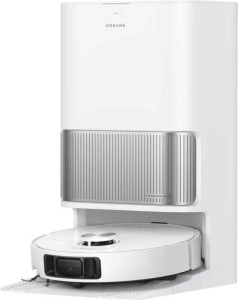
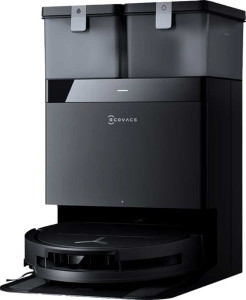
In terms of smart home integration and filtration, both robots are on equal footing: each carries a HEPA allergy filter and supports both Google Assistant and Alexa, making either a seamless fit into any major smart home ecosystem. Noise output is also identical at 63 dB, so neither has an acoustic advantage during cleaning cycles.
Where a real difference emerges is in physical footprint and weight. The Ecovacs Deebot T50 Omni is meaningfully lighter at 3,700 g versus the Dreame L40s Ultra's 4,230 g — a 530 g gap that matters most during manual relocation or when the robot needs to navigate ramps and thresholds. More significantly, the T50 Omni stands just 81 mm tall compared to the L40s Ultra's 103.5 mm, translating to a roughly 22% lower profile. In practice, this allows the T50 Omni to glide under lower-clearance furniture — sofas, bed frames, and cabinet toe-kicks — that the L40s Ultra may simply be unable to reach. This is reflected in the overall robot volume: ~10,045 cm³ for the T50 Omni versus ~12,679 cm³ for the L40s Ultra.
The docking stations are comparably sized, with the T50 Omni's base being only marginally smaller (~88,984 cm³ vs ~91,830 cm³), so neither has a meaningful edge on floor space consumption there. Overall, for general physical specs, the Ecovacs Deebot T50 Omni holds a clear advantage thanks to its lower height and reduced weight — both of which directly improve real-world coverage and handling — while the two robots remain evenly matched on noise, filtration, and smart home compatibility.