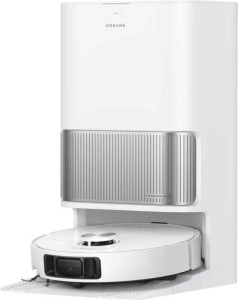
Dreame L40s Ultra
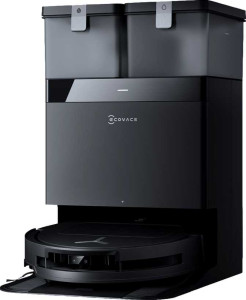
Ecovacs Deebot T50 Pro Omni

Dreame L40s Ultra Ecovacs Deebot T50 Pro Omni

Overview

Choosing between the Dreame L40s Ultra and the Ecovacs Deebot T50 Pro Omni is no easy task — both are premium, self-emptying robot vacuums that share an impressive list of features, from HEPA filtration and mopping to full mapping and smart home compatibility. Yet beneath the surface, key differences in suction power, runtime, and design make each robot better suited to a different kind of home and user. Read on to see how they stack up across every major specification.

Common Features

  • Both products include a HEPA filter.
  • Both products include an allergy filter.
  • Both products produce 63 dB of audible noise during operation.
  • Both products are compatible with Google Assistant.
  • Both products work with Alexa.
  • Both products support mapping.
  • Both products support no-go zones.
  • Both products support remote smartphone control.
  • Both products have an obstacle sensor.
  • Both products support problem area cleaning.
  • Both products are self-emptying.
  • Both products have carpet detection.
  • Neither product gets stuck during operation.
  • Neither product has a display.
  • Neither product has twin side brushes.
  • Both products include washable filters.
  • Both products automatically adjust their height.
  • Neither product indicates when the dustbin is full.
  • Both products use bags.
  • Both products clean all floor types.
  • Both products offer 4 cleaning modes.
  • Both products support mopping.
  • Neither product has UV light.
  • Both products have a 5200 mAh battery.
  • Neither product has a removable battery.
  • Both products have an auto-off feature.

Main Differences

  • Weight is 4230 g on Dreame L40s Ultra and 3700 g on Ecovacs Deebot T50 Pro Omni.
  • Width is 350 mm on Dreame L40s Ultra and 351.6 mm on Ecovacs Deebot T50 Pro Omni.
  • Height is 103.5 mm on Dreame L40s Ultra and 81 mm on Ecovacs Deebot T50 Pro Omni.
  • Thickness is 350 mm on Dreame L40s Ultra and 352.7 mm on Ecovacs Deebot T50 Pro Omni.
  • Volume is 12678.75 cm³ on Dreame L40s Ultra and 10044.75 cm³ on Ecovacs Deebot T50 Pro Omni.
  • Docking station size is 91829.58 cm³ on Dreame L40s Ultra and 88984.35 cm³ on Ecovacs Deebot T50 Pro Omni.
  • Dustbin capacity is 0.32 l on Dreame L40s Ultra and 0.26 l on Ecovacs Deebot T50 Pro Omni.
  • Suction power is 19000 Pa on Dreame L40s Ultra and 15000 Pa on Ecovacs Deebot T50 Pro Omni.
  • A dirt sensor is present on Ecovacs Deebot T50 Pro Omni but not available on Dreame L40s Ultra.
  • Runtime is 160 minutes on Dreame L40s Ultra and 175 minutes on Ecovacs Deebot T50 Pro Omni.
  • Charge time is 4 hours on Dreame L40s Ultra and 3.25 hours on Ecovacs Deebot T50 Pro Omni.
  • Operating power consumption is 38W on Dreame L40s Ultra and 75W on Ecovacs Deebot T50 Pro Omni.
Specs Comparison
Dreame L40s Ultra

Dreame L40s Ultra

Ecovacs Deebot T50 Pro Omni

Ecovacs Deebot T50 Pro Omni

General info:
has HEPA filter
audible noise 63 dB 63 dB
has an allergy filter
compatible with Google Assistant
works with Alexa
release date June 2025 March 2025
weight 4230 g 3700 g
width 350 mm 351.6 mm
height 103.5 mm 81 mm
thickness 350 mm 352.7 mm
volume 12678.75 cm³ 10044.75492 cm³
docking station size 91829.58 cm³ 88984.35 cm³

In terms of smart home compatibility and filtration, both the Dreame L40s Ultra and the Ecovacs Deebot T50 Pro Omni are evenly matched: each supports Google Assistant and Alexa, and both include a HEPA allergy filter — an important feature for households with pets or allergy sufferers. Audible noise is identical at 63 dB, meaning neither robot will be noticeably quieter in daily use.

The more meaningful differences emerge in physical dimensions. The Ecovacs weighs 3700 g versus the Dreame's 4230 g — a 530 g gap that matters when manually lifting the unit for maintenance or repositioning. More significantly, the Ecovacs stands only 81 mm tall compared to the Dreame's 103.5 mm, translating to a roughly 22% smaller robot body volume (~10,045 cm³ vs ~12,679 cm³). In practice, that slimmer profile gives the Ecovacs a real-world advantage in navigating under low-clearance furniture like sofas or bed frames where the Dreame may simply not fit.

The docking stations are close in footprint (~91,830 cm³ for the Dreame vs ~88,984 cm³ for the Ecovacs), so neither holds a meaningful edge there. Overall, the Ecovacs Deebot T50 Pro Omni has the edge in this group, primarily due to its lower profile and lighter weight — practical advantages for real-world deployment in furnished homes.

Features:
has mapping
supports no-go zones
supports a remote smartphone
has an obstacle sensor
has problem area cleaning
is self-emptying
has carpet detection
doesn't get stuck
supports virtual barriers
has route mapping
Has voice prompts
auto docking
has anti-fall sensor
can be scheduled
has a remote control
has water level adjustment
supports Wi-Fi
has mop cleaning
has mop raising
has mop drying

Across all 20 features in this group, the Dreame L40s Ultra and the Ecovacs Deebot T50 Pro Omni are in complete lockstep — every capability present on one is equally present on the other. This is notable because the feature set itself is impressively comprehensive: both robots cover the full modern automation stack, including mapping with no-go zones, virtual barriers, obstacle sensing, and problem-area cleaning, meaning users of either machine get genuinely intelligent floor management rather than simple random-pattern vacuuming.

On the mopping side, both units go beyond basic wet-cloth dragging. The combination of mop raising, mop cleaning, and mop drying — all confirmed on both — represents a complete automated mop lifecycle. Mop raising prevents carpet soaking when transitioning between floor types, mop cleaning keeps the pad hygienic mid-session, and mop drying reduces mildew risk between uses. These three together are a meaningful quality-of-life package that not all robots in this class offer.

Since the data yields zero differentiators between the two products in this group, the verdict is a definitive tie. A buyer prioritizing features alone cannot use this category to separate the two — the decision will need to rest on the differences surfaced in other specification groups.

Design:
dustbin capacity 0.32 l 0.26 l
Has a display
has twin side brushes
has included washable filters
automatically adjusts its height
Indicates when full
uses bags

Most design elements here are shared between the two robots: neither has a display or twin side brushes, both include washable filters, both auto-adjust their height for different floor surfaces, and both use bags rather than bagless collection — a design choice that keeps dust sealed during emptying, which is particularly relevant for allergy-sensitive households. None of these shared traits create a competitive distinction.

The one concrete differentiator is dustbin capacity: the Dreame L40s Ultra holds 0.32 l versus the Ecovacs Deebot T50 Pro Omni's 0.26 l — a roughly 23% larger on-board bin. In practice, since both robots are self-emptying, the robot's own dustbin only needs to hold debris between docking cycles. A larger bin provides a modest buffer if the robot runs extended sessions in heavily soiled areas without returning to base, but for most normal cleaning schedules the real-world impact of this gap is limited.

The Dreame L40s Ultra holds a narrow edge in this group purely on dustbin volume, though it is worth noting that neither unit signals when full — so users of both machines rely entirely on the auto-empty station's own capacity rather than any on-robot feedback. Overall, the design group is largely a wash, with the Dreame's larger dustbin being the only meaningful differentiator.

Cleaning power:
suction power 19000 Pa 15000 Pa
cleans all floor types
cleaning modes 4 4
mops
has a dirt sensor
has UV light

Suction power is where this group's headline difference lives. The Dreame L40s Ultra delivers 19,000 Pa against the Ecovacs Deebot T50 Pro Omni's 15,000 Pa — a 27% gap that is hard to dismiss. In practical terms, higher Pascal ratings translate to stronger pickup of embedded debris, fine particles, and pet hair from carpets. For households with thick-pile rugs or heavy shedding pets, that extra suction headroom can make a tangible difference in cleaning thoroughness per pass.

The Ecovacs counters with one exclusive capability: a dirt sensor, which the Dreame lacks. A dirt sensor allows the robot to detect heavily soiled areas and automatically increase effort or repeat passes — effectively compensating for lower raw suction with smarter application of it. Whether that intelligence bridges the 4,000 Pa gap depends heavily on the home environment; in consistently lightly soiled spaces, the sensor advantage shrinks, while in high-traffic or uneven-mess scenarios it becomes more relevant. Both robots share identical cleaning mode counts (4 each), mop capability, and universal floor type compatibility, so those factors do not differentiate them.

On balance, the Dreame L40s Ultra holds the edge in raw cleaning power for this group. Brute suction is a more universally applicable advantage than a dirt sensor, particularly on carpeted surfaces where peak Pa matters most. The Ecovacs's sensor is a meaningful feature, but it is best viewed as a partial offset rather than a full equalizer against a 27% suction deficit.
Power:
battery power 5200 mAh 5200 mAh
runtime 160 min 175 min
charge time 4 hours 3.25 hours
operating power consumption 38W 75W
has a removable battery
has auto-off

Both robots share the same 5200 mAh battery and neither offers a removable pack — standard design choices at this tier. The interesting story emerges when comparing what each machine does with that identical energy reserve. The Ecovacs Deebot T50 Pro Omni squeezes out 175 minutes of runtime versus the Dreame L40s Ultra's 160 minutes, a 15-minute advantage that can be the difference between completing a large home in a single run or triggering a mid-clean recharge and dock cycle.

Charge time compounds this advantage further. The Ecovacs returns to full in 3.25 hours compared to the Dreame's 4 hours — meaning not only does it run longer per session, it is ready for the next one sooner. For users who schedule multiple daily cleans or have larger floor plans, that 45-minute faster recharge has genuine practical value. What makes these figures particularly striking is that the Ecovacs draws 75W of operating power against the Dreame's 38W — nearly double the consumption — yet still manages to outlast it on the same capacity battery. The data does not explain this directly, but it points to efficiency differences in how each machine manages its power draw across a session.

The Ecovacs Deebot T50 Pro Omni takes a clear edge in this group. Longer runtime and a faster charge cycle are unambiguously user-facing advantages, and they hold regardless of home size or cleaning frequency.

Comparison Summary & Verdict

After a thorough comparison, both robots prove themselves as capable, feature-rich cleaners — but they cater to different priorities. The Dreame L40s Ultra holds a clear edge in raw suction power at 19000 Pa and offers a larger 0.32-litre dustbin, making it the stronger choice for homes with heavy debris loads or pet hair. Its lower operating power draw of 38W may also appeal to energy-conscious users. On the other hand, the Ecovacs Deebot T50 Pro Omni wins on practicality: it is notably lighter and slimmer, charges faster at 3.25 hours, runs longer on a single charge at 175 minutes, and adds a dirt sensor for smarter, more adaptive cleaning. If low-profile navigation under furniture and intelligent soil detection matter most to you, the Ecovacs is the wiser pick.

Dreame L40s Ultra
Buy Dreame L40s Ultra if...

Buy the Dreame L40s Ultra if you need maximum suction power and a larger dustbin capacity for handling heavier debris or pet hair throughout your home.

Ecovacs Deebot T50 Pro Omni
Buy Ecovacs Deebot T50 Pro Omni if...

Buy the Ecovacs Deebot T50 Pro Omni if you want a slimmer, lighter robot with a longer runtime, faster charging, and built-in dirt sensor for smarter adaptive cleaning.