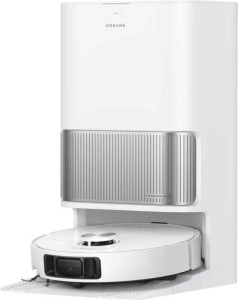
Both robots share a strong baseline of smart-home compatibility — Google Assistant and Alexa support, HEPA and allergy filtration, and a 1-year warranty — so neither has an edge on connectivity or air-quality credentials. Where they diverge meaningfully is in physical design. The Ecovacs Deebot X9 Pro Omni is dramatically slimmer at 59.8 mm tall versus the Dreame L40s Ultra's 103.5 mm, and nearly three times lighter at 1,500 g compared to 4,230 g. In practice, the X9 Pro Omni slides under low-clearance furniture — bed frames, sofas, cabinets — that the L40s Ultra simply cannot reach, which is a tangible daily cleaning advantage in most homes.
The docking station footprint tells a similar story: the L40s Ultra's base occupies roughly 91,830 cm³, almost double the X9 Pro Omni's 46,644 cm³. For users with limited floor space or a tucked-away charging nook, the Deebot's far more compact dock is a real-world convenience win. On the flip side, the Dreame is slightly quieter at 63 dB versus 65.7 dB — a modest but perceptible difference if the robot typically runs during calls or light sleep, though neither unit is whisper-quiet by any measure.
The most striking operational gap is dustbin autonomy: the X9 Pro Omni can go 150 days between auto-empty cycles versus 100 days for the L40s Ultra. That is a 50% longer maintenance interval, meaning significantly fewer bag changes or manual interventions per year. On general-info specs alone, the Ecovacs Deebot X9 Pro Omni holds a clear edge — it is substantially smaller, lighter, less obtrusive in the home, and demands less routine upkeep, with only a marginal noise trade-off against the Dreame.