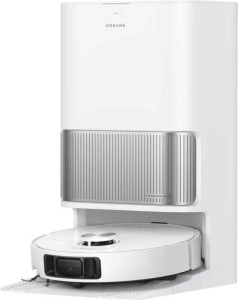
Dreame L40s Ultra
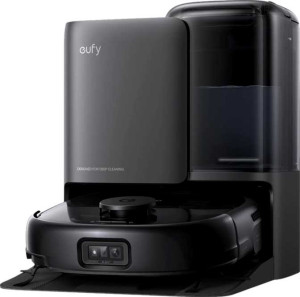
Eufy Omni E25

Dreame L40s Ultra Eufy Omni E25

Overview

Welcome to our in-depth spec comparison between the Dreame L40s Ultra and the Eufy Omni E25 — two capable robot vacuums competing for a spot in your smart home. While both share a strong foundation of features like HEPA filtration, route mapping, and voice assistant compatibility, they diverge in meaningful ways across self-emptying functionality, suction power, battery runtime, and overall design. Read on to see which one truly fits your cleaning needs.

Common Features

  • Both products include a HEPA filter.
  • Both products include an allergy filter.
  • Both products are compatible with Google Assistant.
  • Both products work with Amazon Alexa.
  • Both products come with a 1-year warranty.
  • Both products support no-go zones.
  • Both products support remote smartphone control.
  • Both products have an obstacle sensor.
  • Both products are designed not to get stuck.
  • Both products support virtual barriers.
  • Both products have route mapping.
  • Both products have voice prompts.
  • Both products feature auto docking.
  • Neither product has a display.
  • Neither product has twin side brushes.
  • Neither product indicates when the dustbin is full.
  • Both products clean all floor types.
  • Both products offer 4 cleaning modes.
  • Both products are capable of mopping.
  • Neither product has UV light.
  • Both products have a charge time of 4 hours.
  • Both products feature auto-off functionality.

Main Differences

  • Audible noise is 63 dB on Dreame L40s Ultra and 60 dB on Eufy Omni E25.
  • Weight is 4230 g on Dreame L40s Ultra and 1500 g on Eufy Omni E25.
  • Width is 350 mm on Dreame L40s Ultra and 327 mm on Eufy Omni E25.
  • Height is 103.5 mm on Dreame L40s Ultra and 111 mm on Eufy Omni E25.
  • Thickness is 350 mm on Dreame L40s Ultra and 346 mm on Eufy Omni E25.
  • Volume is 12678.75 cm³ on Dreame L40s Ultra and 12558.762 cm³ on Eufy Omni E25.
  • Estimated empty time is 100 days on Dreame L40s Ultra and 75 days on Eufy Omni E25.
  • Docking station size is 91829.58 cm³ on Dreame L40s Ultra and 74167.524 cm³ on Eufy Omni E25.
  • Self-emptying functionality is present on Dreame L40s Ultra but not available on Eufy Omni E25.
  • Dustbin capacity is 0.32 l on Dreame L40s Ultra and 0.3 l on Eufy Omni E25.
  • Washable filters are included with Dreame L40s Ultra but not included with Eufy Omni E25.
  • Automatic height adjustment is present on Dreame L40s Ultra but not available on Eufy Omni E25.
  • Suction power is 19000 Pa on Dreame L40s Ultra and 20000 Pa on Eufy Omni E25.
  • A dirt sensor is present on Eufy Omni E25 but not available on Dreame L40s Ultra.
  • Battery power is 5200 mAh on Dreame L40s Ultra and 5000 mAh on Eufy Omni E25.
  • Runtime is 160 min on Dreame L40s Ultra and 180 min on Eufy Omni E25.
  • Operating power consumption is 38W on Dreame L40s Ultra and 33W on Eufy Omni E25.
Specs Comparison
Dreame L40s Ultra

Dreame L40s Ultra

Eufy Omni E25

Eufy Omni E25

General info:
has HEPA filter
audible noise 63 dB 60 dB
has an allergy filter
compatible with Google Assistant
works with Alexa
release date June 2025 April 2025
weight 4230 g 1500 g
width 350 mm 327 mm
height 103.5 mm 111 mm
thickness 350 mm 346 mm
volume 12678.75 cm³ 12558.762 cm³
warranty period 1 years 1 years
estimated empty time 100 days 75 days
docking station size 91829.58 cm³ 74167.524 cm³

Both the Dreame L40s Ultra and the Eufy Omni E25 share a strong foundation in general specs: each includes a HEPA allergy filter, full compatibility with Google Assistant and Alexa, and a standard 1-year warranty. Their footprints and volumes are also remarkably close, meaning neither will claim noticeably more floor space under furniture. For everyday smart home integration and filtration quality, these two are effectively tied.

The most striking divergence is in robot weight: the L40s Ultra comes in at 4230 g versus the E25's 1500 g. This nearly 3x weight difference suggests the L40s Ultra carries significantly more onboard hardware — likely larger water tanks, more powerful internal components, or heavier-duty build materials. While this rarely matters once the robot is running autonomously, it does affect how easy the unit is to lift for maintenance or transport. On noise, the E25 has a slight edge at 60 dB versus the L40s Ultra's 63 dB — a modest but perceptible difference in quieter home environments. The L40s Ultra's docking station is also notably bulkier at 91,829 cm³ compared to the E25's 74,167 cm³, which is roughly a 24% larger base footprint — a real consideration in tighter spaces.

Where the L40s Ultra does pull ahead is in estimated empty time: its bin or dust collection system is rated to go 100 days between empties versus the E25's 75 days. That 25-day gap translates to roughly one fewer manual intervention per month, which is a tangible convenience win for low-maintenance users. Overall, the Eufy E25 holds advantages in physical footprint and noise, while the Dreame L40s Ultra earns the edge in hands-off autonomy through its longer emptying interval — making it the better fit for users who prioritize set-and-forget operation.

Features:
supports no-go zones
supports a remote smartphone
has an obstacle sensor
is self-emptying
doesn't get stuck
supports virtual barriers
has route mapping
Has voice prompts
auto docking
has anti-fall sensor
can be scheduled
has a remote control
supports Wi-Fi
has mop cleaning
has mop raising
has mop drying

Across nearly the entire feature set, these two robots are mirror images of each other. Both support no-go zones, virtual barriers, route mapping, obstacle and anti-fall sensors, scheduled cleaning, auto docking, voice prompts, and full smartphone control over Wi-Fi — a comprehensive toolkit that covers everything most users will ever need. Notably, neither includes a physical remote control, which is increasingly standard as app-based control has made dedicated remotes redundant.

On the mopping side, the parity continues: both the L40s Ultra and the E25 offer mop cleaning, mop raising, and mop drying — the latter being a premium capability that prevents mildew buildup on the mop pad between cycles. Having all three in both products means neither cuts corners on wet-floor maintenance.

With the feature sets this closely matched, the single deciding factor is self-emptying: the Dreame L40s Ultra supports it, the Eufy E25 does not. This is a meaningful real-world gap — a self-emptying robot can run unattended for weeks without user intervention on the dustbin, while the E25 requires manual emptying after each run or every few runs. For users who prioritize a truly hands-off cleaning experience, the L40s Ultra holds a clear advantage in this category on the strength of that one feature alone.

Design:
dustbin capacity 0.32 l 0.3 l
Has a display
has twin side brushes
has included washable filters
automatically adjusts its height
Indicates when full

Dustbin capacity is nearly identical between the two — 0.32 l for the L40s Ultra versus 0.3 l for the E25 — a difference so small it has no practical impact on cleaning frequency. Neither robot features a display or twin side brushes, and neither indicates when the bin is full, so users on both sides are equally in the dark about dustbin status without checking manually or through the app.

The more consequential design differences lie in two areas. The L40s Ultra includes washable filters out of the box, which means lower long-term maintenance costs and no recurring expense on replacement filters — the E25 does not include them. Additionally, the L40s Ultra automatically adjusts its height to navigate different floor surfaces and transition between carpet and hard floors without interruption, while the E25 lacks this capability entirely. In homes with mixed flooring — rugs, hardwood, tile — the automatic height adjustment can meaningfully reduce the chance of the robot getting stuck or underperforming on thicker surfaces.

The Dreame L40s Ultra takes a clear edge in this category. The included washable filters reduce ownership cost, and the automatic height adjustment adds real-world navigational versatility that the Eufy E25 simply does not offer.

Cleaning power:
suction power 19000 Pa 20000 Pa
cleans all floor types
cleaning modes 4 4
mops
has a dirt sensor
has UV light

At the core of cleaning performance, suction power and mode variety are nearly dead even. The Eufy E25 edges ahead with 20,000 Pa versus the L40s Ultra's 19,000 Pa — a 5% difference that is technically measurable but unlikely to be noticeable in everyday use on most floor types. Both robots clean all floor surfaces and offer 4 cleaning modes, meaning users get the same range of intensity options regardless of which unit they choose.

The more meaningful differentiator here is the E25's dirt sensor, which the L40s Ultra lacks. A dirt sensor allows the robot to dynamically detect heavily soiled areas and automatically increase suction or make additional passes — a genuinely useful feature for homes with pets, kids, or high-traffic zones. Without it, the L40s Ultra applies a fixed cleaning intensity based on the selected mode, leaving it unable to react to concentrated messes in real time. Both robots forgo UV light, so neither offers any sanitization beyond physical debris removal.

For cleaning power, the Eufy E25 holds a modest but real advantage. Its marginally higher suction is largely cosmetic at this level, but the dirt sensor adds adaptive intelligence that makes it a more responsive cleaner in varied, real-world conditions — something the L40s Ultra cannot match in this category.

Power:
battery power 5200 mAh 5000 mAh
runtime 160 min 180 min
charge time 4 hours 4 hours
operating power consumption 38W 33W
has auto-off

Battery capacity is close — 5200 mAh for the L40s Ultra versus 5000 mAh for the E25 — but the runtime tells a more interesting story. Despite carrying a larger battery, the L40s Ultra delivers only 160 minutes of runtime compared to the E25's 180 minutes. This apparent paradox is explained by power draw: the L40s Ultra consumes 38W during operation versus the E25's more efficient 33W. In other words, the L40s Ultra's additional onboard hardware draws enough extra power to outpace its larger battery, resulting in a 20-minute runtime deficit.

In practical terms, that 20-minute gap can matter in larger homes. At typical robot vacuum coverage speeds, 20 additional minutes can translate to several hundred extra square feet of cleaning on a single charge. Both units share the same 4-hour charge time and include auto-off, so neither has an edge on recharging convenience or safety.

The Eufy E25 holds the advantage in this category, delivering longer runtime through better power efficiency despite a slightly smaller battery. For users with larger floor plans who want to maximize coverage between charges, the E25's combination of lower wattage and longer runtime makes it the more capable performer on power alone.

Comparison Summary & Verdict

After examining every specification, it is clear that these two robots serve different priorities. The Dreame L40s Ultra stands out for its self-emptying station, washable filters, automatic height adjustment, and an impressive 100-day estimated empty time — making it the stronger pick for users who want true hands-off convenience and minimal maintenance. On the other hand, the Eufy Omni E25 counters with a higher 20000 Pa suction power, a longer 180-minute runtime, a built-in dirt sensor, lower noise levels at 60 dB, and a significantly lighter 1500 g body — advantages that appeal to those who prioritize raw cleaning performance and a more compact, energy-efficient machine. Both robots share the same 4-hour charge time, smart home integration, and a full suite of navigation features, so neither disappoints on the fundamentals.

Dreame L40s Ultra
Buy Dreame L40s Ultra if...

Buy the Dreame L40s Ultra if you want a fully self-emptying robot vacuum with washable filters, automatic height adjustment, and up to 100 days before you need to empty the bin.

Eufy Omni E25
Buy Eufy Omni E25 if...

Buy the Eufy Omni E25 if you prioritize stronger suction at 20000 Pa, a longer 180-minute runtime, a lighter and quieter design, and a built-in dirt sensor for smarter cleaning.