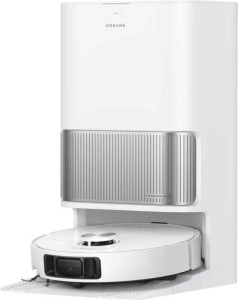
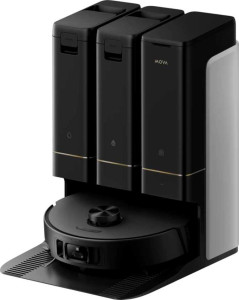
Both the Dreame L40s Ultra and the Mova Z50 Ultra share a strong common baseline: HEPA and allergy filtration, a 1-year warranty, and full smart home integration with both Google Assistant and Amazon Alexa. Their footprints are identical — 350 × 350 mm — so neither has an edge when it comes to navigating under furniture.
The most consequential difference in this group is noise output. The L40s Ultra operates at 63 dB versus the Z50 Ultra's 74 dB — an 11 dB gap that is perceptually significant. Because the decibel scale is logarithmic, the Z50 Ultra is roughly twice as loud to the human ear during operation, which matters if you run cleaning cycles while working from home, during naps, or in noise-sensitive households. On the physical side, the L40s Ultra is also notably lighter at 4,230 g versus 4,600 g, and its overall robot volume (12,679 cm³ vs 13,598 cm³) makes it the more compact unit. The Z50 Ultra's dock is also larger at roughly 98,411 cm³ versus 91,830 cm³, which could matter in tighter laundry rooms or utility closets.
The one area where the Z50 Ultra pulls ahead is maintenance convenience: its estimated bin-empty interval is 120 days compared to 100 days for the L40s Ultra — meaning roughly one fewer manual intervention every four months. Still, given the substantial noise and size advantages of the L40s Ultra, the Dreame L40s Ultra holds a clear overall edge in this general-info group for users who prioritize quieter operation and a more compact form factor.