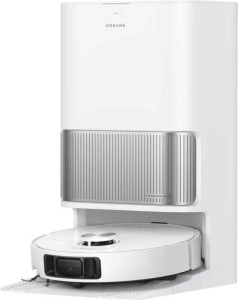
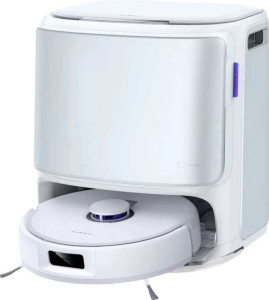
Both the Dreame L40s Ultra and the Narwal Freo Z10 share a strong foundation in their general specs: both carry a HEPA and allergy filter, and both integrate seamlessly with Google Assistant and Alexa, so neither has an edge on ecosystem compatibility or filtration. Warranty coverage is identical at 1 year for each. The real differentiation emerges in the subtler, but practically meaningful, details.
On noise, the Freo Z10 operates at 58 dB versus the L40s Ultra's 63 dB. A 5 dB gap is not trivial — it is roughly perceived as about 75% of the loudness, which translates to a noticeably quieter cleaning cycle, especially relevant if you run the robot during work-from-home hours or light sleep. Meanwhile, the L40s Ultra is the lighter robot at 4,230 g compared to the Freo Z10's 4,600 g, a difference that matters mostly during manual repositioning or transport between floors. The robots share the same 350 mm depth and are nearly identical in footprint, though the Freo Z10 is marginally taller and wider.
Two specs tip the overall balance toward the Freo Z10: its estimated dustbin empty cycle is 120 days versus 100 days for the L40s Ultra — meaning less frequent maintenance — and its docking station is physically smaller (~84,893 cm³ vs ~91,830 cm³), which is a real advantage in tighter living spaces despite the robot itself being slightly bulkier. If low noise and a compact, low-maintenance station are priorities, the Freo Z10 holds the edge in this category; the L40s Ultra offers a marginal win only in robot weight.