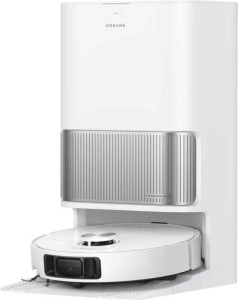
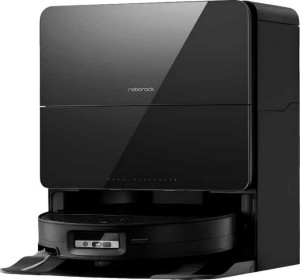
Both the Dreame L40s Ultra and the Roborock Saros 10 share a strong baseline of smart-home integration — full compatibility with Google Assistant and Alexa — plus HEPA and allergy filtration, making either a solid choice for allergy-sensitive households. Their footprints are nearly identical in width and thickness (~350 mm), so neither has a clear edge when navigating under furniture laterally. Where they diverge meaningfully is in profile and weight: the Saros 10 stands just 79.8 mm tall versus the L40s Ultra's 103.5 mm, giving it a significant low-clearance advantage under beds and sofas. The L40s Ultra, however, is notably lighter at 4230 g compared to the Saros 10's 5000 g, which matters when manually lifting or relocating the unit.
On acoustics, the L40s Ultra runs at 63 dB versus the Saros 10's 68 dB — a 5 dB gap that is perceptible to the human ear and translates to a noticeably quieter cleaning cycle in practice, especially in open-plan living spaces or during nighttime runs. In terms of dustbin autonomy, the L40s Ultra offers an estimated 100 days before emptying is needed, more than double the Saros 10's 49 days — a major convenience differentiator for users who want truly hands-off maintenance. Both docking stations are large, but the Saros 10's base is modestly more compact at roughly 84,581 cm³ versus the L40s Ultra's 91,830 cm³.
Overall, neither robot dominates across the board. The Saros 10 has a clear edge in physical profile (slimmer height), making it better suited to low-clearance environments. The L40s Ultra holds the advantage in noise level, dustbin self-sufficiency, and lighter weight — factors that matter more in day-to-day living comfort and reduced user intervention. Both carry a standard 1-year warranty.