Dreame L50 Ultra
Dreame X50 Master

Dreame L50 Ultra Dreame X50 Master

Overview

When comparing the Dreame L50 Ultra and the Dreame X50 Master, two of Dreame's most capable robot vacuums go head-to-head across a wide range of specifications. Both models share a strong foundation — from HEPA filtration and self-emptying docks to advanced mapping and smart home compatibility — but they diverge in meaningful ways. This comparison digs into the key battlegrounds of suction power, noise levels, docking station footprint, warranty coverage, and extra cleaning features to help you determine which one truly fits your home and lifestyle.

Common Features

  • Both products include a HEPA filter.
  • Both products include an allergy filter.
  • Both products are compatible with Google Assistant.
  • Both products work with Amazon Alexa.
  • Both products support mapping.
  • Both products support no-go zones.
  • Both products support remote smartphone control.
  • Both products have an obstacle sensor.
  • Both products have problem area cleaning.
  • Both products are self-emptying.
  • Both products have carpet detection.
  • Neither product gets stuck during operation.
  • Neither product has a display.
  • Neither product has twin side brushes.
  • Both products include washable filters.
  • Both products automatically adjust their height.
  • Neither product indicates when the dustbin is full.
  • Both products use bags.
  • Both products clean all floor types.
  • Both products offer 4 cleaning modes.
  • Both products can mop.
  • Both products have an electrostatic filtration system.
  • Both products have a battery capacity of 6400 mAh.
  • Both products have a runtime of 220 minutes.
  • Neither product has an overheating indicator.
  • Neither product has a removable battery.
  • Both products have auto-off functionality.

Main Differences

  • Audible noise is 70 dB on Dreame L50 Ultra and 60 dB on Dreame X50 Master.
  • Weight is 4440 g on Dreame L50 Ultra and 4530 g on Dreame X50 Master.
  • Width is 352 mm on Dreame L50 Ultra and 350 mm on Dreame X50 Master.
  • Height is 97 mm on Dreame L50 Ultra and 89 mm on Dreame X50 Master.
  • Thickness is 348 mm on Dreame L50 Ultra and 350 mm on Dreame X50 Master.
  • Volume is 11882.112 cm³ on Dreame L50 Ultra and 10902.5 cm³ on Dreame X50 Master.
  • Warranty period is 1 year on Dreame L50 Ultra and 2 years on Dreame X50 Master.
  • Estimated empty time is 75 days on Dreame L50 Ultra and 100 days on Dreame X50 Master.
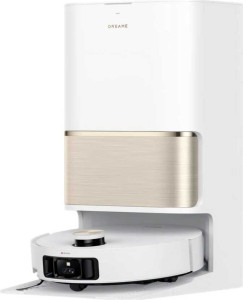
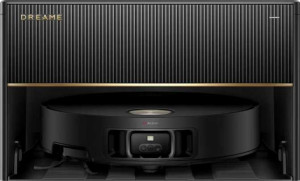
  • Docking station size is 91518.82 cm³ on Dreame L50 Ultra and 43298.112 cm³ on Dreame X50 Master.
  • A remote control is present on Dreame X50 Master but not available on Dreame L50 Ultra.
  • Dustbin capacity is 0.4 l on Dreame L50 Ultra and 0.395 l on Dreame X50 Master.
  • Suction power is 19500 Pa on Dreame L50 Ultra and 20000 Pa on Dreame X50 Master.
  • A dirt sensor is present on Dreame X50 Master but not available on Dreame L50 Ultra.
  • UV light is present on Dreame X50 Master but not available on Dreame L50 Ultra.
  • Charge time is 4 hours on Dreame L50 Ultra and 4.5 hours on Dreame X50 Master.
  • Operating power consumption is 38W on Dreame L50 Ultra and 75W on Dreame X50 Master.
Specs Comparison
Dreame L50 Ultra

Dreame L50 Ultra

Dreame X50 Master

Dreame X50 Master

General info:
has HEPA filter
audible noise 70 dB 60 dB
has an allergy filter
compatible with Google Assistant
works with Alexa
release date March 2025 January 2025
weight 4440 g 4530 g
width 352 mm 350 mm
height 97 mm 89 mm
thickness 348 mm 350 mm
volume 11882.112 cm³ 10902.5 cm³
warranty period 1 years 2 years
estimated empty time 75 days 100 days
docking station size 91518.82 cm³ 43298.112 cm³

Both the Dreame L50 Ultra and Dreame X50 Master share a strong baseline of core features — HEPA and allergy filtration, plus full compatibility with both Google Assistant and Alexa — so neither has a meaningful edge on smart-home integration or air-quality credentials. Where they begin to diverge is in the details that affect day-to-day living. The X50 Master operates at 60 dB versus the L50 Ultra's 70 dB: a 10 dB gap is not incremental, it is perceived by the human ear as roughly twice as loud, meaning the L50 Ultra will be noticeably more disruptive during calls, TV watching, or light sleep. The X50 Master also empties its dustbin less frequently — every 100 days compared to 75 days — a 33% reduction in maintenance touchpoints that adds up meaningfully over a year of ownership.

On physical footprint, the robots themselves are closely matched, but the docking stations tell a very different story. The L50 Ultra's dock occupies roughly 91 500 cm³ of floor space, more than double the X50 Master's 43 300 cm³. For anyone placing the base in a living room, hallway, or tight utility corner, the X50 Master's dock is a substantially smaller intrusion. The robot units themselves weigh within 90 g of each other (4 440 g vs 4 530 g), a difference too small to matter in practice. The L50 Ultra does sit slightly taller at 97 mm versus the X50 Master's 89 mm, which could affect clearance under low furniture.

Based strictly on the general-info specs, the X50 Master holds a clear overall edge. Its quieter operation, longer dust-collection interval, more compact docking station, and double the warranty period (2 years vs 1 year) combine into a package that is less demanding of space, attention, and noise tolerance. The L50 Ultra does not lead on any of the differentiating specs in this group, making the X50 Master the stronger choice for users who prioritize a lower-maintenance, less obtrusive experience.
Features:
has mapping
supports no-go zones
supports a remote smartphone
has an obstacle sensor
has problem area cleaning
is self-emptying
has carpet detection
doesn't get stuck
supports virtual barriers
has route mapping
Has voice prompts
auto docking
has anti-fall sensor
can be scheduled
has a remote control
has water level adjustment
supports Wi-Fi
has mop cleaning
has mop raising
has mop drying

Across nearly every feature in this group, the two robots are functionally identical — both offer a comprehensive, modern autonomous cleaning suite including mapping, no-go zones, virtual barriers, obstacle sensing, anti-fall protection, problem-area cleaning, scheduling, and full mop management with raising, drying, and water-level adjustment. This level of parity is notable; a user picking up either machine will find the same intelligent workflow for navigating, mopping, and self-maintaining without manual intervention.

The sole differentiator in this group is remote control support: the X50 Master includes it, while the L50 Ultra does not. A physical or in-app remote control allows users to manually steer the robot in real time — useful for directing it to a specific spill or spot-cleaning an area without setting up a full scheduled run. It is a convenience feature rather than a core capability, but it does add flexibility for users who want more direct, hands-on control over the robot's movement without relying entirely on automation.

For this group, the X50 Master holds a narrow edge purely by virtue of offering everything the L50 Ultra does, plus remote control functionality. The practical gap is modest — most users will rely on smartphone app control the majority of the time — but in an otherwise tied feature set, the X50 Master's additional option gives it the marginal win here.

Design:
dustbin capacity 0.4 l 0.395 l
Has a display
has twin side brushes
has included washable filters
automatically adjusts its height
Indicates when full
uses bags

From a design standpoint, the Dreame L50 Ultra and Dreame X50 Master are remarkably alike. Both use bagged collection with included washable filters, automatically adjust their height to transition across floor types, and share an identical feature set across every design spec in this group — no display, no twin side brushes, no full-bin indicator. The shared design philosophy is clear: these are premium, self-sufficient machines built around low-touch ownership rather than manual interaction.

The only measurable difference is dustbin capacity: 0.4 l for the L50 Ultra versus 0.395 l for the X50 Master. In absolute terms, this 5 ml gap is negligible — roughly a teaspoon — and will have zero real-world impact on cleaning performance or emptying frequency. It is a distinction that exists in the spec sheet but not in practice.

For the Design group, these two products are effectively tied. There is no meaningful differentiator between them here. Buyers should look to other specification groups — such as noise levels, docking station size, or warranty — to drive their decision, as design alone offers no basis for choosing one over the other.

Cleaning power:
suction power 19500 Pa 20000 Pa
cleans all floor types
cleaning modes 4 4
mops
has a dirt sensor
Has an electrostatic filtration system
has UV light

Suction power is the headline metric in this group, and the gap is modest but real: the X50 Master delivers 20 000 Pa versus the L50 Ultra's 19 500 Pa — a 2.5% difference. At this tier of performance, both machines generate more than enough force to handle deep-pile carpet, embedded pet hair, and fine debris on hard floors. The practical distinction is marginal for most homes, though the X50 Master's ceiling gives it a slight edge in worst-case scenarios like heavily soiled carpets. Both robots share identical coverage in terms of floor-type compatibility and cleaning modes (4 modes each), so neither offers more strategic flexibility in how it approaches a clean.

Where the X50 Master pulls further ahead is in two additional capabilities: a dirt sensor and UV light. A dirt sensor allows the robot to detect and concentrate cleaning effort on visibly soiled areas rather than applying uniform passes everywhere — a meaningful real-world advantage that leads to more thorough results on high-traffic zones. UV light adds a layer of surface sanitization beyond mechanical cleaning, which matters for households with allergy sufferers, pets, or young children. The L50 Ultra lacks both, relying instead on its shared electrostatic filtration system — which both units carry — for air-quality protection.

The X50 Master holds a clear advantage in this group. It matches the L50 Ultra on cleaning modes and floor compatibility, edges it on raw suction, and then adds genuinely useful capabilities in the dirt sensor and UV sanitization that the L50 Ultra simply does not offer. For users who prioritize cleaning thoroughness and hygiene, the X50 Master is the stronger performer here.

Power:
battery power 6400 mAh 6400 mAh
runtime 220 min 220 min
charge time 4 hours 4.5 hours
operating power consumption 38W 75W
Has an overheating indicator
has a removable battery
has auto-off

Starting with what is shared: both robots run on an identical 6400 mAh battery and deliver the same 220-minute runtime, meaning neither has an endurance advantage in the field. For context, 220 minutes is substantial — enough to cover large homes on a single charge without needing to dock and resume. The shared auto-off feature and non-removable battery design are also consistent across both units.

The divergence comes in two areas. On charge time, the L50 Ultra returns to full power in 4 hours versus the X50 Master's 4.5 hours — a 30-minute difference that is relevant primarily for users who run back-to-back cleaning sessions or need the robot ready again quickly after a long run. More striking is the gap in operating power consumption: the L50 Ultra draws 38W while the X50 Master consumes 75W — nearly double. Over hundreds of cleaning cycles per year, that difference compounds into a meaningful electricity cost gap and a larger environmental footprint for X50 Master owners.

Given identical battery capacity and runtime, the L50 Ultra holds the edge in this group. It recharges faster and operates at significantly lower power draw, making it the more energy-efficient choice without sacrificing any cleaning time. The X50 Master's higher consumption is likely linked to its additional capabilities seen in other spec groups, but on power efficiency alone, the L50 Ultra is the cleaner performer.

Comparison Summary & Verdict

After a thorough review of the specifications, both robots are highly capable, but each has a distinct edge. The Dreame L50 Ultra stands out with a significantly more compact docking station (91518.82 cm³ vs 43298.112 cm³ — note the X50 Master wins here), quieter operation at just 60 dB, and a smaller overall volume, making the Dreame X50 Master the better fit for users who prioritize a quieter, more feature-rich clean with its dirt sensor, UV light, remote control, longer estimated empty time of 100 days, and a 2-year warranty. The Dreame L50 Ultra, on the other hand, suits those who want a lower operating power draw at 38W and a faster 4-hour charge time. Choose based on whether advanced cleaning intelligence or energy efficiency and quicker recharging matter most to you.

Dreame L50 Ultra
Buy Dreame L50 Ultra if...

Buy the Dreame L50 Ultra if you prefer lower power consumption at 38W and a faster 4-hour charge time, and are happy to skip extras like a dirt sensor, UV light, and remote control.

Dreame X50 Master
Buy Dreame X50 Master if...

Buy the Dreame X50 Master if you want a quieter robot vacuum with stronger suction, a dirt sensor, UV light, remote control, a longer 100-day empty cycle, and the added peace of mind of a 2-year warranty.