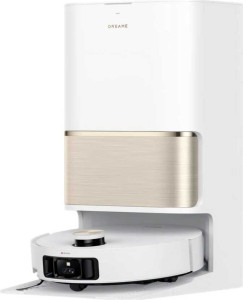
Dreame L50 Ultra
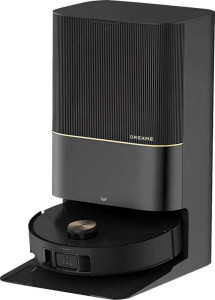
Dreame X50 Ultra

Dreame L50 Ultra Dreame X50 Ultra

Overview

When choosing between the Dreame L50 Ultra and the Dreame X50 Ultra, you are looking at two high-performance robot vacuums that share a strong foundation of smart features, yet diverge in meaningful ways. This comparison examines their key battlegrounds: noise levels and cleaning power, battery efficiency, smart sensing capabilities, and overall value — helping you decide which model best suits your home and lifestyle.

Common Features

  • Both the Dreame L50 Ultra and Dreame X50 Ultra include a HEPA filter.
  • An allergy filter is present on both products.
  • Both products are compatible with Google Assistant.
  • Both products work with Amazon Alexa.
  • Mapping is supported on both the Dreame L50 Ultra and Dreame X50 Ultra.
  • No-go zones are supported on both products.
  • Remote smartphone control is supported on both products.
  • An obstacle sensor is present on both products.
  • Problem area cleaning is available on both products.
  • Both products are self-emptying.
  • Carpet detection is available on both products.
  • Neither product gets stuck during operation.
  • Neither product has a display.
  • Twin side brushes are not present on either product.
  • Both products include washable filters.
  • Both products automatically adjust their height.
  • Neither product indicates when the dustbin is full.
  • Both products use bags.
  • Both products clean all floor types.
  • Both products offer 4 cleaning modes.
  • Both products are capable of mopping.
  • An electrostatic filtration system is present on both products.
  • Both products have a battery power of 6400 mAh.
  • Both products offer a runtime of 220 minutes.
  • Neither product has an overheating indicator.
  • The battery is not removable on either product.
  • Both products feature auto-off functionality.

Main Differences

  • Audible noise is 70 dB on the Dreame L50 Ultra and 60 dB on the Dreame X50 Ultra.
  • Weight is 4440 g on the Dreame L50 Ultra and 4530 g on the Dreame X50 Ultra.
  • Width is 352 mm on the Dreame L50 Ultra and 350 mm on the Dreame X50 Ultra.
  • Height is 97 mm on the Dreame L50 Ultra and 89 mm on the Dreame X50 Ultra.
  • Thickness is 348 mm on the Dreame L50 Ultra and 350 mm on the Dreame X50 Ultra.
  • Volume is 11882.112 cm³ on the Dreame L50 Ultra and 10902.5 cm³ on the Dreame X50 Ultra.
  • Warranty period is 1 year on the Dreame L50 Ultra and 2 years on the Dreame X50 Ultra.
  • Estimated empty time is 75 days on the Dreame L50 Ultra and 100 days on the Dreame X50 Ultra.
  • Docking station size is 91518.82 cm³ on the Dreame L50 Ultra and 91674.2 cm³ on the Dreame X50 Ultra.
  • A remote control is included with the Dreame X50 Ultra but not available on the Dreame L50 Ultra.
  • Dustbin capacity is 0.4 l on the Dreame L50 Ultra and 0.395 l on the Dreame X50 Ultra.
  • Suction power is 19500 Pa on the Dreame L50 Ultra and 20000 Pa on the Dreame X50 Ultra.
  • A dirt sensor is present on the Dreame X50 Ultra but not available on the Dreame L50 Ultra.
  • UV light is present on the Dreame X50 Ultra but not available on the Dreame L50 Ultra.
  • Charge time is 4 hours on the Dreame L50 Ultra and 4.5 hours on the Dreame X50 Ultra.
  • Operating power consumption is 38W on the Dreame L50 Ultra and 75W on the Dreame X50 Ultra.
Specs Comparison
Dreame L50 Ultra

Dreame L50 Ultra

Dreame X50 Ultra

Dreame X50 Ultra

General info:
has HEPA filter
audible noise 70 dB 60 dB
has an allergy filter
compatible with Google Assistant
works with Alexa
release date March 2025 January 2025
weight 4440 g 4530 g
width 352 mm 350 mm
height 97 mm 89 mm
thickness 348 mm 350 mm
volume 11882.112 cm³ 10902.5 cm³
warranty period 1 years 2 years
estimated empty time 75 days 100 days
docking station size 91518.82 cm³ 91674.2 cm³

Both the Dreame L50 Ultra and the Dreame X50 Ultra share a strong foundation in general specs: each carries a HEPA and allergy filter, and both integrate seamlessly with Google Assistant and Amazon Alexa, so smart-home compatibility is a non-issue for either choice. Where they begin to diverge is in the details that matter most during day-to-day living.

The most tangible real-world difference is noise. The X50 Ultra operates at 60 dB versus the L50 Ultra's 70 dB — a 10 dB gap that, on a logarithmic scale, means the X50 Ultra is perceived as roughly half as loud. That is a meaningful quality-of-life upgrade, particularly in smaller homes or for users who run the robot during calls or quiet hours. The X50 Ultra is also slightly slimmer at 89 mm tall (vs. 97 mm), giving it a modest edge under low-profile furniture, and its smaller robot body volume of 10,902 cm³ makes it fractionally more maneuverable in tight spaces, even though the two docking stations are virtually identical in footprint.

Two further specs reinforce the X50 Ultra's advantage at the general level: its dust bin emptying interval of 100 days (versus 75 days) means less frequent maintenance, and its 2-year warranty doubles the coverage offered by the L50 Ultra's single year — a meaningful long-term value difference for a premium appliance. The L50 Ultra is marginally lighter at 4,440 g compared to 4,530 g, but a 90 g difference is imperceptible in use. Overall, the X50 Ultra holds a clear edge in this spec group, driven by noticeably quieter operation, a longer maintenance cycle, and superior warranty protection.

Features:
has mapping
supports no-go zones
supports a remote smartphone
has an obstacle sensor
has problem area cleaning
is self-emptying
has carpet detection
doesn't get stuck
supports virtual barriers
has route mapping
Has voice prompts
auto docking
has anti-fall sensor
can be scheduled
has a remote control
has water level adjustment
supports Wi-Fi
has mop cleaning
has mop raising
has mop drying

Across the features category, the Dreame L50 Ultra and X50 Ultra are remarkably well-matched. Both robots cover the full spectrum of modern autonomous cleaning: multi-room mapping, no-go zones, virtual barriers, scheduled cleaning, obstacle and anti-fall sensors, and problem-area targeting all feature on each model. Critically, both include a complete mop management suite — mop cleaning, mop raising, and mop drying — alongside self-emptying and auto-docking, meaning neither requires much hands-on intervention once set up.

With nearly every feature box ticked on both sides, the sole differentiator is the remote control — present on the X50 Ultra and absent on the L50 Ultra. In an era where app and voice control dominate, a physical remote may seem minor, but it offers a genuine convenience advantage: quickly redirecting the robot without reaching for a phone or issuing a voice command. For users in environments where the app isn't always at hand — say, a secondary property or a shared household — that tactile option carries real practical value.

The verdict here is close, but the X50 Ultra edges ahead purely by addition: it delivers every feature the L50 Ultra offers, then adds remote control on top. There is no trade-off — it is a strict superset, making it the marginally more versatile choice in this category.

Design:
dustbin capacity 0.4 l 0.395 l
Has a display
has twin side brushes
has included washable filters
automatically adjusts its height
Indicates when full
uses bags

From a design standpoint, the Dreame L50 Ultra and X50 Ultra are essentially identical twins. Both use a bagged collection system with washable filters included, both automatically adjust their cleaning head height to transition between floor surfaces, and neither features an onboard display or a bin-full indicator. The shared design philosophy is clear: these are set-and-forget machines built around station-based maintenance rather than robot-level feedback.

The only measurable divergence is dustbin capacity — 0.4 l for the L50 Ultra versus 0.395 l for the X50 Ultra. A 5 ml difference is, in practice, completely negligible; it would never influence a real-world cleaning cycle or emptying frequency. It is a rounding-level variation, not a meaningful design distinction.

Given that every design attribute is shared and the sole numerical difference is functionally irrelevant, this category is a dead heat. Neither robot offers a design advantage over the other — buyers should look to other spec groups to differentiate the two.

Cleaning power:
suction power 19500 Pa 20000 Pa
cleans all floor types
cleaning modes 4 4
mops
has a dirt sensor
Has an electrostatic filtration system
has UV light

Cleaning power is where the X50 Ultra starts to pull more meaningfully ahead. Both robots share strong fundamentals — universal floor-type compatibility, mopping capability, electrostatic filtration, and four cleaning modes — but the X50 Ultra adds three capabilities the L50 Ultra lacks. Its suction is rated at 20,000 Pa versus 19,500 Pa on the L50 Ultra: a 500 Pa gap that is modest in absolute terms, though at this performance tier even marginal gains can translate to slightly better debris extraction from carpet pile.

The more impactful differentiators are the X50 Ultra's dirt sensor and UV light. A dirt sensor enables the robot to dynamically intensify cleaning in heavily soiled areas rather than applying uniform effort across the floor — a smarter, more adaptive approach that delivers cleaner results with less redundant passes. UV light, meanwhile, adds a layer of surface sanitization beyond what suction and mopping alone achieve, which is a tangible benefit for households with pets, allergies, or hygiene-sensitive occupants. The L50 Ultra, lacking both, cleans reactively rather than intelligently.

The conclusion in this category is clear: the X50 Ultra holds a meaningful advantage. It matches the L50 Ultra on every shared cleaning capability and then layers in smarter dirt detection and UV sanitization — features that directly elevate cleaning quality rather than just replicating it.

Power:
battery power 6400 mAh 6400 mAh
runtime 220 min 220 min
charge time 4 hours 4.5 hours
operating power consumption 38W 75W
Has an overheating indicator
has a removable battery
has auto-off

On paper, the power specs of the L50 Ultra and X50 Ultra look nearly identical: same 6,400 mAh battery, same 220-minute runtime, and identical safety provisions — auto-off enabled, no removable battery, no overheating indicator. For users prioritizing floor coverage per charge, both robots deliver the same endurance, which is reassuring across a product tier where runtime can vary significantly.

Dig into the remaining two figures, however, and a notable divergence emerges. The X50 Ultra draws 75W of operating power compared to just 38W on the L50 Ultra — nearly double the consumption. Yet both achieve the same runtime on the same capacity battery, which points to the X50 Ultra's additional hardware (UV light, dirt sensor, higher suction) demanding considerably more energy. As a direct consequence, the X50 Ultra also takes longer to recharge: 4.5 hours versus 4 hours for the L50 Ultra. That 30-minute difference is minor in isolation, but in high-frequency cleaning scenarios or larger homes requiring mid-session docking, it adds a small but real delay before the robot is ready again.

In this specific category, the L50 Ultra holds a narrow edge: it charges faster and operates at less than half the power draw, all while matching the X50 Ultra's runtime exactly. The X50 Ultra's higher consumption is an acceptable trade-off for its added cleaning capabilities, but from a pure power-efficiency standpoint, the L50 Ultra is the more frugal performer.
Comparison Summary & Verdict

Both the Dreame L50 Ultra and the Dreame X50 Ultra are capable, feature-rich robot vacuums built for serious home cleaning. However, the differences between them cater to distinct types of users. The Dreame X50 Ultra stands out with a quieter operation at 60 dB, higher suction power of 20000 Pa, a longer estimated empty time of 100 days, a dirt sensor, UV light, and a doubled warranty period of 2 years — making it the stronger choice for allergy-conscious users and those seeking a more autonomous, long-term investment. The Dreame L50 Ultra, on the other hand, offers a faster 4-hour charge time and significantly lower operating power consumption of 38W, which may appeal to energy-conscious households. If advanced hygiene features and quieter cleaning matter most, the X50 Ultra wins; if energy efficiency and quicker turnaround are your priority, the L50 Ultra holds its ground.

Dreame L50 Ultra
Buy Dreame L50 Ultra if...

Buy the Dreame L50 Ultra if you want a faster charging robot vacuum with significantly lower power consumption, making it a better fit for energy-conscious households.

Dreame X50 Ultra
Buy Dreame X50 Ultra if...

Buy the Dreame X50 Ultra if you prioritize quieter operation, stronger suction, built-in dirt sensing, UV light hygiene, and a longer 2-year warranty for greater long-term peace of mind.