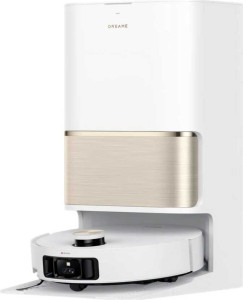
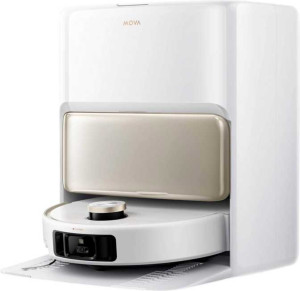
At their core, the Dreame L50 Ultra and Mova V50 Ultra are remarkably well-matched on the fundamentals: both carry HEPA and allergy filtration, operate at an identical 70 dB noise level, support Google Assistant and Alexa, share a 1-year warranty, and are estimated to run 75 days before the dustbin needs emptying. For most buyers, these shared traits mean neither robot has a practical edge in day-to-day smart-home integration or air-quality performance.
Where the two diverge is in physical dimensions. The V50 Ultra stands notably shorter at 89.5 mm versus the L50 Ultra's 97 mm — a difference of 7.5 mm that directly translates to under-furniture reach. In real-world terms, the V50 Ultra is more likely to slip beneath low-profile sofas and bed frames that would block the taller L50 Ultra. Conversely, the L50 Ultra is meaningfully lighter at 4,440 g compared to the V50 Ultra's 4,600 g, a 160 g gap that matters if you ever need to manually lift or reposition the robot. Their docking stations are virtually identical in footprint, so neither has an advantage on counter or floor space.
On balance, the V50 Ultra holds a clear edge for low-clearance environments thanks to its reduced height, which is arguably the more impactful differentiator for typical home layouts. The L50 Ultra's slight weight advantage is real but minor. If under-furniture coverage is a priority, the V50 Ultra wins this category; if the floor plan is open and weight is a concern, the L50 Ultra is the marginally more manageable unit.