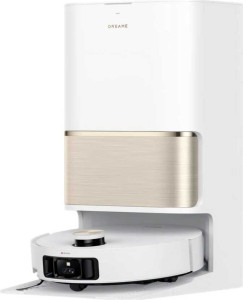
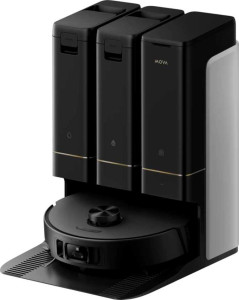
Both the Dreame L50 Ultra and the Mova Z50 Ultra share a strong foundation of shared features: HEPA and allergy filtration, full compatibility with Google Assistant and Alexa, and identical 1-year warranties. For most users, these headline features will feel equivalent out of the box.
Where real differences emerge is in acoustics, physical footprint, and dustbin autonomy. The L50 Ultra operates at 70 dB versus the Z50 Ultra's 74 dB — a 4 dB gap that is perceptible to the human ear and translates to a meaningfully quieter cleaning cycle, especially relevant in open-plan homes or during work-from-home hours. On size, the L50 Ultra is notably slimmer at 97 mm tall compared to the Z50 Ultra's 111 mm, giving it a better chance of fitting under low-clearance furniture. Its docking station footprint is also smaller (~91,519 cm³ vs ~98,411 cm³), which matters in tighter utility spaces.
The most striking divergence, however, is the estimated empty time: the Z50 Ultra can go 120 days between dustbin empties versus the L50 Ultra's 75 days — a 60% advantage that directly reduces maintenance effort. For users who prioritize a truly hands-off experience, this is a significant practical edge. Overall, the L50 Ultra wins on quietness and physical compactness, while the Z50 Ultra wins decisively on maintenance autonomy; the right choice depends on whether you value a quieter, lower-profile robot or one you need to tend to far less often.