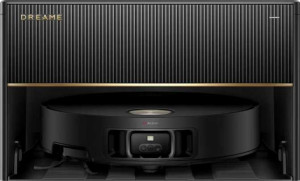
Dreame X50 Master
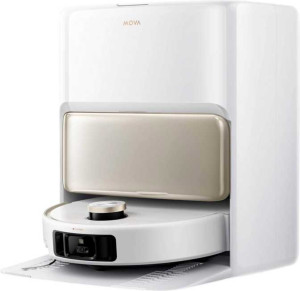
Mova V50 Ultra

Dreame X50 Master Mova V50 Ultra

Overview

Welcome to this in-depth spec comparison between the Dreame X50 Master and the Mova V50 Ultra — two capable robot vacuums competing in the premium self-emptying segment. Both share a strong foundation of smart features, but they take notably different approaches when it comes to cleaning power, noise levels, and docking station design. Read on to see exactly how these two stack up across every key specification.

Common Features

  • Both products include a HEPA filter.
  • Both products include an allergy filter.
  • Both products are compatible with Google Assistant.
  • Both products work with Amazon Alexa.
  • Both products have a width of 350 mm.
  • Both products have a thickness of 350 mm.
  • Both products support mapping functionality.
  • Both products support no-go zones.
  • Both products support remote smartphone control.
  • Both products include an obstacle sensor.
  • Both products support problem area cleaning.
  • Both products are self-emptying.
  • Both products feature carpet detection.
  • Both products are designed to avoid getting stuck.
  • Neither product has a built-in display.
  • Neither product has twin side brushes.
  • Both products include washable filters.
  • Both products automatically adjust their height.
  • Neither product indicates when the dustbin is full.
  • Both products use bags.
  • Both products clean all floor types.
  • Both products offer 4 cleaning modes.
  • Both products are capable of mopping.
  • Both products feature an electrostatic filtration system.
  • Both products have a battery capacity of 6400 mAh.
  • Both products have a runtime of 220 minutes.
  • Neither product has an overheating indicator.
  • Neither product has a removable battery.
  • Both products feature an auto-off function.

Main Differences

  • Audible noise is 60 dB on Dreame X50 Master and 70 dB on Mova V50 Ultra.
  • Weight is 4530 g on Dreame X50 Master and 4600 g on Mova V50 Ultra.
  • Height is 89 mm on Dreame X50 Master and 89.5 mm on Mova V50 Ultra.
  • Volume is 10902.5 cm³ on Dreame X50 Master and 10963.75 cm³ on Mova V50 Ultra.
  • Warranty period is 2 years on Dreame X50 Master and 1 year on Mova V50 Ultra.
  • Estimated empty time is 100 days on Dreame X50 Master and 75 days on Mova V50 Ultra.
  • Docking station size is 43298.112 cm³ on Dreame X50 Master and 90409.2 cm³ on Mova V50 Ultra.
  • A remote control is included with Dreame X50 Master but is not available on Mova V50 Ultra.
  • Dustbin capacity is 0.395 l on Dreame X50 Master and 0.3 l on Mova V50 Ultra.
  • Suction power is 20000 Pa on Dreame X50 Master and 24000 Pa on Mova V50 Ultra.
  • A dirt sensor is present on Dreame X50 Master but not available on Mova V50 Ultra.
  • UV light is present on Dreame X50 Master but not available on Mova V50 Ultra.
  • Charge time is 4.5 hours on Dreame X50 Master and 4 hours on Mova V50 Ultra.
  • Operating power consumption is 75W on Dreame X50 Master and 38W on Mova V50 Ultra.
Specs Comparison
Dreame X50 Master

Dreame X50 Master

Mova V50 Ultra

Mova V50 Ultra

General info:
has HEPA filter
audible noise 60 dB 70 dB
has an allergy filter
compatible with Google Assistant
works with Alexa
release date January 2025 June 2025
weight 4530 g 4600 g
width 350 mm 350 mm
height 89 mm 89.5 mm
thickness 350 mm 350 mm
volume 10902.5 cm³ 10963.75 cm³
warranty period 2 years 1 years
estimated empty time 100 days 75 days
docking station size 43298.112 cm³ 90409.2 cm³

Both the Dreame X50 Master and the Mova V50 Ultra share a nearly identical physical footprint — same width and thickness at 350 mm, near-equal weight around 4.5 kg, and the same smart home ecosystem support (Google Assistant and Alexa). For most users, these similarities mean day-to-day handling and smart home integration will feel interchangeable between the two.

The real-world differences emerge in three areas. First, noise: the X50 Master operates at 60 dB versus the V50 Ultra's 70 dB — a 10 dB gap that, due to the logarithmic nature of sound, means the V50 Ultra is perceived as roughly twice as loud in normal use. This matters significantly if you run the robot while working from home or during nap times. Second, the X50 Master's docking station is dramatically more compact at ~43,300 cm³ compared to the V50 Ultra's ~90,400 cm³ — more than twice the volume — which has a real impact on where the base can realistically be placed in a home. Third, the X50 Master empties its dustbin every 100 days on average versus 75 days for the V50 Ultra, meaning fewer manual interventions over time.

Adding it all up, the Dreame X50 Master holds a clear edge in this category. Its quieter operation, much smaller docking station footprint, longer auto-empty interval, and 2-year warranty (versus 1 year on the V50 Ultra) collectively make it the more practical and better-supported choice for everyday living — particularly in space-constrained or noise-sensitive households.

Features:
has mapping
supports no-go zones
supports a remote smartphone
has an obstacle sensor
has problem area cleaning
is self-emptying
has carpet detection
doesn't get stuck
supports virtual barriers
has route mapping
Has voice prompts
auto docking
has anti-fall sensor
can be scheduled
has a remote control
has water level adjustment
supports Wi-Fi
has mop cleaning
has mop raising
has mop drying

Across nearly the entire feature spectrum, these two robots are functionally identical. Both offer a comprehensive modern toolkit: full mapping with no-go zones and virtual barriers, obstacle sensing, anti-fall protection, carpet detection with automatic mop raising, self-emptying, mop washing and drying, scheduled cleaning, and Wi-Fi connectivity with smartphone control. For the vast majority of users, this parity means neither robot will feel feature-limited compared to the other.

The sole differentiator in this group is that the Dreame X50 Master includes a physical remote control, while the Mova V50 Ultra does not. In practice, a hardware remote is a convenience fallback — useful when your phone is out of reach, unavailable, or for households where less tech-savvy users prefer a tangible button over an app. It is not a critical feature given that both robots support full smartphone control, but it is a genuine usability advantage in specific scenarios.

The edge here goes narrowly to the Dreame X50 Master, strictly because of the added remote control option. However, users who are comfortable exclusively using a smartphone app will find the V50 Ultra's feature set equally capable in every practical respect.

Design:
dustbin capacity 0.395 l 0.3 l
Has a display
has twin side brushes
has included washable filters
automatically adjusts its height
Indicates when full
uses bags

From a design standpoint, these two robots are nearly mirror images of each other. Both use bagged collection systems with included washable filters, automatically adjust their height to handle different floor surfaces, and lack an onboard display — a common trade-off in robots that rely entirely on app-based interaction. None of these shared traits meaningfully separate the two.

The only design specification that differs is onboard dustbin capacity: the Dreame X50 Master holds 0.395 L versus the Mova V50 Ultra's 0.3 L. That roughly 32% larger bin matters most in homes with pets or high debris loads, where the robot may fill its bin before returning to the dock to empty. A larger onboard capacity reduces the chance of the robot pausing mid-clean — a practical, if secondary, advantage given that both units are self-emptying.

The Dreame X50 Master takes a narrow edge here on the strength of its larger dustbin. In most households with regular self-emptying dock usage, the difference will rarely be felt — but in demanding cleaning environments, that extra capacity provides a small but real buffer.

Cleaning power:
suction power 20000 Pa 24000 Pa
cleans all floor types
cleaning modes 4 4
mops
has a dirt sensor
Has an electrostatic filtration system
has UV light

Suction power is where these two robots part ways most visibly. The Mova V50 Ultra delivers 24,000 Pa versus the Dreame X50 Master's 20,000 Pa — a 20% gap that translates to meaningfully stronger pickup on embedded debris, thick carpets, and fine particulates like pet dander. Both robots cover all floor types with four cleaning modes and integrated mopping, so the structural cleaning toolkit is identical; it is the raw pulling force where the V50 Ultra pulls ahead.

However, the X50 Master counters with two qualitative advantages: a dirt sensor and UV light. The dirt sensor allows the robot to detect and automatically re-clean heavily soiled areas rather than making a single uniform pass — a smarter approach that can compensate for lower peak suction in practice. UV light adds a sanitization layer that the V50 Ultra entirely lacks, which is a meaningful differentiator for allergy sufferers or pet owners concerned about bacteria and odors beyond visible dirt. Both units share an electrostatic filtration system, keeping fine particle capture on equal footing.

This group produces a genuine split depending on user priorities. The Mova V50 Ultra wins on brute suction, making it the stronger choice for homes with heavy-pile carpets or persistent debris. The Dreame X50 Master wins on cleaning intelligence and hygiene, making it the more well-rounded performer for mixed-surface homes where adaptive cleaning and sanitization matter as much as raw power.

Power:
battery power 6400 mAh 6400 mAh
runtime 220 min 220 min
charge time 4.5 hours 4 hours
operating power consumption 75W 38W
Has an overheating indicator
has a removable battery
has auto-off

On paper, these two robots look almost identical in the power department: same 6,400 mAh battery, same 220-minute runtime, and matching safety features including auto-off and non-removable cells. For users focused on how long the robot runs per charge, there is no practical difference to speak of.

Dig into the remaining figures, though, and a notable gap appears. The Dreame X50 Master draws 75W during operation compared to the Mova V50 Ultra's 38W — nearly double the power consumption for the same runtime and battery size. This higher draw likely reflects the energy cost of features like UV sanitization and more aggressive processing. It also contributes to the X50 Master's slightly longer charge time of 4.5 hours versus the V50 Ultra's 4 hours. Neither gap is dramatic in isolation, but together they signal that the V50 Ultra is the more energy-efficient machine on a per-session basis.

The Mova V50 Ultra earns the edge in this category. Faster recharge and significantly lower operating wattage mean lower long-term electricity costs and a quicker turnaround between cleaning sessions — a quiet but consistent advantage for users who run their robot daily.

Comparison Summary & Verdict

After examining every spec, both robots prove to be well-equipped smart cleaners, yet each suits a different type of buyer. The Dreame X50 Master stands out with its quieter operation at 60 dB, a longer 100-day estimated empty cycle, a 2-year warranty, a built-in dirt sensor, UV light, and a notably more compact docking station — making it the stronger choice for users who value long-term value and thorough cleaning intelligence. The Mova V50 Ultra, on the other hand, counters with higher 24000 Pa suction power, a faster 4-hour charge time, and significantly lower 38W power consumption, appealing to those who prioritize raw cleaning strength and energy efficiency. Neither product is a clear-cut winner — your ideal pick depends on whether quiet, feature-rich autonomy or powerful, efficient performance matters more to you.

Dreame X50 Master
Buy Dreame X50 Master if...

Buy the Dreame X50 Master if you want quieter operation, a longer self-empty cycle, a dirt sensor, UV light, a compact docking station, and the peace of mind of a 2-year warranty.

Mova V50 Ultra
Buy Mova V50 Ultra if...

Buy the Mova V50 Ultra if you prioritize stronger suction power at 24000 Pa, faster charging, and significantly lower energy consumption during operation.