Dreame X50 Master
Roborock Saros 10

Dreame X50 Master Roborock Saros 10

Overview

Welcome to our in-depth spec comparison between the Dreame X50 Master and the Roborock Saros 10, two premium robot vacuums competing at the top of the market. Both share strong foundations — including HEPA filtration, self-emptying docks, and full mopping capability — yet they diverge in meaningful ways across noise levels, suction power, battery charging speed, and dock design. Read on to see which one earns its place in your home.

Common Features

  • Both products include a HEPA filter.
  • Both products include an allergy filter.
  • Both products are compatible with Google Assistant.
  • Both products work with Alexa.
  • Both products have a thickness of 350 mm.
  • Both products support mapping.
  • Both products support no-go zones.
  • Both products support remote smartphone control.
  • Both products have an obstacle sensor.
  • Both products feature problem area cleaning.
  • Both products are self-emptying.
  • Both products have carpet detection.
  • Neither product gets stuck.
  • Neither product has twin side brushes.
  • Both products include washable filters.
  • Both products automatically adjust their height.
  • Both products use bags.
  • Both products clean all floor types.
  • Both products can mop.
  • Both products have a dirt sensor.
  • Both products have a battery capacity of 6400 mAh.
  • Both products have a runtime of 220 minutes.
  • Neither product has a removable battery.

Main Differences

  • Audible noise is 60 dB on Dreame X50 Master and 68 dB on Roborock Saros 10.
  • Weight is 4530 g on Dreame X50 Master and 5000 g on Roborock Saros 10.
  • Width is 350 mm on Dreame X50 Master and 353 mm on Roborock Saros 10.
  • Height is 89 mm on Dreame X50 Master and 79.8 mm on Roborock Saros 10.
  • Volume is 10902.5 cm³ on Dreame X50 Master and 9859.29 cm³ on Roborock Saros 10.
  • Warranty period is 2 years on Dreame X50 Master and 1 year on Roborock Saros 10.
  • Estimated empty time is 100 days on Dreame X50 Master and 49 days on Roborock Saros 10.
  • Docking station size is 43298.112 cm³ on Dreame X50 Master and 84581.2 cm³ on Roborock Saros 10.
  • A remote control is included with Dreame X50 Master but not available on Roborock Saros 10.
  • Dustbin capacity is 0.395 l on Dreame X50 Master and 0.27 l on Roborock Saros 10.
  • A display is present on Roborock Saros 10 but not available on Dreame X50 Master.
  • A full-bin indicator is present on Roborock Saros 10 but not available on Dreame X50 Master.
  • Suction power is 20000 Pa on Dreame X50 Master and 22000 Pa on Roborock Saros 10.
  • UV light is featured on Dreame X50 Master but not available on Roborock Saros 10.
  • Charge time is 4.5 hours on Dreame X50 Master and 2.5 hours on Roborock Saros 10.
  • Operating power consumption is 75W on Dreame X50 Master and 60W on Roborock Saros 10.
Specs Comparison
Dreame X50 Master

Dreame X50 Master

Roborock Saros 10

Roborock Saros 10

General info:
has HEPA filter
audible noise 60 dB 68 dB
has an allergy filter
compatible with Google Assistant
works with Alexa
release date January 2025 February 2025
weight 4530 g 5000 g
width 350 mm 353 mm
height 89 mm 79.8 mm
thickness 350 mm 350 mm
volume 10902.5 cm³ 9859.29 cm³
warranty period 2 years 1 years
estimated empty time 100 days 49 days
docking station size 43298.112 cm³ 84581.2 cm³

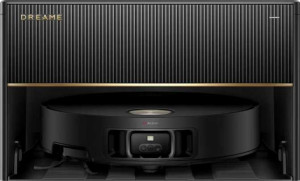
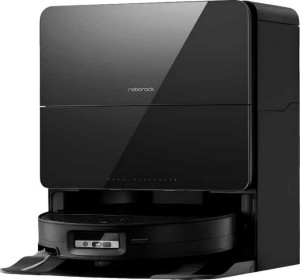
Both the Dreame X50 Master and the Roborock Saros 10 share a strong baseline of features: HEPA and allergy filtration, and full compatibility with both Google Assistant and Alexa. Where they diverge meaningfully is in acoustics, physical footprint, and ownership convenience. The X50 Master operates at 60 dB versus the Saros 10's 68 dB — an 8 dB gap that is not trivial. Because the decibel scale is logarithmic, this translates to the Saros 10 sounding roughly 2.5 times louder in practice, which matters significantly if you run cleaning cycles during calls, nap times, or light sleeping hours.

On physical design, the trade-offs cut both ways. The Saros 10 is notably slimmer at 79.8 mm tall compared to the X50 Master's 89 mm, giving it a real edge at sneaking under low-clearance furniture like certain sofas and bed frames. The X50 Master, however, is lighter at 4530 g versus 5000 g, which is relevant when manually moving or carrying the unit. Critically, the Saros 10's docking station is nearly twice the volume of the X50 Master's dock (84,581 cm³ vs 43,298 cm³), meaning it demands considerably more floor space in your home — a practical concern for smaller apartments or tight laundry areas.

From a long-term ownership perspective, the X50 Master holds a decisive advantage. Its dustbin needs emptying only every 100 days on average, more than double the Saros 10's 49 days, and it backs the product with a 2-year warranty versus just 1 year for the Saros 10. Overall, the X50 Master edges out this category for most users: it is quieter, requires less maintenance, has a far more compact dock, and offers stronger purchase protection — with the Saros 10's only genuine win being its lower profile for under-furniture reach.
Features:
has mapping
supports no-go zones
supports a remote smartphone
has an obstacle sensor
has problem area cleaning
is self-emptying
has carpet detection
doesn't get stuck
supports virtual barriers
has route mapping
Has voice prompts
auto docking
has anti-fall sensor
can be scheduled
has a remote control
has water level adjustment
supports Wi-Fi
has mop cleaning
has mop raising
has mop drying

Across the full breadth of smart features, these two robots are remarkably well-matched. Both cover the complete modern checklist: multi-room mapping, no-go zones, virtual barriers, route mapping, obstacle and anti-fall sensors, carpet detection, scheduled cleaning, self-emptying, and a full wet-mopping suite that includes mop raising, cleaning, and drying. For the vast majority of users, either robot will feel equally capable from a software and automation standpoint.

The sole functional difference in this category is that the Dreame X50 Master includes a physical remote control, while the Roborock Saros 10 does not. In an era where most users interact with robot vacuums exclusively through smartphone apps or voice assistants, a hardware remote may seem minor — but it carries real value in specific scenarios: guests or family members without the app installed, rooms with poor Wi-Fi signal, or simply moments when reaching for a phone feels like friction. It also serves as a useful backup if the app or cloud service experiences an outage.

The conclusion here is straightforward: the X50 Master holds a narrow but genuine edge in this group purely by virtue of including the remote control. The Saros 10 sacrifices no smart functionality in doing so, but the X50 Master offers one additional layer of direct, app-free control that its competitor simply lacks.

Design:
dustbin capacity 0.395 l 0.27 l
Has a display
has twin side brushes
has included washable filters
automatically adjusts its height
Indicates when full
uses bags

The shared design foundations here are solid on both sides: washable filters are included with each robot, both automatically adjust their height to handle different floor surfaces, and both use bags in their docking stations — a hygienic choice that minimizes dust exposure during emptying. Neither unit features twin side brushes, so edge-cleaning performance is on equal footing by design.

Where the two diverge is in on-board dustbin capacity and user-facing feedback. The Dreame X50 Master carries a noticeably larger 0.395 L dustbin compared to the Saros 10's 0.27 L — a roughly 46% difference. While both robots are self-emptying and return to dock regularly, a larger onboard bin acts as a buffer during intensive cleaning sessions or in high-debris environments like homes with pets, reducing the frequency of mid-clean dock returns. The Roborock Saros 10, meanwhile, counters with two quality-of-life advantages: a built-in display on the robot itself for at-a-glance status checks, and a full bin indicator that actively alerts the user when the dustbin needs attention — a feature the X50 Master notably lacks.

These two products trade blows in this category without a clean sweep. The X50 Master's larger dustbin is the more operationally impactful advantage, but the Saros 10's display and full-bin notification add meaningful convenience for users who prefer less reliance on the app for basic status monitoring. Buyers who prioritize uninterrupted cleaning performance will lean toward the X50 Master, while those who value intuitive, at-a-glance feedback will appreciate the Saros 10's design touches.

Cleaning power:
suction power 20000 Pa 22000 Pa
cleans all floor types
mops
has a dirt sensor
has UV light

The Dreame X50 Master and Roborock Saros 10 both offer strong cleaning power, with each capable of cleaning all floor types and mopping. The Dreame X50 Master provides a suction power of 20000 Pa, while the Roborock Saros 10 offers slightly more with 22000 Pa.

Both models are equipped with a dirt sensor, ensuring effective cleaning. However, the Dreame X50 Master has the added feature of UV light, which the Roborock Saros 10 does not include.

While both robots feature similar cleaning capabilities, the Roborock Saros 10 has a slight advantage in suction power, but the Dreame X50 Master offers the additional benefit of UV light for sanitizing surfaces.

Power:
battery power 6400 mAh 6400 mAh
runtime 220 min 220 min
charge time 4.5 hours 2.5 hours
operating power consumption 75W 60W
has a removable battery

Both the Dreame X50 Master and Roborock Saros 10 feature the same battery power of 6400 mAh and offer a runtime of 220 minutes, ensuring long cleaning sessions. However, the Roborock Saros 10 has a shorter charge time of 2.5 hours, compared to the Dreame X50 Master's 4.5 hours.

In terms of operating power consumption, the Dreame X50 Master uses 75W, while the Roborock Saros 10 is more energy-efficient with 60W. Neither product has a removable battery.

While the two products share similar runtime and battery power, the Roborock Saros 10 stands out with a faster charge time and lower power consumption.

Comparison Summary & Verdict

After weighing all the evidence, both robots are highly capable, but they cater to different priorities. The Dreame X50 Master stands out with its quieter 60 dB operation, a generous 100-day dust bin emptying interval, a longer 2-year warranty, UV light cleaning, and a more compact docking station — making it an excellent choice for those who value low maintenance and a discreet setup. The Roborock Saros 10, on the other hand, wins on raw suction power at 22000 Pa, a faster 2.5-hour charge time, a built-in display with a full-bin indicator, and lower power consumption, appealing to users who want maximum cleaning performance and smarter feedback from their device. Neither is a poor choice, but your decision should hinge on whether you prioritize quiet long-term convenience or powerful, fast-turnaround performance.

Dreame X50 Master
Buy Dreame X50 Master if...

Buy the Dreame X50 Master if you want a quieter robot vacuum with a longer warranty, UV light cleaning, a vastly longer dust bin emptying cycle, and a more compact dock footprint.

Roborock Saros 10
Buy Roborock Saros 10 if...

Buy the Roborock Saros 10 if you prioritize stronger suction power, significantly faster recharging, and a built-in display that tells you when the bin is full.